


Is your 9 month old suddenly trying to climb everything in sight, waking up at night again, or clinging to you like never before? You are not alone. This is one of the most exciting and exhausting stages of your baby's first year, and it can leave even experienced parents wondering, "What should a 9 month old be doing, anyway?"
At 9 months, your little one is transforming from a mostly stationary baby into a determined explorer with a budding personality. They are mastering new physical skills, experiencing cognitive leaps, and navigating big emotions like separation anxiety. It is a lot for both of you to handle. That is why we created this comprehensive guide to 9 month old baby development, covering everything from milestones and sleep schedules to feeding transitions and engaging activities. We understand the joys and challenges of this stage, and we are here to support your parenting journey every step of the way.
Whether your baby is crawling circles around you or still perfecting their sitting skills, remember this: developmental ranges are completely normal, and every baby progresses at their own unique pace. This guide will give you expert-backed information to help you understand what is typical, what to celebrate, and when to seek guidance from your pediatrician.
Key Developmental Milestones for Your 9 Month Old Baby
The 9 month old developmental milestones your baby reaches during this period are truly remarkable. According to the CDC's milestone checklist, these milestones represent skills that 75% or more of babies can do by this age. Let us explore what your little one may be accomplishing.
Physical Milestones: Crawling, Standing, and Motor Skills
Your 9 month old is becoming increasingly mobile, though their chosen method of getting around may surprise you. Some babies master traditional hands-and-knees crawling, while others prefer army crawling, bottom scooting, or rolling to their destination. All of these are perfectly normal variations of 9 month old crawling.
Physical milestones you might observe include:
- Sitting independently without support and reaching for toys without toppling over
- Pulling to stand using furniture, your hands, or anything they can grab
- Cruising along furniture, which is early preparation for walking
- Transferring objects smoothly from one hand to the other
- Developing the pincer grasp, using thumb and forefinger to pick up small objects
- Clapping hands and possibly waving bye-bye
The emergence of the pincer grasp around 9 months is particularly exciting. Your baby is learning to pick up small items between their thumb and index finger rather than raking everything with their whole hand. This fine motor skill is essential for self-feeding and countless other tasks.
Cognitive Development: Problem-Solving and Object Permanence
Your baby's brain is making incredible connections right now. One of the most significant cognitive leaps at this age is understanding object permanence, the knowledge that objects and people continue to exist even when they cannot be seen. This might seem like a simple concept to adults, but for your baby, it represents a major breakthrough in how they understand the world.
Research shows that object permanence typically develops between 6 and 9 months, which explains why peek-a-boo suddenly becomes hilarious and why your baby might look for dropped toys instead of forgetting they existed. This cognitive skill is also why separation anxiety emerges around this time. Your baby now knows you exist even when you leave the room, but they have not yet learned that you always come back.
Cognitive skills emerging at 9 months include:
- Looking for objects when they are dropped or hidden
- Understanding simple cause and effect (push the button, hear the music)
- Remembering where toys are hidden
- Beginning to understand simple words like "no" and their own name
- Pointing at objects of interest
Social and Emotional Milestones at Nine Months
Here is something that might surprise you: if your 9 month old suddenly becomes clingy and fearful around strangers, this is actually a sign of healthy brain development. According to the American Academy of Pediatrics, separation anxiety typically peaks between 10 and 18 months, but it often begins around 9 months.
Social and emotional developments you may notice:
- Showing shyness or fearfulness around unfamiliar people
- Strong attachment to primary caregivers
- Expressing a wider range of emotions including joy, frustration, and fear
- Imitating sounds, gestures, and facial expressions
- Showing preferences for certain toys and people
- Seeking your attention and reacting when you leave the room
9 Month Old Sleep Schedule: Navigating Naps and Night Sleep

Sleep is often a hot topic for parents of 9 month olds, and for good reason. Between developmental leaps, teething, and separation anxiety, your baby's sleep patterns may be changing. Understanding what is normal can help you navigate this period with more confidence.
How Much Sleep Does a 9 Month Old Need
According to the American Academy of Sleep Medicine, infants 4 to 12 months should sleep 12 to 16 hours per 24 hours, including naps. These guidelines have been endorsed by the American Academy of Pediatrics.
For most 9 month olds, this breaks down to:
- Nighttime sleep: 10-12 hours (many babies can sleep through the night)
- Daytime naps: 2-3 hours total across 2 naps
- Wake windows: 2.75-3.5 hours between sleep periods
Remember that individual variation is completely normal. Some babies genuinely need more or less sleep than average.
Sample Nap Schedule for 9 Month Olds Transitioning to Two Naps
Most babies drop their third nap between 6-9 months. If your little one is fighting that late afternoon catnap or taking forever to fall asleep at bedtime, they may be ready for a two-nap schedule.
| Time | Activity |
|---|---|
| 6:30 AM | Wake up and first feed |
| 9:30 - 10:00 AM | Morning nap (1-1.5 hours) |
| 2:00 - 2:30 PM | Afternoon nap (1-1.5 hours) |
| 6:30 PM | Bedtime routine begins |
| 7:00 - 7:30 PM | Asleep for the night |
Signs your baby is ready for two naps include consistently refusing the third nap, taking longer to fall asleep at bedtime, and being able to stay awake for 3+ hours comfortably.
Understanding the 9 Month Sleep Regression and How to Cope
If your previously great sleeper is suddenly waking frequently or fighting bedtime, you may be experiencing the 9 month sleep regression. According to pediatric sleep experts, this regression typically lasts between 2 to 6 weeks.
Common causes include:
- Developmental milestones (babies want to practice new skills like standing)
- Separation anxiety peaks
- Teething discomfort
- Increased cognitive awareness
Coping strategies that help:
- Maintain consistent bedtime routines
- Keep the sleep environment dark, cool (68-72 degrees), and quiet
- Offer extra comfort and reassurance without creating new sleep dependencies
- Give your baby opportunities to practice new motor skills during the day
- Be patient with yourself and your baby
Comfortable sleepwear can make a difference in your baby's sleep quality. Soft, breathable baby clothes help regulate temperature throughout the night, reducing wake-ups from overheating or discomfort.
Feeding Your 9 Month Old: From Purees to Finger Foods
At 9 months, your baby is transitioning from smooth purees to more textured foods and learning the exciting skill of self-feeding. This messy but important phase helps develop fine motor skills and builds independence.
Best Finger Foods for 9 Month Old Babies
The AAP notes that babies are typically ready for self-feeding around 8 or 9 months, when they can sit independently and have developed sufficient hand-eye coordination.
Safe finger foods for 9 month olds include:
- Soft, ripe fruits: banana slices, avocado chunks, ripe mango, soft pear
- Steamed vegetables: sweet potato sticks, broccoli florets, soft carrots
- Soft proteins: scrambled eggs, flaked fish, small pieces of soft-cooked chicken
- Grains: soft pasta shapes, toast strips, O-shaped cereals
- Dairy: soft cheese cubes, plain whole-milk yogurt (spoon-fed)
Choking hazards to avoid:
- Whole grapes, cherry tomatoes, or blueberries (cut into quarters)
- Raw vegetables like carrots or celery
- Popcorn, nuts, and hard candies
- Hot dogs (even cut up)
- Sticky foods like spoonfuls of nut butter
The golden rule: if a food cannot be easily mashed between your fingers, it is too hard for your baby.
Sample Feeding Schedule With Solids and Milk
At 9 months, breast milk or formula still provides the majority of your baby's nutrition, but solid foods are becoming increasingly important for meeting nutritional needs and developing eating skills. Many parents wonder how to balance milk and solids. The key is to offer milk before or between solid meals rather than replacing milk feeds entirely. Think of solids as complementary nutrition that supplements rather than replaces breast milk or formula at this stage.
| Time | Feeding |
|---|---|
| 7:00 AM | Breast/bottle feed (6-8 oz) |
| 8:00 AM | Breakfast solids (finger foods and soft foods) |
| 10:00 AM | Breast/bottle feed (6-8 oz) |
| 12:00 PM | Lunch solids (variety of textures) |
| 2:00 PM | Breast/bottle feed (6-8 oz) |
| 5:00 PM | Dinner solids (family meal adaptations) |
| 7:00 PM | Breast/bottle feed before bed (6-8 oz) |
Most 9 month olds consume 24-32 ounces of breast milk or formula daily, supplemented by three meals of solid food. You can also offer small amounts of water in a sippy cup with meals.
Encouraging Self-Feeding and the Pincer Grasp
Self-feeding supports your baby's development in multiple ways. It builds independence, strengthens fine motor skills, and allows babies to regulate their own food intake.
Foods that encourage pincer grasp practice:
- O-shaped cereal
- Cooked peas
- Small pieces of soft fruit
- Tiny pasta shapes
- Shredded cheese
Yes, mealtimes will be messy. Embrace it. Place a mat under the high chair, use a bib with a pocket, and let your baby explore. The mess is temporary, but the skills they are building last a lifetime.
Average Weight and Growth for 9 Month Old Babies
Parents often wonder if their baby's growth is on track. While pediatricians focus on growth trends rather than specific numbers, understanding typical ranges can provide reassurance.
What Is Normal Weight and Height at 9 Months
Growth is a common concern for parents, and knowing the averages can be reassuring. According to World Health Organization growth standards, which are recommended by the Centers for Disease Control and Prevention (CDC) for babies up to 2 years, average measurements for 9 month olds are:
| Measurement | Boys (Average) | Girls (Average) |
|---|---|---|
| Weight | 20 lbs (9.1 kg) | 18.5 lbs (8.4 kg) |
| Length | 28.5 inches (72 cm) | 27.5 inches (70 cm) |
Most babies have nearly tripled their birth weight by 9 months. However, healthy babies come in all sizes. What matters most is that your baby is following their own consistent growth curve.
Understanding Growth Spurts and Percentile Changes
Your baby may experience growth spurts around this age, characterized by increased hunger, more frequent nursing or bottle-feeding, and sometimes disrupted sleep. These spurts typically last a few days to a week.
When reviewing growth charts, remember:
- Percentile consistency matters more than the specific number
- A baby in the 25th percentile is just as healthy as one in the 75th
- Premature babies should be assessed using their adjusted age
- Sudden drops or jumps in percentile warrant a conversation with your pediatrician
Fun Activities and Games to Boost 9 Month Old Development
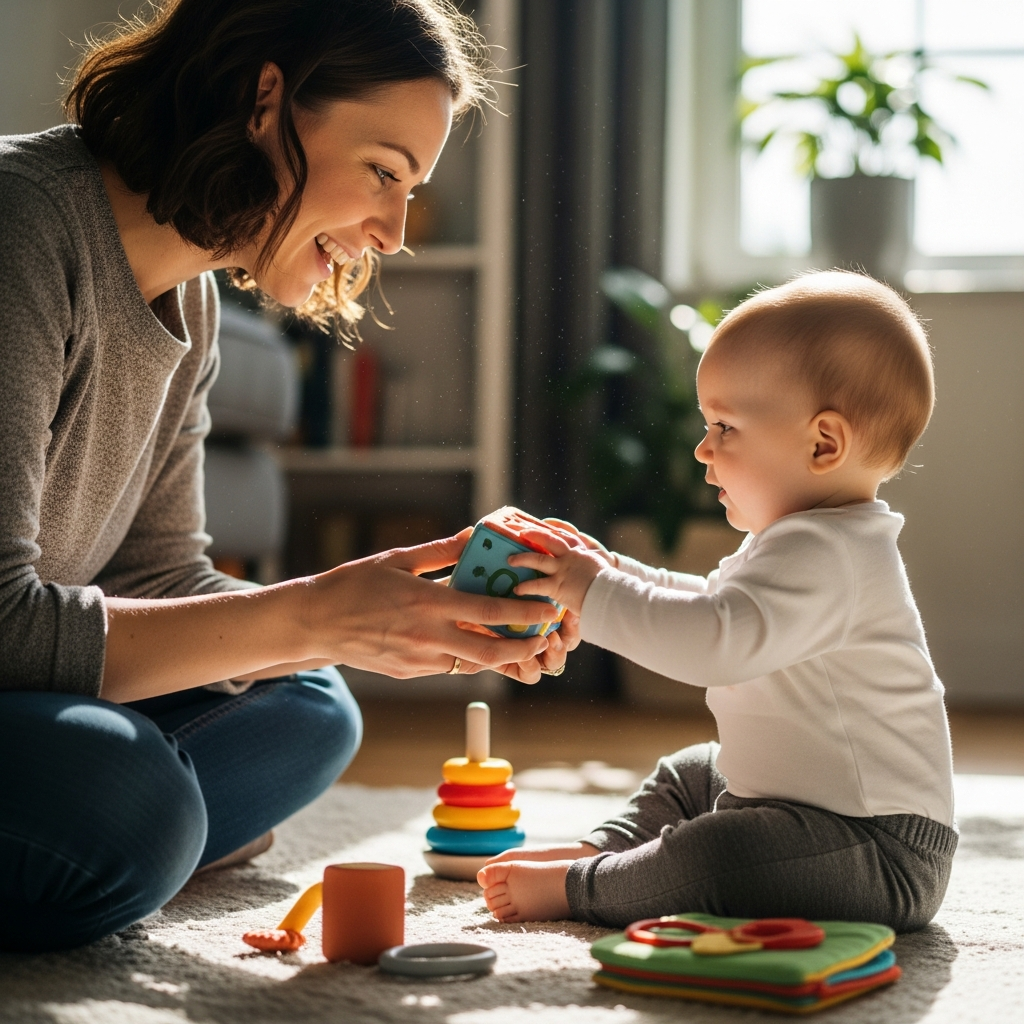
Play is serious business for babies. It is how they learn about the world, develop new skills, and bond with caregivers. The best news? You do not need expensive toys or complicated setups. Simple, everyday interactions are often the most valuable for your 9 month old's development. Here are activities perfectly suited for your baby's developmental stage.
Best Developmental Toys and Sensory Activities for 9 Month Olds
The best toys for 9 month olds encourage exploration, cause-and-effect learning, and motor skill development:
- Stacking cups and blocks for problem-solving and motor skills
- Push toys for babies learning to cruise and stand
- Musical instruments like shakers and drums for cause-and-effect learning
- Board books with textures and flaps for sensory exploration and language
- Balls of various sizes for rolling, chasing, and throwing
- Shape sorters for cognitive development
For sensory activities, try supervised water play, exploring safe household objects of different textures, or creating simple sensory bins with large items like wooden spoons and fabric scraps.
Interactive Games to Play That Support Learning
Simple games provide powerful learning opportunities:
- Peek-a-boo variations: Hide behind your hands, a blanket, or furniture to reinforce object permanence
- Pat-a-cake and clapping games: Build rhythm awareness, coordination, and social connection
- Hide the toy: Partially hide a toy under a blanket and let your baby find it
- Roll the ball: Sit facing your baby and roll a ball back and forth
- Mirror play: Let your baby explore their reflection, make faces together
- Imitation games: Copy your baby's sounds and gestures, then introduce new ones
Language-Building Activities for Your Nine Month Old
Although your baby may not say recognizable words yet, they are absorbing language constantly. Support their language development by:
- Narrating your daily activities ("Now we are putting on your socks!")
- Reading together every day, pointing to pictures and naming objects
- Singing songs with hand motions like "Itsy Bitsy Spider"
- Responding to babbling as if it were conversation
- Teaching simple baby signs (more, milk, all done)
- Labeling emotions ("You look frustrated! That toy is tricky.")
All this active play means lots of movement for your little explorer. Soft, stretchy clothing allows unrestricted movement for crawling, climbing, and all the busy activities of this stage. Breathable bamboo fabrics are especially gentle on sensitive skin during messy sensory play.
Common Concerns Parents Have About 9 Month Old Development
Parenting often comes with worry. Let us address some of the most common concerns parents have about their 9 month olds.
Why Is My 9 Month Old Not Crawling Yet (And Is It Normal)
Here is something important to know: crawling is not a required milestone. The CDC's milestone checklist does not include crawling because many healthy babies skip it entirely.
Some babies go straight from sitting to pulling up and cruising. Others prefer scooting on their bottoms or rolling to get around. What matters is that your baby shows interest in mobility and is making progress toward movement, whatever form that takes.
When to consult your pediatrician about mobility:
- Your baby cannot bear weight on their legs when held standing
- Your baby cannot sit even with support
- Your baby shows no interest in moving toward objects or people
- One side of the body seems weaker than the other
Managing Separation Anxiety and Clingy Behavior
If your 9 month old cries every time you leave the room, congratulations. This is actually a sign of healthy cognitive development and secure attachment.
Separation anxiety typically begins around 8 months as babies develop object permanence. They now understand that you exist even when you are not visible, but they do not yet understand that you will always come back.
Strategies for managing separation anxiety:
- Practice brief separations at home (leave the room and return quickly)
- Keep goodbyes short and consistent, not drawn-out
- Never sneak away, as this increases anxiety
- Time departures for after naps and meals when your baby is well-rested and fed
- Introduce new caregivers gradually
This phase is temporary. Most babies show significant improvement by 18 months to 2 years.
Teething, Health Checkups, and When to Call Your Pediatrician
Your baby is due for their 9 month well-child visit, which includes developmental screening recommended by the American Academy of Pediatrics. This checkup is an important opportunity to discuss any concerns you have and ensure your baby is on track. Many babies are also experiencing teething around this age, with the first teeth commonly appearing between 6 and 10 months. Teething can cause drooling, fussiness, and disrupted sleep, which can sometimes be confused with other developmental changes.
What to expect at the 9 month checkup:
- Growth measurements (weight, length, head circumference)
- Developmental screening
- Physical examination
- Discussion of feeding, sleep, and safety
- Possible vaccinations
Contact your pediatrician if your baby:
- Does not respond to sounds or their name
- Does not babble or make sounds
- Cannot bear weight on legs when held standing
- Does not sit even with support
- Does not recognize familiar people
- Does not look where you point
Trust your instincts. If something feels off, it is always appropriate to ask your pediatrician.
Language and Communication: What to Expect From Your 9 Month Old
Your baby's language skills are developing rapidly, even if they are not saying actual words yet. Understanding what is typical can help you support this crucial area of development.
Babbling, First Sounds, and Pre-Language Development
At 9 months, most babies are babbling up a storm with sounds like "ba-ba-ba," "da-da-da," and "ma-ma-ma." While these sounds may not have specific meaning yet, they are building blocks for real words. You might notice your baby experimenting with different tones and volumes, almost as if they are practicing having a real conversation. This "jargon babbling" shows they are learning the rhythm and patterns of language.
Language milestones to look for:
- Babbling with a variety of consonant sounds
- "Conversational" babbling with rising and falling tones
- Responding to their name
- Understanding simple words like "no" and "bye-bye"
- Using gestures like pointing and waving
- Imitating sounds they hear
Receptive language (understanding) develops before expressive language (speaking). Your baby likely understands far more than they can say.
How to Encourage Your Baby's Communication Skills
You are your baby's first and most important language teacher. Here is how to boost their communication development:
- Talk constantly: Describe what you are doing throughout the day
- Read together: Make it a daily habit, even if your baby just wants to chew the book
- Wait for responses: Pause after speaking to encourage turn-taking
- Sing songs: Especially ones with repetition and hand motions
- Use real words: Skip excessive baby talk in favor of clear pronunciation
- Respond to attempts: Celebrate all communication efforts
Frequently Asked Questions About 9 Month Old Development
What should a 9 month old be doing developmentally?
At 9 months, most babies can sit independently, crawl or move in some way, pull to stand, and may cruise along furniture. They babble with sounds like "ba-ba" and "da-da," respond to their name, and show stranger anxiety. They use a pincer grasp to pick up small objects and understand object permanence through games like peek-a-boo.
How many naps should a 9 month old take?
Most 9 month olds take 2 naps per day, totaling 2-3 hours of daytime sleep. A typical schedule includes a morning nap around 9-10 AM and an afternoon nap around 1-2 PM. Some babies may still be transitioning from 3 naps to 2 during this month.
What finger foods can I give my 9 month old?
Safe finger foods for 9 month olds include soft, ripe fruits (banana, avocado, mango), steamed vegetables (carrots, broccoli, sweet potato), soft pasta, scrambled eggs, toast strips, soft cheese cubes, and O-shaped cereals. All foods should be soft enough to mash easily between your fingers. Avoid choking hazards like whole grapes, raw vegetables, and popcorn.
Should I be worried if my 9 month old is not crawling?
No, crawling is not a required milestone. Many healthy babies skip crawling entirely and move straight to walking, or use alternative methods like scooting or rolling. What matters is that your baby shows interest in movement and mobility. If your baby cannot bear weight on legs and shows no movement attempts, discuss this with your pediatrician.
Is there a sleep regression at 9 months?
Yes, the 9 month sleep regression is common. It is typically caused by developmental milestones (crawling, standing), separation anxiety, and increased cognitive awareness. Signs include frequent night waking, difficulty falling asleep, and nap resistance. This phase usually lasts 2-6 weeks. Maintain consistent routines and offer extra comfort while this passes.
What is the average weight for a 9 month old?
The average weight for a 9 month old boy is approximately 20 pounds (9.1 kg), and for girls approximately 18.5 pounds (8.4 kg). However, healthy babies come in many sizes. Consistent growth along your baby's own percentile curve matters more than matching average numbers. Most babies have nearly tripled their birth weight by this age.
Why is my 9 month old so clingy and crying when I leave?
Clinginess and crying when you leave are signs of separation anxiety, which peaks around 8-10 months. This is actually a positive sign of healthy cognitive development. Your baby now understands you exist even when out of sight and prefers you to strangers. This phase is temporary and typically eases by 18 months.
How can I help my 9 month old's development?
Support your 9 month old's development through plenty of floor time for movement practice, interactive games like peek-a-boo, reading together daily, talking and singing throughout the day, offering safe finger foods for self-feeding, and providing age-appropriate toys that encourage exploration. Most importantly, respond warmly to your baby and follow their lead in play.
Celebrating Your 9 Month Old's Amazing Journey
Your 9 month old is at a remarkable stage of development, transforming daily before your eyes. From those first wobbly attempts at standing to the joy of discovering that toys still exist under a blanket, every day brings new accomplishments to celebrate. This is a period of rapid growth in every area: physical, cognitive, social, and emotional.
Remember that developmental timelines are guides, not rules. Your baby is unique, and their journey will not look exactly like anyone else's. A baby who is not crawling yet might be an early talker. A baby who seems "behind" in one area often surprises everyone with sudden leaps forward. Focus on providing a loving, stimulating environment, and trust that your baby is developing exactly as they should.
At PatPat, we are honored to be part of your parenting journey. Whether you are navigating the 9 month sleep regression, introducing new finger foods, or simply trying to keep up with your newly mobile baby, know that you are doing an incredible job. Every cuddle, every game of peek-a-boo, and every patient response to those clingy moments is helping your baby build the foundation for a lifetime of learning and growth.
The coming months will bring even more exciting changes as your baby approaches their first birthday. Keep nurturing their curiosity, responding to their needs, and celebrating every milestone, big or small. If you have concerns about your baby's development, trust your instincts and reach out to your pediatrician. And remember to bookmark this guide to revisit as your baby continues to grow and reach new 9 month old milestones.


