


Have you ever wished you could predict when your period is coming instead of being caught off guard? Learning how to track your menstrual cycle is one of the most empowering things you can do for your health -- and it is far simpler than most people think.
Whether you recently stopped birth control or you are starting to think about family planning, cycle tracking for beginners starts with one small habit: paying attention. The American College of Obstetricians and Gynecologists classifies the menstrual cycle as a vital sign -- right alongside blood pressure and heart rate. Meanwhile, the menstrual health app market has exploded to an estimated $1.69 billion worldwide, signaling that millions of women are embracing cycle awareness.
This step-by-step period tracking guide covers everything from identifying Day 1 to reading cervical mucus, charting basal body temperature, understanding your four cycle phases, and using your data for real life. No prior knowledge assumed. At PatPat, we believe understanding your body is the first step in every journey -- from better self-care to family planning. Let's begin.
Why Tracking Your Menstrual Cycle Matters for Your Health
Your Period as a Vital Sign of Overall Health
ACOG considers the menstrual cycle a vital sign because cycle changes can be the first indicator of thyroid disorders, PCOS, stress overload, and nutritional deficiencies. The Office on Women's Health recommends all women of reproductive age monitor their cycles to help doctors understand individual health risks. Tracking gives you a personal baseline so you spot deviations early.
Five Practical Benefits of Knowing Your Cycle
- Predict your period accurately -- Plan vacations and events with confidence.
- Understand mood and energy patterns -- Mid-cycle surges and pre-period fatigue are hormonally driven, not random.
- Detect health issues early -- Sudden cycle changes can signal conditions worth discussing with your doctor.
- Support fertility planning -- Knowing your fertile window is foundational whether you are trying to conceive or avoiding pregnancy.
- Optimize daily life through cycle syncing -- Align exercise, nutrition, and social energy with your cycle phases.
What You Need Before You Start Tracking Your Period
Essential Supplies (You Only Need One to Begin)
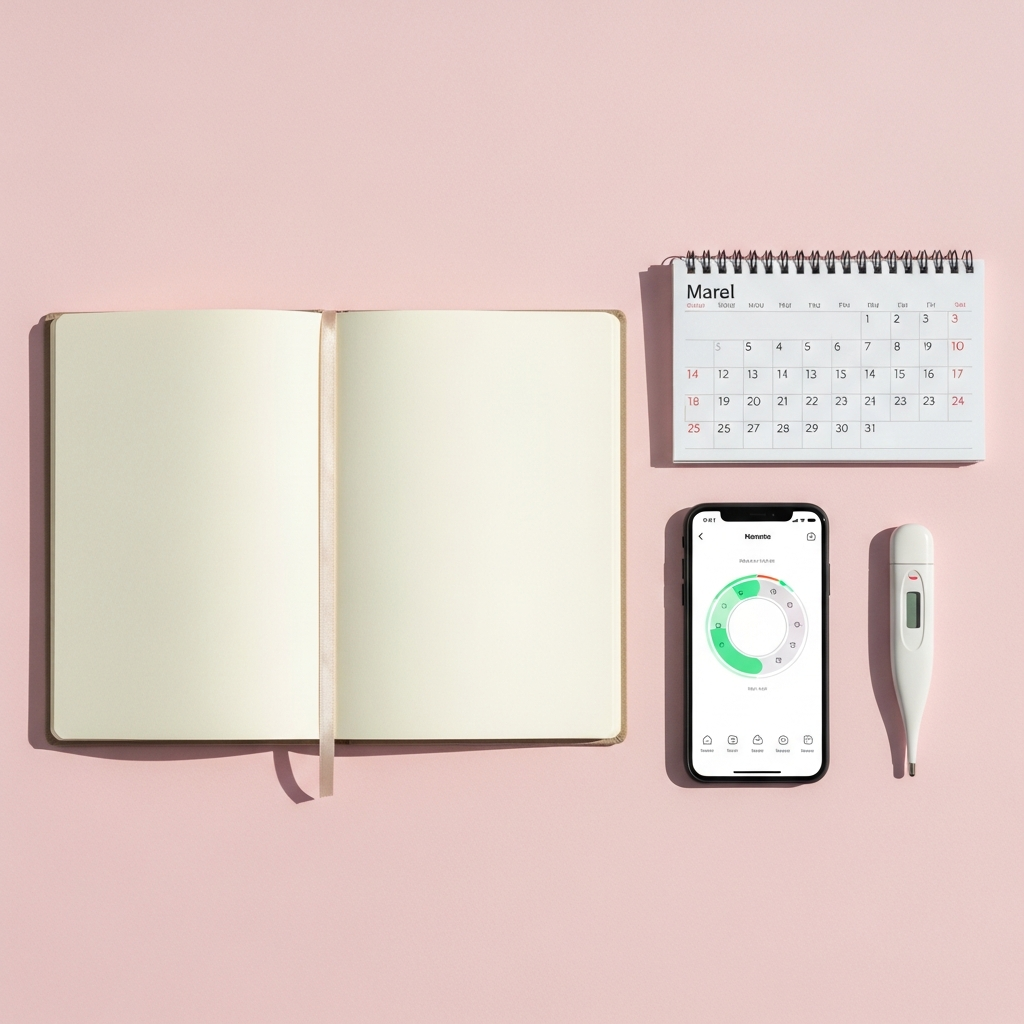
You can start tracking today with nothing more than a calendar or a free phone app. Everything else is optional.
- Paper calendar or notebook -- Write start date, end date, and symptoms.
- Smartphone app -- Flo, Clue, and Natural Cycles are popular; most have free tiers.
Optional Tools to Add Over Time
- BBT thermometer -- Measures to two decimal places; needed for temperature tracking.
- Ovulation predictor kits (OPKs) -- Urine strips detecting the LH surge before ovulation.
- Wearable devices -- Tempdrop, Oura Ring, and Apple Watch offer passive cycle tracking.
Mindset Preparation -- Consistency Over Perfection
Expect to track for at least three full cycles before clear patterns emerge. Missed a day? Skip it and pick up tomorrow. Set a simple daily reminder. The goal is observation, not obsession.
Step 1 -- How to Identify Day 1 and Record Your Period Dates
Defining Cycle Day 1 (Spotting vs. Full Flow)
Cycle Day 1 is the first day of full menstrual bleeding -- not spotting. If light spotting appears in the evening followed by true flow the next morning, that morning is Day 1.
- Spotting: Light pink or brown, visible only when wiping, no pad needed.
- Full flow: Bright red bleeding requiring menstrual protection.
Getting Day 1 right is critical. An incorrect Day 1 shifts your entire cycle map -- every calculation that follows depends on this starting point.
How to Calculate Your Menstrual Cycle Length
- Mark the first day of full bleeding as Day 1.
- Count every day, including bleeding days.
- The day before your next period starts is the last day of that cycle.
- Cycle length = total days from Day 1 to the day before the next Day 1.
- Repeat for at least three cycles to identify your personal pattern.
A normal cycle ranges from 21 to 35 days according to the Cleveland Clinic. The 28-day cycle is simply an average -- research in Nature Digital Medicine found only about 13% of women actually have a 28-day cycle. Variation of up to seven days between cycles is considered normal.
What to Log Each Period (Quick Checklist)
- Start date (Day 1) and end date
- Total days of bleeding
- Flow intensity each day (light, moderate, heavy)
- Unusual observations (color changes, clots, pain level)
Step 2 -- How to Track Daily Symptoms and Spot Patterns
Physical Symptoms Worth Logging Every Day
| Symptom | What to Note | Why It Matters |
|---|---|---|
| Cramps | Location, intensity (1-10) | Distinguishes ovulatory vs. menstrual pain |
| Bloating | Presence and severity | Confirms hormonal cause (luteal phase) |
| Headaches | Timing and severity | Estrogen-withdrawal headaches cluster pre-period |
| Breast tenderness | When it starts/resolves | Progesterone-driven; luteal phase only |
| Acne | Location, timing | Hormonal acne peaks before menstruation |
| Energy levels | High, moderate, low | Reveals follicular peaks and luteal dips |
| Sleep quality | Restful or disrupted | Progesterone affects sleep architecture |
Emotional and Behavioral Indicators to Record
- Mood -- Calm, anxious, irritable, weepy, confident.
- Appetite and cravings -- Sugar, salt, carbs, overall hunger.
- Libido -- Often higher around ovulation, lower in late luteal phase.
- Social energy -- Desire for company vs. solitude.
The Simple Rating System That Makes Tracking Stick
Use a 1-5 scale for recurring symptoms. Spend no more than 60 seconds per day -- anything longer and most beginners quit within two weeks. After three cycles, circle the symptoms that repeat at the same point every cycle. Those are your personal patterns.

Step 3 -- How to Monitor Cervical Mucus and Basal Body Temperature
Reading Your Cervical Mucus -- A Day-by-Day Progression
- Dry (post-period) -- Little to no mucus. Fertility: Low.
- Sticky -- Thick, white, crumbly. Fertility: Low.
- Creamy -- Lotion-like, moist. Fertility: Medium.
- Wet / watery -- Clear, thin, slippery. Fertility: High.
- Egg white (EWCM) -- Clear, stretchy 2-3 inches without breaking. Fertility: Peak.
- Return to dry -- Ovulation has likely passed. Fertility: Dropping.
How to check: Observe mucus on toilet paper before urination, or collect gently with clean fingers. Check at the same time each day. Egg white cervical mucus is one of the strongest natural indicators that ovulation is approaching, as recognized by both ACOG and the American Pregnancy Association.
How to Take Your Basal Body Temperature (BBT) Correctly
- Use a BBT thermometer that reads to two decimal places (e.g., 97.86 F).
- Take temperature at the same time every morning, immediately upon waking.
- Record on your chart or app.
- After ovulation, expect a sustained rise of 0.2-0.5 degrees Fahrenheit lasting until your next period.
- BBT confirms ovulation already occurred -- it is retrospective, not predictive.
Beginner tip: BBT charts look messy for the first two cycles. Alcohol, poor sleep, and inconsistent wake times cause fluctuations. Patterns emerge by cycle three. Wearables like Tempdrop and Oura Ring can automate this process by taking continuous overnight readings.
Combining Both Methods (The Symptothermal Approach)
When you track cervical mucus and BBT together, you are using the symptothermal method -- the most accurate fertility awareness approach. Mucus tells you ovulation is approaching (predictive). BBT confirms it happened (retrospective). Together, they bracket your fertile window. Research confirms the symptothermal method is highly effective for family planning with perfect-use rates above 99%. Start with mucus alone and add BBT in your second or third cycle.
Understanding the Four Phases of Your Menstrual Cycle
Phase-by-Phase Breakdown with What You Will See in Your Tracking Data
| Phase | Timing* | Key Hormone | What You Will Notice |
|---|---|---|---|
| Menstrual | Days 1-5 | Estrogen + progesterone lowest | Bleeding; low energy; possible cramps |
| Follicular | Days 6-13 | Estrogen rising | Energy improves; mucus shifts dry to creamy |
| Ovulatory | ~Day 14 | LH surge | EWCM present; peak energy and libido |
| Luteal | Days 15-28 | Progesterone dominant | BBT rises; mucus dries; PMS may appear |
*Based on a 28-day average. Your timing will vary.
How Your Personal Data Rewrites the Textbook
The "Day 14 ovulation" rule is a statistical average, not a personal fact. Many women ovulate on Day 12, 16, or 20. Your follicular phase is the variable part; your luteal phase stays relatively consistent at 10-16 days. After three cycles, you will know your typical ovulation day and fertile window -- far more useful than any generic chart. This kind of self-knowledge is what experts call "body literacy."
Choosing the Right Tracking Method: Apps, Paper, and Wearables Compared
Paper and Calendar Tracking -- Simple, Private, and Free
Best for immediate starters and privacy-conscious trackers. The Office on Women's Health offers free guidance on manual methods. Pros: zero privacy risk, no cost. Cons: no automatic predictions.
App-Based Tracking -- Features and Privacy
| App | Free Tier | Key Strength | Privacy |
|---|---|---|---|
| Clue | Yes | Science-based, GDPR compliant | High |
| Flo | Yes | Largest user base, anonymous mode | Medium-High |
| Natural Cycles | Paid | FDA-cleared, BBT integration | High |
| Apple Health | Built-in | On-device storage only | Very High |
App predictions are estimates based on past cycles, not guarantees. Always check each app's privacy policy before entering personal health data.
Wearable Technology for Passive Tracking
Tempdrop, Oura Ring, and Apple Watch offer passive BBT tracking for women with irregular sleep or who dislike the morning thermometer routine. Costs range from $150-$400+, so consider starting with free methods first.
Putting Your Cycle Data to Work: From Fertility Planning to Everyday Life
Using Your Data for Fertility Planning
Your fertile window spans approximately six days: the five days before ovulation plus ovulation day itself. Mayo Clinic recommends using cycle tracking to identify this window. Look for egg white mucus, a positive OPK, and the BBT shift the next day. For the best conception chances, aim for intercourse in the two to three days leading up to ovulation.
If your cycle tracking journey is pointing toward family planning, it is never too early to start browsing newborn essentials and baby clothing -- a small, hopeful act many women enjoy during the trying-to-conceive phase.
Cycle Syncing -- Aligning Your Lifestyle with Your Phases
Cycle syncing for beginners means matching exercise, nutrition, and energy planning to your current phase. It is a lifestyle strategy, not a medical requirement, and works best after three months of data.
| Phase | Exercise | Nutrition | Energy Tip |
|---|---|---|---|
| Menstrual | Yoga, walking | Iron-rich foods | Rest and reflect |
| Follicular | Strength training, cardio | Complex carbs, lean protein | Schedule brainstorming |
| Ovulatory | HIIT, group fitness | Light, balanced meals | Ideal for presentations |
| Luteal | Pilates, swimming | Magnesium, healthy fats | Solo focus work |
Comfort matters during the menstrual and late luteal phases when your body craves softness. Bamboo fabric -- the same gentle material used in baby clothing for sensitive skin -- has become a popular loungewear choice for its temperature-regulating, ultra-soft properties.
Red Flags -- When to See a Doctor
- Cycles consistently shorter than 21 days or longer than 35 days
- Periods lasting over 7 days or requiring hourly protection changes
- Severe pain interfering with daily activities
- Bleeding between periods
- No period for 3+ months (not pregnant or breastfeeding)
- Sudden changes to a previously regular cycle
Bring your tracking data to appointments. The Mayo Clinic recommends keeping a record of your cycles to help identify irregularities faster.
Frequently Asked Questions About Cycle Tracking for Beginners
How long does it take for cycle tracking to show patterns?
Most women need at least three complete cycles. The first cycle establishes a baseline, the second allows comparison, and by the third you can identify typical cycle length, ovulation timing, and recurring symptoms. Avoid conclusions from a single cycle.
Can I track my menstrual cycle without using an app?
Absolutely. A paper calendar, notebook, or printable chart works perfectly. Record start and end dates, daily symptoms, and cervical mucus observations. The method matters less than consistency.
What is egg white cervical mucus and what does it mean?
EWCM is clear, stretchy, slippery discharge resembling raw egg whites. It appears one to three days before ovulation and signals peak fertility by creating a sperm-friendly environment.
How do I know for sure that I ovulated?
A sustained BBT rise of 0.2-0.5 degrees Fahrenheit, lasting several days, confirms ovulation occurred. Combining BBT with cervical mucus observation (the symptothermal method) provides the highest confidence. OPKs predict ovulation but do not confirm it happened.
Is a 28-day menstrual cycle actually normal?
A 28-day cycle is normal but not the standard. Normal ranges from 21 to 35 days, and fewer than 15% of women have an exact 28-day cycle. Your cycle can vary by several days month to month. Consistency within the 21-35 range is what matters.
How do I track my cycle if my periods are irregular?
Tracking is even more important with irregular periods because it creates data for your doctor. Focus on cervical mucus and BBT to pinpoint ovulation regardless of cycle length. Common causes include PCOS, stress, and thyroid imbalance. Track four to six cycles before expecting trends.
What is the best time of day to check cervical mucus?
Afternoon or evening is ideal, but the most practical approach is checking each time you use the bathroom. Consistency matters more than specific timing.
Should I stop tracking my cycle once I get pregnant?
Your last menstrual period date -- the Day 1 of your final cycle -- is used by doctors to calculate your due date. Share your records at your first prenatal visit. You can stop cervical mucus and BBT tracking after confirming pregnancy, but logging symptoms can help monitor early pregnancy changes.
Your First Cycle Starts Now
You now have everything you need to start tracking your menstrual cycle for the first time. Here is a quick recap:
- Identify Day 1 -- the first day of full bleeding.
- Log period dates -- start, end, flow intensity.
- Track daily symptoms -- physical and emotional, 60 seconds per day.
- Observe cervical mucus -- note the dry-to-egg-white progression.
- Add BBT tracking -- when ready, take your temperature each morning.
- Learn your four phases -- overlay symptoms onto the menstrual, follicular, ovulatory, and luteal framework.
- Use your data -- for fertility planning, cycle syncing, or simply understanding yourself better.
Period tracking for beginners is not about perfection -- it is about curiosity. Start with a calendar and a willingness to pay attention. Your body has been speaking in a language of symptoms, temperatures, and hormonal shifts your entire adult life. Now you are learning to listen.
At PatPat, we are here for every stage of your journey -- from understanding your cycle to preparing for the adventures ahead. Whatever your reason for tracking, the simple act of paying attention to your body is self-care that pays dividends for years to come.




