


You have probably seen them in every baby store: flashy electronic toys promising to teach your little one their ABCs, colors, and first words. With catchy jingles and bright lights, these toys seem like the perfect shortcut to raising a verbal genius. But here is a question worth asking: do these toys actually help your baby learn to talk?
As a new or expecting parent, you want to give your child every possible advantage. The toy aisle can feel overwhelming, and the guilt of choosing "wrong" is real. The truth might surprise you. Research shows that the most expensive, high-tech toys for baby language development are not necessarily your best investment.
In this evidence-based guide, you will discover what science actually says about baby toys and speech development. You will learn which toys speech therapists genuinely recommend, why simple often beats sophisticated, and practical techniques to turn any toy into a language-building opportunity.
How Babies Learn Language Through Play and Interaction
Before diving into which toys work best, let us understand how language actually develops in your baby's growing brain. This foundation will help you make smarter choices about play and interaction.
The Science of Serve-and-Return Communication
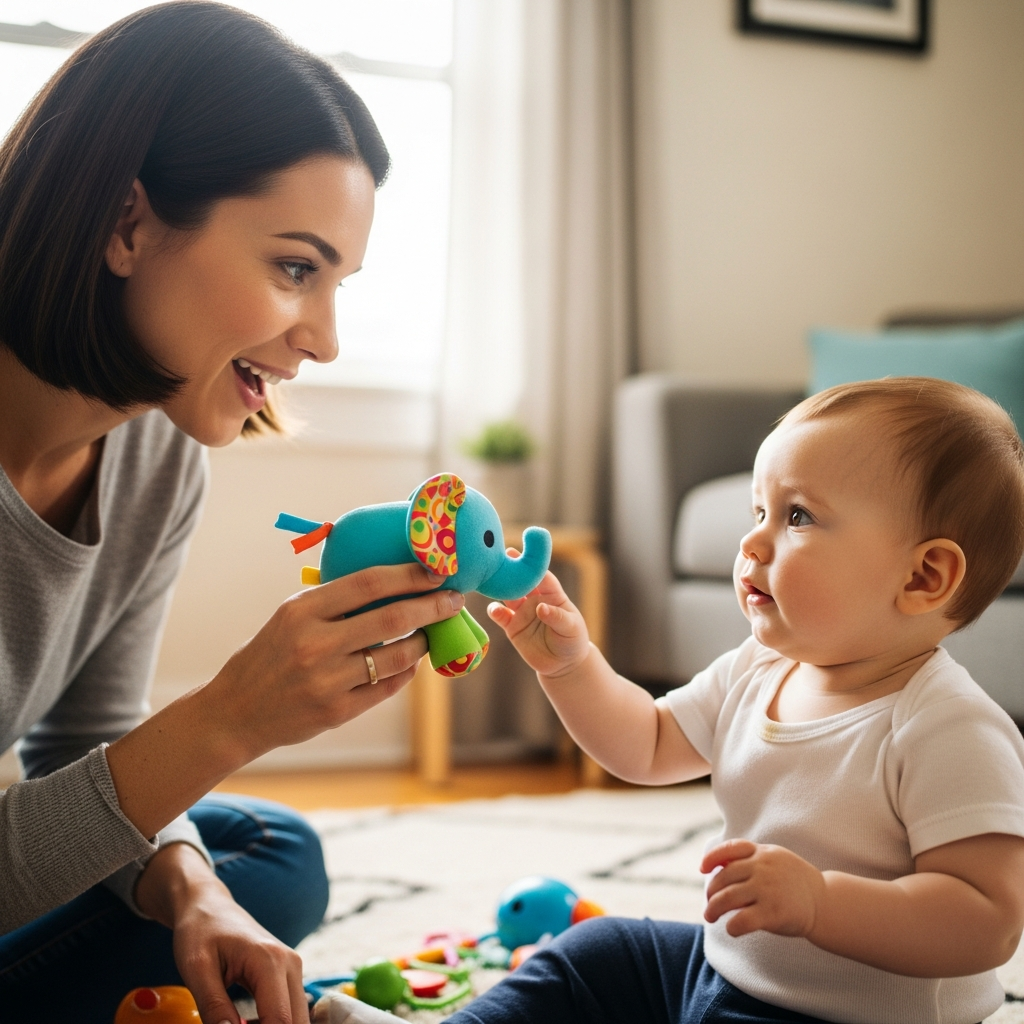
When your baby coos, babbles, or reaches for something, they are "serving" a communication ball to you. When you respond with eye contact, words, or a smile, you are "returning" it. According to the Harvard Center on the Developing Child, these back-and-forth exchanges build and strengthen neural connections in your child's brain.
This is not just theory. Brain imaging studies show that responsive, contingent interactions literally shape brain architecture. The human brain expects this game of back and forth, and it is essential for healthy development. Here is the crucial insight: toys are tools that facilitate this interaction, but they cannot replace it. No electronic device can substitute for your engaged presence.
Why Joint Attention Matters for First Words
Joint attention happens when you and your baby focus on the same object while remaining aware of each other. It is that magical moment when your baby points at a dog, looks at you, and you say, "Yes, that is a big dog!"
Research published in peer-reviewed journals confirms that joint attention is important for many aspects of language development including comprehension, production, and word learning. Studies show that children's ability to respond to joint attention at 6 to 18 months predicts vocabulary size at 30 months.
Toys can facilitate joint attention beautifully. When you both focus on stacking blocks or looking at a picture book together, you create the perfect conditions for vocabulary growth. But the key word is "together." A toy playing by itself in the corner does nothing for language development.

What Research Says About Electronic Toys vs Traditional Toys
This is where things get interesting. A landmark study published in JAMA Pediatrics has changed how many parents and speech therapists think about toy choices.
The JAMA Pediatrics Study Every Parent Should Know
In 2015, researcher Dr. Anna Sosa from Northern Arizona University conducted a controlled study with 26 parent-infant pairs. The children were 10 to 16 months old. Parents were given three types of toys to play with: electronic toys (baby laptops, talking farms, toy cell phones), traditional toys (blocks, shape sorters, puzzles), and board books.
The results were striking. According to the published findings, during play with electronic toys, there were fewer adult words, fewer conversational turns, fewer parental responses, and fewer content-specific words compared to traditional toys or books. Children also vocalized less during electronic toy play than during book reading.
As NPR reported, experts noted that electronic toys that make noises or light up are extremely effective at commanding children's attention. However, they appear to reduce parent-child verbal interactions because when the toy talks, parents talk less.
Why Speech-Language Pathologists Recommend Battery-Free Toys
Speech-language pathologists (SLPs) see these research findings play out daily in their practice. Simple, open-ended toys require adult narration and interaction to be interesting. When a toy does not talk, sing, or flash lights, you become the entertainment. And that is exactly what builds language.
This does not mean electronic toys are inherently harmful. The study had limitations, including its small sample size. Balance is key. If your child enjoys an electronic toy, stay engaged and talk about what is happening rather than letting the toy do all the talking.

Best Types of Toys for Speech Development (SLP-Recommended)
Ready for the good news? The most effective toys for language development are often the simplest and most affordable. Here is what speech therapists actually use in their sessions.
Open-Ended Toys That Encourage Conversation
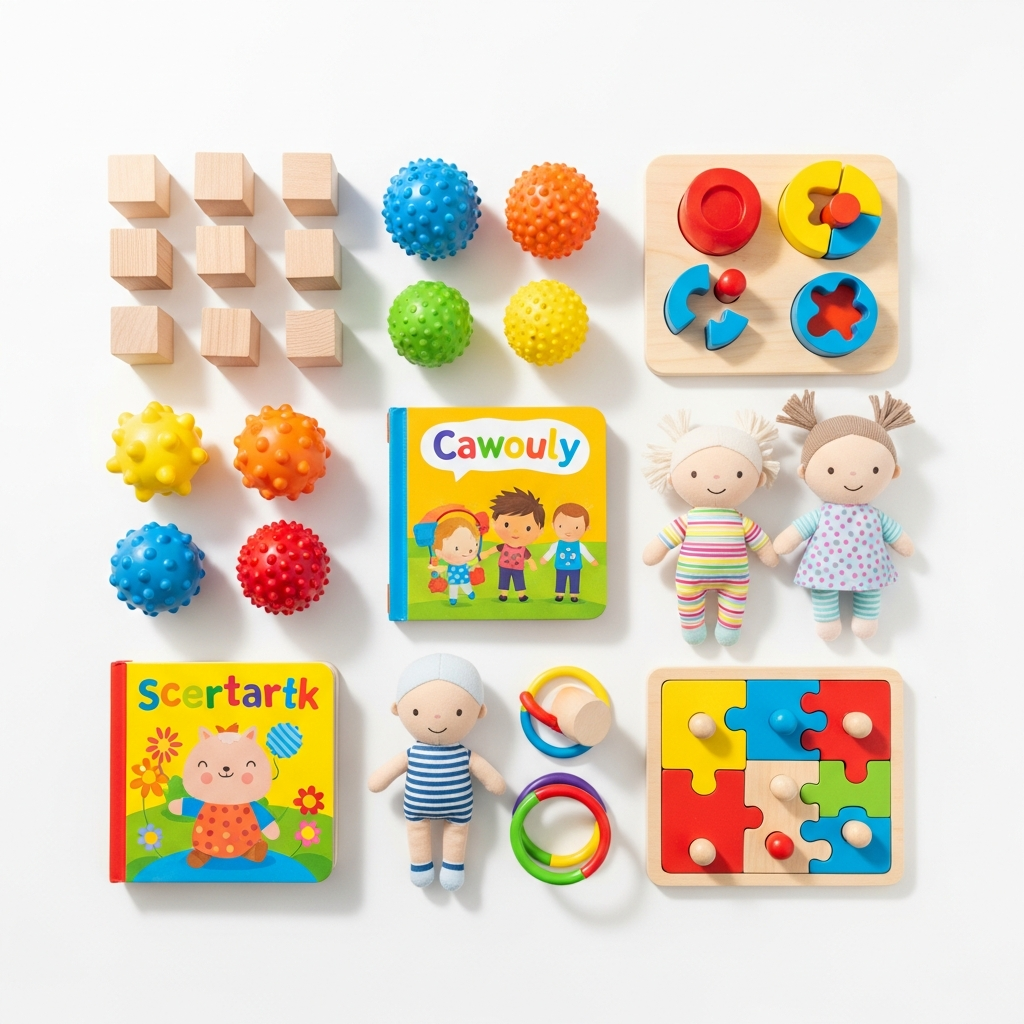
According to speech-language pathologists, simplistic toys without sounds, flashy lights, talking creatures, and batteries are a great choice when trying to increase your child's language.
| Toy Type | Language Skills Promoted | Words to Use |
|---|---|---|
| Blocks and Stacking Toys | Spatial vocabulary, turn-taking, cause and effect | "Up, down, tower, crash, more, tall" |
| Dolls and Figurines | Pretend play, social vocabulary, emotion words | "Baby hungry, baby sleepy, hug, kiss" |
| Board Books | Vocabulary, pointing, naming | Name pictures, ask "Where is the...?" |
| Bubbles | Requesting, anticipation, joint attention | "More, pop, again, ready, blow" |
| Simple Puzzles | Problem-solving vocabulary, naming | "Turn it, fits, you did it!" |
| Cause-and-Effect Toys | Anticipation, requesting, exclamations | "Ready, set, go! Uh-oh! Again!" |
Bubbles deserve special mention. They are universally loved by toddlers and incredibly effective for language. You can wait for your child to request "more" before blowing, celebrate each "pop," and practice the word "again" dozens of times in one session.
Household Items That Double as Language-Building Toys
Here is a counterintuitive truth: you do not need expensive toys at all. Many speech therapists use ordinary household items:
- Kitchen items - Wooden spoons, plastic bowls, and measuring cups for stacking, sorting, and pretend cooking
- Empty boxes - Perfect for in/out, open/close, and imaginative play
- Soft balls - Rolling back and forth teaches turn-taking and "ready, set, go"
- Scarves or fabric - Peek-a-boo never gets old and builds anticipation vocabulary
When spending time on the floor playing with your baby, comfortable clothing makes a difference for both of you. PatPat baby clothes offers soft, play-friendly options that let little ones move freely during these important interactions.
Age-by-Age Guide to Toys and Language Milestones
Different developmental stages call for different approaches. Here is your roadmap matching toys to your baby's growing abilities.
Newborn to 6 Months: Laying the Foundation
According to the National Institute on Deafness and Other Communication Disorders (NIDCD), the first 3 years of life, when the brain is developing and maturing, is the most intensive period for acquiring speech and language skills.
Language milestones: Cooing by 3 months, babbling with sounds like "ba" and "ma" emerging around 6 months, responding to your voice and facial expressions.
Best toys: High-contrast images, simple rattles, soft toys with different textures, unbreakable mirrors.
Your role: Talk constantly. Narrate diaper changes, feeding, and daily routines. Sing songs. Respond to every coo and sound your baby makes.
6 to 12 Months: Building Understanding
Language milestones: Babbling with consonant sounds, responding to their name, understanding "no," possibly first words emerging around 11-12 months.
Best toys: Board books, stacking cups, balls, cause-and-effect toys like pop-up toys, simple musical instruments.
Your role: Name everything. "That is your cup. Mama's cup. Big cup!" Play peek-a-boo. Read the same books over and over because repetition builds vocabulary.
12 to 18 Months: First Words Emerge
Language milestones: First words appear, pointing to request things, following simple directions like "Give me the ball."
Best toys: Shape sorters, simple puzzles, dolls with accessories, push toys, toy phones.
Your role: Expand single words. When your child says "ball," respond "Yes, big red ball!" Offer choices: "Do you want the apple or banana?" Celebrate every attempt at communication.
18 to 24 Months: Vocabulary Explosion
Language milestones: Vocabulary grows rapidly, two-word phrases emerge like "more milk" or "daddy go," naming body parts.
Best toys: Play kitchens, dress-up items, crayons and paper, more complex puzzles, toy vehicles.
Your role: Model phrases. If your child says "car go," respond "Yes, the car is going fast!" Ask open questions. Engage in pretend play together.
Floor play sessions are essential for language development at every age. Soft, breathable fabrics like those in bamboo baby clothes keep babies comfortable during extended play time, allowing them to focus on learning rather than discomfort.

How to Use Any Toy to Support Language Development
Here is the empowering truth: the toy matters far less than how you use it. With the right techniques, almost any toy becomes a language-learning tool.
Five Strategies Speech Therapists Use During Play
-
Self-Talk and Parallel Talk
Narrate what you are doing (self-talk) and what your baby is doing (parallel talk). "I am stacking the red block. You knocked it down! Crash!" This floods your child's brain with vocabulary connected to real actions.
-
Wait Time
After you speak, pause. Give your baby 5-10 seconds to respond. This feels awkward at first, but waiting creates space for communication. Resist the urge to fill every silence.
-
Expand and Extend
When your baby says one word, add to it. "Ball" becomes "Red ball." "Mama" becomes "Mama is here." You are modeling the next level of language complexity.
-
Follow Their Lead
Play with whatever interests your child, even if it is not what you planned. Intrinsic motivation powers learning. If they want to bang pots instead of stack blocks, bang pots and narrate enthusiastically.
-
Get Face-to-Face
Position yourself at your baby's eye level. Let them see your mouth move and your facial expressions. This physical positioning makes a measurable difference in language uptake.
Common Mistakes That Hinder Language During Play
- Testing instead of commenting - Constantly asking "What color is this?" puts pressure on your child. Instead, simply comment: "That is a blue block!"
- Talking too fast or using complex sentences - Short, simple phrases work best for young language learners
- Not waiting for responses - Give your baby time to process and attempt communication
- Relying on the toy to teach - Remember, you are the teacher. The toy is just a prop
Signs of Healthy Language Development vs When to Seek Help
Every child develops at their own pace. Some babies say their first words at 9 months; others wait until 15 months. Both can be perfectly normal. However, certain red flags warrant attention.
Typical Language Milestones to Watch For
According to the NIDCD, one-year-olds should understand words for common items such as "cup," "shoe," or "juice" and typically have one or two words. By two years, children should use two- or three-word phrases to talk about and ask for things.
Remember that understanding (receptive language) often develops before speaking (expressive language). Your baby may understand far more than they can say.
When to Talk to Your Pediatrician About Speech Concerns
According to the American Academy of Pediatrics, speech and language delay occurs with an estimated prevalence of 2% to 19%. Early detection and intervention make a significant difference.
Red flags that warrant evaluation:
- No babbling by 12 months
- No words by 16 months
- Not following simple directions by 18 months
- No two-word phrases by 24 months
- Loss of language skills at any age
- Not pointing, waving, or using gestures by 12 months
Research demonstrates that early language and communication interventions for children with language impairments have been shown to be effective. One study found dramatic differences: at 3 years of age, 85% of children without intervention showed language delay while only 5% of children who received early intervention did.
Trust your instincts. You know your baby best. If something feels off, bring it up with your pediatrician. Seeking help is not failure; it is good parenting.
Frequently Asked Questions About Baby Toys and Language Development
Do talking toys actually help babies learn to talk?
Research suggests talking toys may reduce parent-child verbal interaction. When a toy talks, parents talk less. Simple, quiet toys encourage more adult narration and back-and-forth conversation, which research shows is more beneficial for language development than hearing pre-recorded words from toys.
What toys do speech therapists recommend for language development?
Speech-language pathologists typically recommend open-ended, battery-free toys including blocks, bubbles, dolls, books, balls, and simple cause-and-effect toys. These toys require adult participation and naturally promote conversation, turn-taking, and vocabulary building during play sessions.
Are expensive educational toys better for baby language development?
No. Research shows that the quality of parent-child interaction matters far more than the price or complexity of toys. Simple household items like cups, spoons, and boxes can be just as effective as expensive toys when combined with engaged adult interaction and conversation.
How can I help my 1 year old learn to talk with toys?
Choose simple toys that encourage interaction: blocks for building together, books for pointing and naming, balls for rolling back and forth. Narrate your play, wait for your child to respond, and expand on any sounds or words they make. Follow their interests rather than directing play.
At what age should my baby start talking?
Most babies say their first words between 11-14 months, though there is wide normal variation. Babbling with consonant sounds typically begins around 6-9 months. If your child has no words by 16 months or you have concerns earlier, consult your pediatrician.
Are electronic toys bad for babies?
Electronic toys are not inherently harmful, but studies show they may reduce the quantity and quality of parent-child verbal interaction. Balance is key. If using electronic toys, stay engaged and talk about what is happening rather than letting the toy do all the talking.
What is the best way to encourage a late talker?
Focus on interaction over toys. Get down to their level, follow their lead, and narrate daily activities. Use simple language, offer choices, and celebrate all communication attempts including gestures and sounds. If concerned, request an evaluation from a speech-language pathologist.
Do flashcards help babies learn language?
Research does not support flashcard drilling for infant language development. Babies learn language best through natural, meaningful interactions during play and daily routines. Conversation, reading books together, and playing with simple toys provide richer language learning opportunities than flashcard memorization.
The Bottom Line on Baby Toys and Language Development
Here is what the research makes crystal clear: toys are tools, but you are the teacher. The most sophisticated electronic toy cannot match the language-building power of your engaged presence, your narration, your responses to your baby's attempts at communication.
You do not need to spend a fortune on flashy educational toys. Simple blocks, books, balls, and bubbles, used with the strategies outlined in this guide, will serve your child's language development beautifully. What matters most is the quality of interaction, the back-and-forth serve and return, the joint attention you share.
Start today with whatever toys you already have. Get down on the floor, follow your baby's lead, and talk. Narrate your day. Wait for responses. Celebrate every sound and gesture. These simple acts are building your child's brain, one interaction at a time.
At PatPat, we understand the journey of parenthood is filled with questions and choices. We hope this guide helps you feel more confident about supporting your baby's language development. Remember: your love, attention, and voice are the most powerful tools you will ever give your child.

Additional Resources
- Harvard Center on the Developing Child - Serve and Return
- NIDCD Speech and Language Developmental Milestones
- Teach Me To Talk - Ultimate Toy List for Speech Therapy


