


You are watching your baby closely, wondering if that wiggle means something or if they should be doing more by now. Sound familiar? Tracking baby milestones can feel overwhelming, especially when every parent seems to have a different timeline to share. Here is the truth: while baby development month by month follows predictable patterns, every child moves at their own unique pace.
According to the CDC, developmental milestones are things most children can do by a certain age. These guideposts help you understand what to expect without causing unnecessary worry. The key is focusing on progression rather than perfection.
In this comprehensive guide, we will walk you through the four types of baby developmental milestones, explore what to expect from newborn through 12 months, and share practical activities to support your little one's growth. Whether you are tracking your infant milestones for the first time or seeking reassurance about your baby's progress, you will find evidence-based guidance you can trust.
The Four Types of Baby Developmental Milestones Explained
Understanding infant milestones by age becomes easier when you know what categories to watch. Experts divide baby developmental milestones into four main areas, each representing crucial aspects of your child's growth.
Gross and Fine Motor Skill Development
Gross motor development involves those big, exciting movements you cannot wait to see: rolling, sitting, crawling, and walking. These skills require large muscle groups and develop in a predictable pattern. Your baby first gains head control, then trunk stability, and finally limb coordination.
Fine motor skills focus on smaller, precise movements like grasping objects, developing the pincer grip, and hand-eye coordination. These abilities allow your baby to explore their world through touch and manipulation.
Research published in Pediatrics confirms that tummy time is positively associated with gross motor and total development, making it essential for building the strength needed for motor milestones.
Cognitive and Language Milestone Categories
Cognitive milestones include problem-solving, memory development, and understanding cause-and-effect relationships. One fascinating cognitive milestone is object permanence, which typically develops around 4-7 months. This is when your baby understands that objects continue to exist even when hidden from view.
Language milestones progress from early cooing to babbling chains of consonants to those magical first words. An important concept to understand: receptive language (understanding what you say) develops before expressive language (speaking). Your baby comprehends far more than they can verbalize.
Social-Emotional Milestones in Infants
The social smile typically emerges around 6-8 weeks, marking your baby's first intentional social interaction. This milestone signals that vision, hearing, and the nervous system are developing properly.
As your baby grows, you will notice attachment behaviors with primary caregivers, stranger anxiety, and eventually joint attention, where your baby shares focus with you on objects or activities. These social-emotional milestones form the foundation of healthy relationships.
Newborn to 3 Month Baby Milestones: Early Development Foundations
The first three months bring remarkable changes as your baby transitions from newborn reflexes to intentional interactions. Here is what to expect during this foundation-building period.
Newborn Milestones (0-4 Weeks)
Your newborn arrives equipped with essential reflexes: rooting (turning toward touch on the cheek), sucking, the Moro or startle reflex, and a grasp reflex. These automatic responses help ensure survival while the brain continues developing.
During these early weeks, your baby can see faces clearly at 8-12 inches away and prefers high-contrast patterns. They already recognize your voice and smell from their time in the womb. Movements appear jerky and uncontrolled, with hands often clenched in fists. Communication happens entirely through crying, with different cries signaling hunger, discomfort, or tiredness.
One Month Old Development
By one month, subtle changes emerge. Your baby begins tracking objects briefly with their eyes and may lift their head momentarily during tummy time. They respond to sounds by startling or quieting and start making throaty sounds beyond crying. Most excitingly, they begin recognizing your face among others.
Two Month Milestones and Changes
The 2 month old baby milestones include that heart-melting social smile, your baby's first real intentional smile in response to you. They begin cooing and making gurgling sounds, follow objects past midline with their eyes, and can hold their head at a 45-degree angle during tummy time.
Three Month Old Baby Development
At three months, your baby opens and closes their hands intentionally, brings hands to mouth, and holds their head steady when supported upright. The 3 month old baby development milestones also include recognizing familiar faces at a distance, enjoying play with others, babbling with expression, and pushing up on forearms during tummy time.
| Age | Motor Skills | Communication | Social-Emotional |
|---|---|---|---|
| Newborn | Reflexes present, jerky movements | Cries for needs | Recognizes parent's voice |
| 1 Month | Brief head lift during tummy time | Throaty sounds | Recognizes faces |
| 2 Months | Head at 45 degrees, tracks objects | Coos and gurgles | Social smile emerges |
| 3 Months | Opens/closes hands, pushes up on forearms | Babbles with expression | Enjoys social play |

When Do Babies Sit Up, Roll Over, and Reach Motor Milestones (4-6 Months)
This exciting period brings major physical achievements. When do babies roll over? When do babies sit up? These common questions find answers in months four through six.
Four Month Old Motor and Social Development
The 4 month old baby milestones mark significant progress. Most babies roll from tummy to back first, as this direction requires less strength. Your baby now holds their head steady without support, brings hands together, reaches for toys with one hand, and pushes up to elbows during tummy time. Socially, they laugh out loud, respond to affection, and show fascination with mirror reflections.
Five Month Development Guide
At five months, babies may begin rolling both directions, though back to tummy requires more core strength. They transfer objects from hand to hand, sit with support while developing trunk strength, respond to their name, and babble chains of consonants like "ba-ba" and "da-da." Curiosity intensifies as they reach for things just out of grasp.
Six Month Baby Milestones and Solid Food Readiness
The 6 month baby milestones what to expect includes independent or minimally supported sitting, rolling both ways easily, and bearing weight on legs when held standing. Your baby passes objects between hands smoothly and may show signs of solid food readiness: good head control and interest in what you are eating. Stranger awareness begins as they distinguish familiar faces from unfamiliar ones.
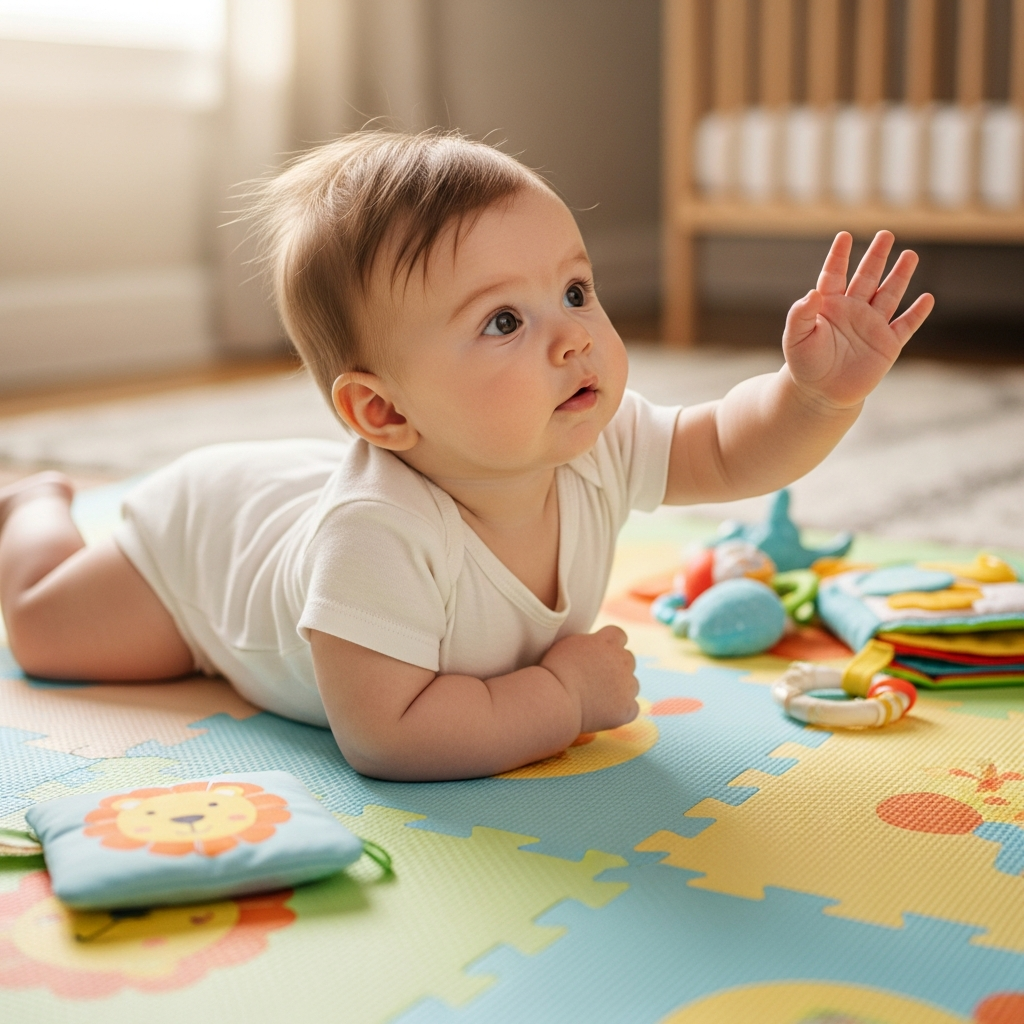
Baby Crawling and Standing Milestones: What to Expect at 7-9 Months
Mobility takes center stage during these months. When do babies crawl? The answer varies more than you might expect, and that is perfectly normal.
Seven Month Old Development Changes
At seven months, your baby may begin rocking on hands and knees, the classic pre-crawling position. They sit independently and can reach for toys while maintaining balance. The raking grasp helps them pick up objects, and they respond to simple words and "no." Games like peek-a-boo and pat-a-cake become favorites, while stranger anxiety may become more prominent.
Eight Month Baby Milestone Progress
Many babies begin crawling between 7-10 months, using either traditional crawling or an army crawl. However, about 10-15% of babies skip crawling entirely and move directly to pulling up and cruising. This variation is typically not concerning.
Your eight-month-old develops the pincer grasp, using thumb and forefinger together. They pull to stand using furniture, point at objects of interest, and look for hidden objects, demonstrating established object permanence.
Nine Month Milestones and Pre-Walking Signs
The 9 month old baby milestones CDC guidelines highlight cruising along furniture as a key pre-walking sign. Your baby crawls proficiently or uses alternative movement methods, stands holding on, and may stand momentarily alone. Language progresses to saying "mama" or "dada" with meaning, understanding "no" and simple commands. Separation anxiety often peaks around this age.

When Do Babies Walk and Talk: 10-12 Month First Year Milestones
The final quarter of the first year brings those moments you have been waiting for: first steps and first words.
Ten Month Old Baby Development
Your ten-month-old stands alone for a few seconds, cruises confidently along furniture, and may take first assisted steps. Social gestures emerge: waving bye-bye and clapping hands. They may say one or two words besides mama and dada, understand simple requests with gestures, and use objects correctly, like holding a phone to their ear.
Eleven Month Milestone Achievements
At eleven months, your baby may walk holding just one hand, points with their index finger accurately, and puts objects in and out of containers. They follow simple directions without gestures, say 2-3 words with meaning, and imitate activities and sounds with enthusiasm.
Twelve Month Old First Birthday Milestones
When do babies walk independently? The 12 month old milestones checklist notes that many babies take first independent steps around this time, though the normal range spans 9-15 months. Your one-year-old says 2-3 words clearly, possibly up to 10 words, and understands many more than they speak.
By their first birthday, babies know names of familiar people and objects, show affection openly through hugs and kisses, and may cry when parents leave. They explore objects in different ways, including shaking, banging, and throwing, and often finger-feed independently while attempting to use a spoon.

| Milestone | Typical Age Range | When to Discuss with Pediatrician |
|---|---|---|
| Rolling over | 4-6 months | Not rolling by 6 months |
| Sitting independently | 6-8 months | Not sitting with help by 9 months |
| Crawling | 7-10 months | No mobility by 12 months |
| Walking | 9-15 months | Not walking by 18 months |
| First words | 10-14 months | No words by 15 months |
Activities to Help Baby Reach Developmental Milestones
While every baby develops at their own pace, you can support their growth through intentional play and interaction.
Tummy Time Techniques and Benefits
Start tummy time from day one, beginning with 3-5 minute sessions multiple times daily. According to research, babies who spend over 30 minutes on their bellies by seven weeks have better developmental outcomes.
Use tummy time mats, mirrors, and toys to encourage engagement. For fussy babies, try tummy time on your chest, which provides comfort while still building strength. Never leave your baby unsupervised during tummy time.
Age-Appropriate Developmental Play Ideas
- 0-3 months: High-contrast images, rattles, singing, face-to-face interaction
- 4-6 months: Reaching toys, textured objects, supported sitting play
- 7-9 months: Peek-a-boo, container play, safe household objects to explore
- 10-12 months: Push toys, stacking blocks, simple puzzles, board books
Remember, interaction with you matters more than specific toys. Follow your baby's lead and interests rather than forcing structured activities.

Encouraging Communication and Language Skills
Talk to your baby constantly, narrating daily activities from birth. Respond to coos and babbles as if having a conversation, which teaches the back-and-forth rhythm of communication. Read to your baby daily, sing songs and nursery rhymes with repetition, and name objects and people consistently.
The American Academy of Pediatrics recommends avoiding screens under 18 months, as face-to-face interaction provides the responsive feedback babies need for language development.
Signs of Developmental Delay and When to Talk to Your Pediatrician
Understanding the difference between normal variation and concerning delays helps you advocate effectively for your child.
Understanding Normal Variation vs Concerning Delays
All babies develop within a range, not on an exact schedule. When wondering "baby not meeting milestones when to worry," remember that milestone ranges span several months. For premature babies, use adjusted age by subtracting weeks born early from their chronological age.
Focus on overall progression rather than hitting exact dates. One delayed milestone may not indicate a problem, but multiple missed milestones or regression, losing skills previously acquired, requires prompt evaluation.
Red Flags by Age That Warrant Medical Consultation
- By 2 months: No response to loud sounds, not watching things move, no social smile
- By 4 months: Not following objects, not bringing hands to mouth, head still wobbly
- By 6 months: No reaching for things, no social responsiveness, not rolling
- By 9 months: Not sitting with help, not babbling, not responding to name
- By 12 months: Not crawling or moving, not pointing, losing previously acquired skills
Early Intervention and Getting Help
The CDC explains that brain connections are most adaptable in the first 8 years of life, making early intervention crucial. Services are available in all US states, often free or low-cost.
Research shows positive outcomes: two-thirds of children receiving early intervention substantially improve, with about half catching up to age-appropriate levels.

Premature Baby Milestones and Adjusted Age Development
If your baby arrived early, understanding adjusted age helps you track development accurately and reduce unnecessary worry.
How to Calculate and Use Adjusted Age
Adjusted age equals chronological age minus weeks born early. For example, a 6-month-old born 8 weeks early has an adjusted age of 4 months. Use adjusted age for tracking developmental milestones until age 2-3. Medical professionals track both chronological and adjusted age, and your baby should meet milestones based on adjusted age.
Developmental Expectations for Preterm Infants
According to HealthyChildren.org, most preemies catch up by 12-18 months of age. Very early preemies born before 28 weeks may need more time, sometimes until age 3.
Motor milestones often take longer due to lower muscle tone in premature infants. Feeding skills may develop more slowly, while communication milestones typically catch up by 2 years. Some preemies qualify for early intervention services, and regular follow-up with developmental specialists is recommended.
Supporting Your Premature Baby's Development
- Provide extra tummy time to build strength
- Protect from overstimulation, as preemies tire easily
- Attend all recommended follow-up appointments
- Connect with other preemie parents for support
- Celebrate progress based on adjusted age, not chronological
Frequently Asked Questions About Baby Milestones
Major first-year milestones include smiling (2 months), rolling over (4-6 months), sitting independently (6-7 months), crawling (7-10 months), pulling to stand (8-9 months), first words (10-12 months), and first steps (9-15 months). Each baby develops at their own pace within these ranges.
Most babies begin crawling between 7-10 months, though some start as early as 6 months or as late as 12 months. About 10-15% of babies skip crawling entirely and move directly to pulling up and cruising, which is typically not concerning.
Babies typically say their first words between 10-14 months. "Mama" and "dada" usually come first, around 10-12 months. By 12 months, most babies can say 2-3 words with meaning and understand many more words than they can speak.
Consult your pediatrician if your baby misses multiple milestones, loses previously acquired skills, or shows no response to sounds or faces by 2-3 months. Trust your instincts as a parent. Early evaluation and intervention lead to better outcomes.
Many parents find months 2-3 most challenging due to peak colic, frequent feeding, and sleep deprivation. However, difficulty varies. Some find 4 months hard due to sleep regression, while others struggle around 8-10 months with separation anxiety and increased mobility.
Yes, most premature babies catch up developmentally by age 2. Use adjusted age (chronological age minus weeks born early) to track milestones. Very early preemies may take until age 3. Regular follow-up and early intervention services support optimal development.
Support development through daily tummy time for motor milestones, talking and reading to baby for language development, responding to coos and babbles for communication skills, age-appropriate play, and plenty of face-to-face interaction. Follow your baby's lead.
Yes, approximately 10-15% of babies skip traditional crawling. They may scoot, roll, or move directly to cruising and walking. As long as your baby finds ways to explore and move around, skipping crawling is typically not a developmental concern.
Tracking Your Baby's Journey: Final Thoughts
Baby milestones by month provide helpful guideposts, but remember they come with wide normal ranges. The most important thing is tracking overall progression rather than comparing your child to exact dates or other babies. Every baby develops at their own unique pace, and that is completely normal.
The baby developmental milestones covered in this guide, from those first reflexes through triumphant first steps, represent an incredible journey of growth. Trust yourself as a parent. You know your baby best. If something concerns you, speak up. Early intervention, when needed, leads to significantly better outcomes.
Download the CDC Milestone Tracker app to conveniently track your baby's development and share information with your pediatrician at well-baby visits.
Support Your Baby's Development Journey
At PatPat, we understand the joy and challenges of watching your little one grow. Explore our collection of developmentally appropriate baby clothing that supports your baby's movement and exploration at every stage. Because every milestone deserves to be celebrated in comfort and style.


