


It is 2 AM. Your baby is crying, and you are running through the mental checklist every parent knows by heart. Hungry? Wet diaper? Too hot? Too cold? In that moment, you would give anything to know exactly what your little one needs.
Here is the good news: you do not have to wait until your baby speaks their first words to understand them. Baby sign language gives infants a way to communicate their needs months before their vocal cords are ready for speech. According to Cleveland Clinic pediatrician Dr. Shannon Thompson, motor skills like using your hands develop earlier than verbal speech abilities, which means babies can share their thoughts through signs well before they can talk.
Whether you are an expecting parent researching ways to connect with your newborn or a parent of a 9-month-old looking to reduce mealtime meltdowns, this guide will walk you through everything you need to know about teaching baby sign language. We believe that communication is the foundation of the parent-child bond, and we are here to support your journey with practical, research-backed guidance.
What Is Baby Sign Language and Why Parents Are Embracing It
Baby sign language uses simplified hand gestures, typically derived from American Sign Language (ASL), to help pre-verbal infants communicate. Think of it as giving your baby a toolkit for expression before their speech muscles are ready to form words.
The concept works because babies understand language long before they can speak it. Your 6-month-old likely recognizes their name, knows what "bottle" means, and understands "no" even though they cannot say any of these words yet. Baby sign language bridges this gap between understanding and speaking.
It is important to note that baby sign language is not the same as full ASL. While most baby signs come from ASL, they are often simplified to match what little hands can physically do. Baby sign language also is not meant to replace verbal communication. Instead, you always speak the word while making the sign, which actually reinforces language development.
Today, pediatricians worldwide endorse baby signing. The American Academy of Pediatrics approves simple sign language with infants and toddlers, recognizing it as a valuable tool for building positive parent-child interaction.
Baby Sign Language Benefits: What Research Says About Early Signing
Parents often wonder whether teaching sign language to babies is worth the effort. The research offers compelling reasons to give it a try.
Reduced Frustration and Fewer Tantrums
When babies cannot express what they need, frustration builds quickly, often ending in tears or tantrums. Research from the University of Kansas found that when sign training was combined with proper techniques, signing replaced crying and whining as infants adopted signs as their primary communication method. Imagine your baby calmly signing "milk" instead of screaming until you figure out what they want.
Stronger Parent-Child Bonding
Teaching signs requires focused, one-on-one interaction with your baby. You make eye contact, slow down, and truly connect during these moments. Research published by The Hanen Centre found that mothers who signed with their babies became more responsive to their baby's non-verbal messages and appeared more "tuned in" to their children overall.
Cognitive and Language Development Advantages
Perhaps the most encouraging finding comes from a landmark study by Goodwyn, Acredolo, and Brown. Their research showed that hearing infants whose parents encouraged symbolic gestures outperformed children whose parents focused only on vocal language on follow-up tests of both receptive and expressive language.
Additional benefits parents report include:
- Earlier and more specific communication about needs
- Increased confidence in baby's ability to express themselves
- Enhanced visual-spatial awareness
- A foundation for learning additional languages

When to Start Baby Sign Language: Age-by-Age Guide
One of the most common questions parents ask is when to begin teaching signs. The short answer: you can start anytime, but there are optimal windows.
Starting Signs with Newborns (0-5 Months)
You can begin exposing your baby to signs from birth, even though they will not sign back yet. Think of this phase as laying the foundation. Every time you make the sign for "milk" before feeding, you are building recognition that will pay off later.
The Ideal Starting Window (6-8 Months)
Dr. Thompson recommends starting baby sign language around 6 to 8 months old. This timing aligns with when babies typically begin mimicking gestures like waving and clapping. At this age, babies are developing the motor control needed to form simple signs and the cognitive ability to understand symbolic communication.
Starting with Older Babies and Toddlers (9-18 Months)
Worried that you missed the window? You absolutely have not. Older babies and toddlers often learn signs faster because their motor skills and cognitive abilities are more developed. A 12-month-old might pick up their first sign within days rather than weeks.
| Age Range | What to Expect | Signs to Introduce | Typical Response Time |
|---|---|---|---|
| 0-5 months | Building recognition; no signing back yet | Milk, eat, diaper | N/A (exposure phase) |
| 6-8 months | Motor skills developing; may attempt first signs | Milk, more, all done | 4-8 weeks |
| 9-12 months | Peak learning period; stronger imitation | Eat, drink, help, mommy, daddy | 2-4 weeks |
| 12-18 months | Rapid vocabulary growth; combining signs | Any relevant to routine | Days to 2 weeks |
First Signs to Teach Your Baby: The Essential Starter Kit
Choosing which signs to teach first can feel overwhelming with hundreds of options available. Focus on signs that connect to your baby's most motivating daily activities.
The Top 5 First Signs Every Parent Should Teach
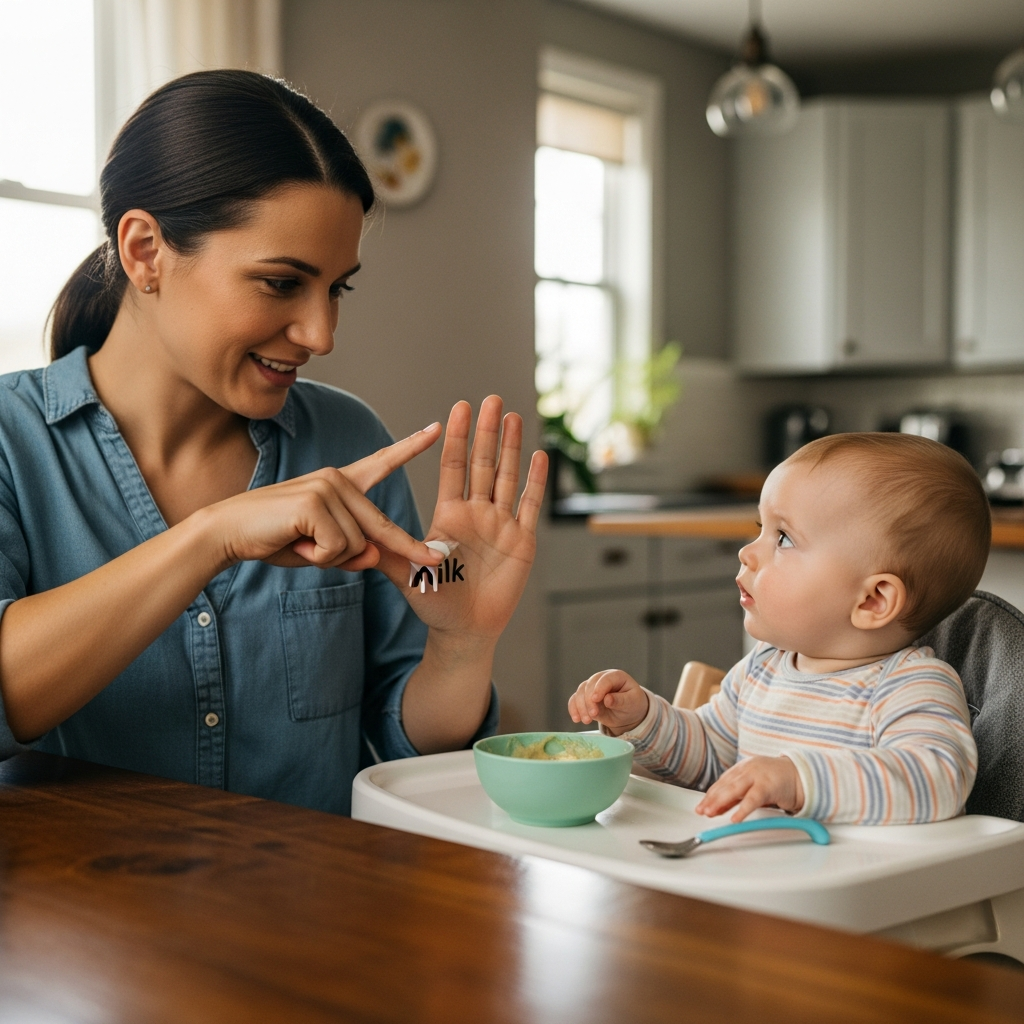
- Milk: Make a fist and open and close it like you are milking a cow. Use this before and during every feeding. It is often the first sign babies master because it connects to such a powerful motivator.
- More: Touch the fingertips of both hands together repeatedly. This versatile sign works for food, play, books, songs, and any activity your baby wants to continue.
- All Done/Finished: Hold both hands up with palms facing out and twist them back and forth. Use this at the end of meals, diaper changes, and activities.
- Eat: Bring your fingertips together and tap them to your lips. Perfect for mealtimes and when introducing solid foods.
- Help: Place a flat hand on top of a fist and raise both upward. This sign dramatically reduces frustration when your baby needs assistance but cannot verbalize it.
Building Your Baby's Sign Vocabulary: Next Steps
Once your baby masters the basics, gradually add new signs:
- Family signs: Mommy, daddy, grandma, grandpa
- Need signs: Water, diaper, sleep, hurt/pain
- Emotion signs: Happy, sad, scared
- Activity signs: Play, book, bath, outside
During signing practice, dress your baby in soft, comfortable clothing that allows free arm movement. Stiff or restrictive clothes can make it harder for little ones to form signs. Many parents find that soft bamboo baby clothes are ideal for signing practice, as the natural fabric keeps babies comfortable and allows their little arms to move freely while learning new signs.
How to Teach Baby Sign Language Step by Step
Teaching baby sign language does not require special training or expensive courses. Follow these research-backed steps to get started.
Step 1: Start with One or Two Signs
Choose contextually relevant signs like "milk" at feeding time. Use this sign every single time the context occurs. Consistency beats variety when you are just beginning.
Step 2: Sign and Speak Simultaneously
Always pair your sign with the spoken word. Say "Do you want MILK?" while making the sign. This multi-sensory approach reinforces learning and ensures verbal language development continues alongside signing.
Step 3: Create Visual Connection
Sign at your baby's eye level. Make eye contact before signing. Exaggerate your movements initially so they are easy to see and understand.
Step 4: Practice During Daily Routines
The best teaching happens naturally during everyday activities:
- Sign "eat" and "more" during mealtimes
- Sign "diaper" during changes
- Sign "sleep" at bedtime
- Sign "bath" before bath time
Step 5: Celebrate Approximations
Your baby's first signs will not look perfect, and that is okay. A baby's version of "milk" might be an open-close hand motion near their chest rather than the precise gesture. Recognize and respond to these attempts enthusiastically. Perfection comes with practice.
Pro Tips for Success
- Involve all caregivers and family members in signing
- Stay patient: responses typically take weeks to months
- Make it fun and never forced
- Use signs during reading time to reinforce vocabulary
Does Baby Sign Language Delay Speech? Debunking the Myth
This is the number one concern parents have about baby sign language. Let us address it directly: No, baby sign language does not delay speech development.
Research consistently shows that baby sign language does not delay speech development. Studies indicate that signing babies often speak earlier and develop larger vocabularies than non-signing peers. This is because signs are always used alongside spoken words, creating multiple pathways for language learning.
According to Ivy Rehab pediatric specialists, research has shown that using baby sign language can actually increase a child's speech skills rather than hinder them.
Why Signs Actually Support Speech
- Signs are always paired with spoken words, reinforcing verbal language
- Creating signs engages multiple areas of the brain, strengthening neural pathways for communication
- Successful communication motivates babies to keep trying, accelerating verbal attempts
- Reduced frustration creates a more positive environment for language practice
A 2013 controlled study by Dr. Elizabeth Kirk found that babies in signing groups did not learn fewer words than control groups. While this particular study did not find signing accelerated speech, it definitively showed signing causes no delay.
Baby Sign Language Troubleshooting: When Baby Is Not Signing Back
You have been signing "milk" for three weeks. Your baby stares at you blankly. Is something wrong? Almost certainly not.
Typical Timeline for First Signs
Most babies sign back after 2-8 weeks of consistent exposure. However, several factors affect timing:
- Younger babies (6 months) typically take longer than older babies (9-10 months)
- Understanding always comes before production
- Some babies are observers who suddenly produce multiple signs at once
Common Reasons Baby May Not Be Signing Yet
- Not enough repetition or consistency
- Signs not being used in meaningful contexts
- Baby is focusing on other developmental milestones
- Individual developmental differences
Practical Solutions to Encourage Signing
- Increase frequency: sign during every relevant opportunity
- Ensure all caregivers are signing consistently
- Watch for baby's own invented signs (these count as success)
- Add highly motivating signs related to favorite foods or toys
- Try changing up the environment or timing
If your baby seems distracted during practice, try creating a special signing time routine. Some parents find that putting baby in a fresh, colorful outfit helps signal that it is time for a fun activity, capturing attention and making signing feel like a special game rather than a lesson.
Remember: your baby is learning even when not signing back yet. Receptive language develops before expressive language. If you are genuinely concerned about your child's development, consult your pediatrician for guidance.
Resources and Next Steps for Your Baby Signing Journey
Ready to dive deeper into baby sign language? Here are resources to support your journey.
Free Resources to Get Started
- YouTube channels with sign demonstrations
- Printable sign language charts available online
- Parent community forums and Facebook groups
- Library books on baby sign language
Books, Apps, and Courses Worth Considering
When choosing resources, look for:
- ASL-based signs rather than made-up gestures
- Video demonstrations in addition to static images
- Age-appropriate progression of signs
- Positive reviews from other parents
Popular programs like Baby Signing Time offer structured curricula with songs and videos. Many parents find apps helpful for quick reference when they forget how to make a sign. Local community centers and libraries sometimes offer free or low-cost baby sign language classes.
Tips for Long-Term Success
- Share this knowledge with grandparents, babysitters, and daycare providers
- Celebrate every communication milestone, signed or spoken
- Transition naturally to verbal language when your child is ready
- Consider continuing sign language learning as your child grows
Frequently Asked Questions About Baby Sign Language
What age should I start teaching my baby sign language?
Most experts recommend beginning baby sign language between 6-8 months, when babies have developed the motor skills to start forming simple gestures. However, you can introduce signs as early as birth to build recognition. Babies typically start signing back between 8-12 months, though some may begin earlier. It is never too late to start, as older babies and toddlers often learn more quickly.
What is the first sign to teach a baby?
The sign for "milk" is often recommended as the first sign to teach because it connects to a high-frequency, highly motivating activity. Other excellent starter signs include "more" (versatile for food and play), "eat," and "all done." Choose signs that relate to your baby's daily routines and interests, as relevance increases motivation to learn and use them.
How long does it take for a baby to learn sign language?
After consistent exposure, most babies begin signing back within 2-8 weeks. The timeline varies based on age, temperament, and practice frequency. Babies who start at 6 months may take longer to respond than those starting at 9-10 months, simply because motor skills are more developed. Remember that understanding precedes production, so your baby is learning even before they sign back.
Does baby sign language delay speech development?
No, baby sign language does not delay speech. Research consistently shows that signing babies often speak earlier and develop larger vocabularies than non-signing peers. This occurs because signs are always used alongside spoken words, creating reinforced language learning. Signs serve as a bridge to verbal communication, not a replacement.
How many signs should I teach my baby at once?
Start with just 1-3 signs and add new ones gradually as your baby masters each sign. Quality and consistency matter more than quantity. Focus on signs relevant to daily routines and high-interest items. Once your baby starts signing back, you can introduce new signs more quickly. Some families eventually teach 50 or more signs before verbal language takes over.
What if my baby makes up their own signs?
This is completely normal and actually shows your baby understands the concept of symbolic communication. Many babies create approximations or entirely invented signs. Accept and respond to these signs while gently modeling the standard version. The goal is communication, not perfection. Your baby's invented signs are a positive milestone.
Can I teach baby sign language in a bilingual household?
Absolutely. Baby sign language works exceptionally well in bilingual or multilingual households because signs provide a consistent bridge across languages. Use the same sign regardless of which language you are speaking. This actually simplifies early communication for babies navigating multiple languages and can reduce confusion.
Should I use ASL or baby sign language?
Most baby sign language uses simplified ASL signs, so the distinction is minimal. Using ASL-based signs is recommended because it connects to a real language your child can build upon later. The main difference is that baby sign language may simplify complex ASL signs to match infant motor abilities. Either approach works well, and consistency matters most.
Start Your Baby Sign Language Journey Today
Teaching baby sign language is one of the most rewarding gifts you can give both yourself and your child. Those 2 AM guessing games become clearer when your baby can sign "milk" or "hurt." The grocery store meltdowns decrease when your toddler can sign "all done" instead of screaming. And those moments when your baby looks into your eyes and signs "more book, please" create memories that last a lifetime.
Remember, you do not need to be perfect. Start with one sign, stay consistent, and trust the process. Your baby is learning even before they sign back. The key ingredients are patience, repetition, and making it fun for everyone involved.
At PatPat, we understand the joys and challenges of early parenthood. Whether you are navigating first signs or celebrating your baby's expanding vocabulary, we are here to support your family's journey with comfortable, practical clothing that moves with your growing baby.
Have questions about baby sign language or success stories to share? We love hearing from parents on their signing journey. Share this guide with your partner, family members, and caregivers so everyone can sign consistently with your baby. After all, the more people who sign, the faster your little one will catch on.
Additional Resources
- American Academy of Pediatrics - Child development guidelines and recommendations
- American Speech-Language-Hearing Association - Speech and language development information
- Zero to Three - Early childhood development resources




