


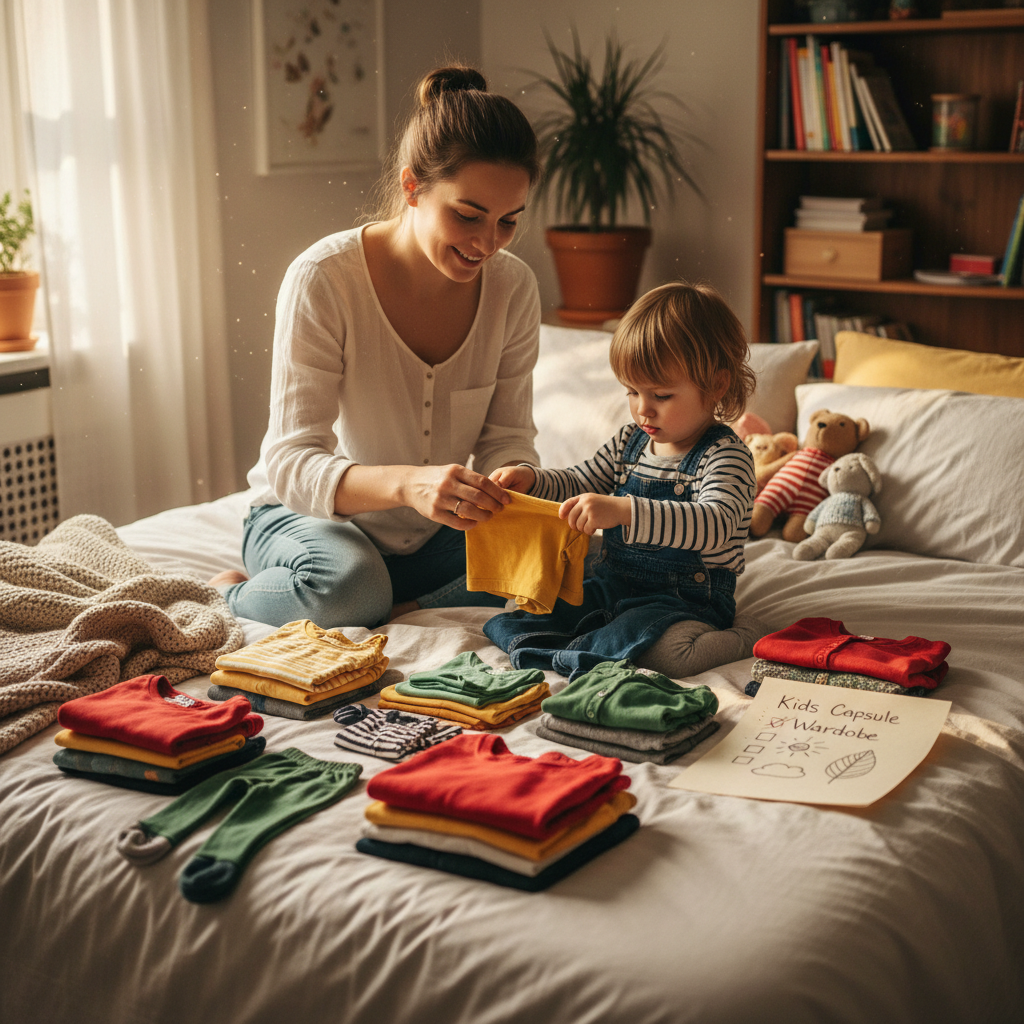
What if your child could get dressed independently in under two minutes, look pulled-together every single day, and you could slash your annual kids clothing budget by 40-60%? That is the promise of a kids capsule wardrobe -- and it is far simpler to build than you might think.
If you are a parent of an elementary-age child, you probably know these frustrations all too well. The closet is overflowing with clothes, yet somehow nothing matches. Morning outfit battles eat into precious time before school. You spend hundreds of dollars on pieces your child wears once or twice before outgrowing them. And every growth spurt feels like a financial reset button that wipes out half the wardrobe overnight.
A capsule wardrobe for kids solves all of these problems with one elegant system: a curated collection of 20-25 versatile, interchangeable pieces that create dozens of complete outfits. This guide is designed specifically for children ages 5 through 10 -- the kindergarten-to-fifth-grade years -- because this age range is uniquely suited for capsule wardrobing. These kids are developing independence, following school routines, and growing fast. A streamlined wardrobe meets them right where they are.
By the time you finish this guide, you will have:
- A printable kids capsule wardrobe checklist with exact item counts and fabric recommendations
- A color palette guide with three ready-to-use palettes so everything coordinates effortlessly
- Mix-and-match outfit grids showing 30+ combinations from just 15 pieces
- A detailed cost breakdown proving capsule wardrobes save real money -- with cost-per-wear analysis
- Seasonal rotation plans for year-round coverage in any climate
- School dress code compatibility tips and battle-tested strategies for picky dressers
Whether you are starting from scratch or looking to simplify an overflowing closet, this is the most comprehensive capsule wardrobe for elementary school kids guide you will find anywhere. For affordable, coordinating basics that make building a children's capsule wardrobe genuinely easy, PatPat offers an extensive kids clothing collection with everyday pricing that parents love. You can also explore their guide to kids clothing styles by age for age-appropriate inspiration as you plan your capsule.
What Is a Kids Capsule Wardrobe and Why Ages 5-10 Is the Perfect Time to Start
A kids capsule wardrobe is a curated collection of 15-25 versatile, interchangeable clothing pieces that combine to create dozens of complete outfits. Think of it as a kids minimalist wardrobe -- not about deprivation, but about intentional abundance through smart selection. Every top pairs with every bottom. Every layer complements every base outfit. The result is a closet where your child can reach in, grab almost anything, and look great without any help from you.
The capsule wardrobe concept was originally popularized by London boutique owner Susie Faux in the 1970s and later adapted for the mainstream by fashion designer Donna Karan. But while the adult version focuses on style sophistication, the kids version is all about practicality: reducing morning chaos, empowering your child's independence, and keeping your budget under control.
This concept works even better for children than it does for adults -- especially those between ages 5 and 10. Here is why this age window is uniquely suited for the capsule approach:
- Independence milestone: Kids this age desperately want to dress themselves. A capsule where "everything matches everything" empowers self-dressing without parent intervention, last-minute outfit vetoes, or tearful standoffs at the closet door. When every combination looks good, your child cannot get it wrong.
- School routine: The consistent daily dressing need of a school schedule creates the ideal structure for a capsule system. Five days a week, your child needs a clean, appropriate outfit. A capsule delivers that on autopilot.
- Growth reality: Children ages 5-10 grow an average of 2-3 inches per year. That means clothing turnover is inevitable. Fewer high-quality pieces mean less financial loss when your child sizes out -- and less guilt about discarding barely-worn items.
- Decision fatigue: Research from the American Psychological Association confirms that even young children experience decision fatigue. A closet with 60 options actually creates more stress than a closet with 20 great options. A simplified wardrobe reduces morning decision overload for the whole family.
- Executive function development: Children in this age range are actively building organizational and planning skills. A well-structured capsule wardrobe gives them a manageable system to practice these skills every day.
Here is the "outfit math" that makes capsule wardrobing so powerful: 5 tops multiplied by 4 bottoms gives you 20 base outfits. Add 3 layering options and the combinations multiply well beyond 30 distinct looks -- more than enough variety for an entire month without repeating a single outfit.
- Saves 40-60% on annual kids clothing costs
- Cuts morning dressing time to under 2 minutes
- Reduces laundry loads by eliminating barely-worn items sitting in the hamper
- Teaches children organization, planning, and decision-making skills
- Creates a clutter-free, visually calm closet space that kids can manage independently
How Many Clothes Does a Child Really Need for a Capsule Wardrobe?
The answer might surprise you: 20-25 pieces total (excluding underwear, socks, sleepwear, and special-occasion items like Halloween costumes or formal wear). That is it. Here is the recommended breakdown by category:
| Category | Quantity | Purpose |
|---|---|---|
| Tops (short and long sleeve) | 6-8 | Daily variety, accent colors, layering bases |
| Bottoms (jeans, joggers, shorts) | 4-5 | Neutral workhorses that pair with every top |
| Dresses or jumpsuits (optional) | 2-3 | One-piece outfit option, especially for girls' capsules |
| Layering pieces (hoodies, sweaters) | 2-3 | Temperature regulation, outfit variety multiplication |
| Shoes | 2-3 pairs | Everyday, warm weather, and occasional/seasonal |
| Outerwear | 1-2 | Weather protection (rain jacket, winter coat) |
| Total | 20-25 pieces | Full wardrobe coverage for every occasion |
Why does this number work so well? It covers a full 5-day school week with room for weekend variety, even on a once-per-week laundry cycle. If you wash clothes twice a week (which most families do), you actually have surplus capacity built in.
Compare that to what most kids actually own. Consumer spending research from the National Retail Federation shows families spend significantly on children's clothing each year, and various parenting surveys suggest the average child owns between 50 and 80 clothing items. Yet children typically rotate through the same 10-15 favorite pieces regardless of how many they own. The rest just takes up space, creates clutter, and gathers dust. A capsule wardrobe simply makes that natural tendency intentional and strategic -- while eliminating the waste.
The Complete Kids Capsule Wardrobe Checklist You Can Print Today
This is the section you will want to bookmark, save, and come back to every season. Below is your complete kids capsule wardrobe checklist -- every essential item, recommended quantities, fabric tips, and practical notes for real-world use. Print it out, check off what your child already owns, and identify the gaps you need to fill. Most families find they already own 40-60% of what they need.
Essential Tops for Every Day of the Week
Tops are the most visible part of any outfit, and they carry the visual weight of your child's capsule wardrobe. This is where your accent colors shine, while neutral tops serve as the reliable backbone. Here is exactly what your child needs:
- 3-4 solid-color short-sleeve tees (cotton or cotton-blend, crew neck) -- Choose 2 in neutral tones (white, gray, or navy) plus 1-2 in your chosen accent colors from the palette. These are the everyday workhorses your child will reach for most often.
- 2-3 long-sleeve tops for layering and cooler days -- Include a mix of solids and one subtle pattern like classic stripes or a simple graphic. Long sleeves extend the life of the capsule into transitional weather without needing a full jacket.
- 1 polo or collared shirt for dress code compliance and dressier occasions -- This single item elevates any bottom in the capsule for picture day, family dinners, or schools that require collared shirts. It is the most versatile dressy piece you can own.
Versatile Bottoms That Go with Everything
Bottoms are your workhorse neutral pieces -- the foundation that makes the entire capsule system function. When bottoms are chosen in versatile neutrals, literally every top in the capsule will pair with every bottom. That is the "everything matches everything" magic in action. Here is what to include:
- 2 pairs of jeans or denim -- one classic medium-blue wash and one dark wash or black. Denim is the single most versatile bottom for kids this age: it goes to school, to the playground, to birthday parties, and to restaurants without looking out of place anywhere. Look for styles with a bit of stretch for active comfort.
- 1-2 pairs of joggers or soft pants with elastic waistbands -- These are essential for comfort and independence. Your child can pull them on and off without help, which matters enormously for bathroom breaks, PE changes, and getting dressed in the morning without your assistance. Choose dark neutral colors like gray, navy, or black.
- 1 pair of shorts (for warm seasons) or leggings (for layering and girls' capsules) -- In warm climates, you may want 2 pairs of shorts. In cooler climates, leggings serve as both a standalone bottom and an under-dress layering piece.
- 1 pair of khakis or chinos -- dress code-friendly and incredibly versatile as a neutral. Khakis bridge the gap between casual and dressy better than any other bottom. They work for school, church, family photos, and everyday play. If your child's school has a semi-uniform policy, khakis are almost always compliant.
Why do elastic and pull-on waists matter so much at ages 5-10? Three words: bathroom independence. Add PE class changes and the morning rush to that list. Buttons and zippers slow kids down and create frustration -- especially for kindergarteners and first-graders who are still developing fine motor skills. Elastic waists are not just a convenience; they are a functional necessity for this age group.
Look for comfortable options in PatPat's boys bottoms collection, and check out their guide to quality pants for kids for more details on choosing bottoms that last through months of active wear.
Layering Pieces, Outerwear, and Shoes
Layering pieces are the secret multipliers of a capsule wardrobe. Every layer you add to a base outfit creates a new look while also serving the practical purpose of temperature regulation. Here is what you need:
Layering pieces (2-3 items):
- 1 zip-up or pullover hoodie -- the single most versatile layering item in any kid's closet. It goes over everything, works indoors and out, and is the piece your child will reach for first on a chilly morning. Choose a neutral color (gray or navy) so it coordinates with every outfit in the capsule.
- 1 lightweight cardigan or pullover sweater -- slightly dressier than a hoodie, this piece bridges casual and dressy occasions. A navy or gray pullover sweater layered over a polo instantly creates a polished look for picture day or a family event.
- 1 vest (optional) -- excellent for transitional weather when a full jacket is too warm but a tee alone is too cool. Vests add visual interest to an outfit and work particularly well in spring and fall. Choose your accent color for the vest to add a pop of personality.
Outerwear (1-2 items, depending on your climate):
- 1 rain-resistant jacket for spring and fall -- look for a lightweight, packable option that your child can shove into a backpack when the sun comes out
- 1 winter coat for cold climates -- this is the one item where you should invest in quality and warmth over capsule color coordination, though a navy or black coat will still match everything
Shoes (2-3 pairs):
- 1 pair of everyday sneakers -- the absolute workhorse of the capsule. Choose white or a neutral color that goes with everything. Your child will wear these 4-5 days per week, so invest in a comfortable, supportive pair. Machine-washable is a huge bonus at this age.
- 1 pair of sandals or slip-ons for warm weather and casual weekend outings. Easy on-off is key for beach trips, pool days, and backyard play.
- 1 pair of dress shoes or boots (optional) -- for occasions, winter weather, or schools that require closed-toe shoes year-round. Boots do double duty as both a cold-weather necessity and a style statement.
For hoodies and layering options, browse PatPat's kids sweatshirts and hoodies, and for outerwear, check their kids jackets and coats collection.
Accessory add-ons (not counted in your 20-25 pieces): 1 warm hat, 1 pair of gloves, 1 scarf (all seasonal), and 1 belt if needed for dress code bottoms. Accessories are where kids can add personality without inflating the capsule count.
Boys vs. Girls vs. Gender-Neutral Capsule Variations
Every child is different, and your capsule should reflect your family's preferences, your child's personality, and your practical needs. The core structure stays the same, but the specific mix shifts depending on what works for your kid. Here is a side-by-side comparison of a sample 22-piece capsule across three approaches:
| Category | Boys Capsule | Girls Capsule | Gender-Neutral |
|---|---|---|---|
| Short-sleeve tees | 4 (2 neutral, 1 color, 1 graphic) | 3 (2 neutral, 1 color) | 4 (solid neutrals + earth tones) |
| Long-sleeve tops | 2 (1 solid, 1 stripe) | 2 (1 solid, 1 pattern) | 2 (solid colors) |
| Polo/collared shirt | 1 | 1 (or blouse) | 1 |
| Jeans/denim | 2 | 2 | 2 |
| Joggers/soft pants | 2 | 1 | 2 |
| Shorts | 2 (including athletic) | 1 | 1 |
| Leggings | 0 | 2 | 1 |
| Dresses/skirts | 0 | 2-3 versatile dresses | 0 |
| Hoodie | 1 | 1 | 1 |
| Sweater/cardigan | 1 | 1 | 1 |
| Vest | 1 | 1 | 1 |
| Rain jacket | 1 | 1 | 1 |
| Winter coat | 1 | 1 | 1 |
| Sneakers | 1 pair | 1 pair | 1 pair |
| Sandals/slip-ons | 1 pair | 1 pair | 1 pair |
| Total | ~22 pieces | ~22 pieces | ~21 pieces |
Boys capsule emphasis: More joggers and athletic shorts reflect the active play patterns common with boys this age. The graphic tee serves as the "fun" piece that keeps things interesting and gives your child a way to express personality (dinosaurs, sports, space -- whatever they are into). The polo anchors the dressier end of the capsule.
Girls capsule emphasis: Dresses are the secret weapon of a girls' capsule wardrobe. A versatile solid-color dress can function as a standalone school outfit, a layering piece over leggings, a dressy option for events, or a summer go-to with sandals. Two to three well-chosen dresses effectively replace multiple separate tops and bottoms. Explore PatPat's girls dresses and girls clothes collections for options that transition seamlessly from school to weekends.
Gender-neutral capsule: Focus entirely on solid neutrals and earth tones -- think olive, rust, cream, dusty blue, and charcoal. Avoid gendered graphics and choose unisex cuts. This approach works beautifully for families with siblings who share hand-me-downs, and it has the bonus of being the easiest capsule to coordinate since neutral palettes match effortlessly. Browse PatPat's children's outfit sets for ready-made coordinating options.
Printable Kids Capsule Wardrobe Checklist
Check off what your child already owns, then shop only for the gaps:
- Short-sleeve tee #1 (neutral) ___________
- Short-sleeve tee #2 (neutral) ___________
- Short-sleeve tee #3 (accent color) ___________
- Short-sleeve tee #4 (accent color) ___________
- Long-sleeve top #1 (solid) ___________
- Long-sleeve top #2 (stripe/pattern) ___________
- Long-sleeve top #3 (optional) ___________
- Polo or collared shirt ___________
- Jeans/denim #1 (classic blue) ___________
- Jeans/denim #2 (dark wash) ___________
- Joggers/soft pants #1 ___________
- Joggers/soft pants #2 ___________
- Shorts or leggings #1 ___________
- Shorts or leggings #2 ___________
- Khakis or chinos ___________
- Hoodie (zip-up or pullover) ___________
- Sweater or cardigan ___________
- Vest (optional) ___________
- Rain jacket ___________
- Winter coat ___________
- Everyday sneakers ___________
- Sandals or slip-ons ___________
- Dress shoes or boots (optional) ___________
Tip: Save or print this page (Ctrl+P / Cmd+P) for a quick reference while shopping online or in store. Highlight the items you already have and focus your budget on the gaps.
The Capsule Color Palette Guide: How to Choose Colors That Always Coordinate
Color coordination is the backbone of every successful kids capsule wardrobe. Get the palette right and the "everything matches everything" magic happens automatically. Get it wrong, and you end up with pieces that only pair with one or two other items -- which is the most common capsule failure and the reason many parents give up on the concept before it has a chance to work.
The good news? Choosing the right palette is easier than you think, especially with the formula below.
The 3-2-1 Color Formula for Kids
This simple formula makes color selection foolproof, even if you have zero fashion sense or color theory knowledge:
- 3 Neutrals (base colors for bottoms and layering pieces): Choose from navy, gray, black, khaki, denim blue, white, or cream. These are the foundation colors that appear in your jeans, joggers, hoodie, and sweater. They are called "neutrals" because they pair well with almost any other color.
- 2 Core Colors (main accent colors for tops): Pick based on your child's preference and what they already gravitate toward. Popular combinations include red + forest green, teal + mustard, coral + olive, or blue + burgundy. These appear primarily in your tees and long-sleeve tops.
- 1 Pop Color (fun accent for one or two statement pieces): A bright or favorite color your child absolutely loves -- sunshine yellow, hot pink, electric blue, whatever lights them up. This is where personality shines. It might appear in just a vest or a single tee, but it makes the whole capsule feel personal to your child.
Here are three complete palettes you can adopt or adapt for your own child's capsule:
Classic Palette
Best for: Traditional look, year-round versatility, works equally well for boys and girls
Earth Tones Palette
Best for: Gender-neutral capsules, nature-loving families, hand-me-down friendly across siblings
Cool Tones Palette
Best for: Kids who love cooler tones, modern aesthetic, stands out from typical kids' primary-color palettes
How to involve your child in choosing the palette: Let them pick the 2 core colors and the 1 pop color from a curated set of options you pre-approve. You control the neutrals (those are the functional foundation), but they get to choose the fun colors. This builds buy-in and dramatically reduces resistance to the capsule concept. Children who feel ownership over the palette are far more likely to embrace the system enthusiastically.
For picky dressers, use this trick: look at the 3 items they wear most often right now. What colors are they? Build the entire palette around those colors, and your child will feel like the capsule was designed around their existing preferences -- because it was.
Colors to Avoid and Pattern Rules for Maximum Versatility
Not all colors and patterns play well in a capsule system. Here is what to watch for:
- Colors to limit: Neon shades (hard to coordinate with anything but black or white), very light pastels for bottoms (stain magnets for the playground-and-lunch-table crowd), and ultra-trendy "it" colors that will look dated within a season
- The 80/20 pattern rule: Keep 80% of pieces as solid colors and 20% as patterns. Solids pair with everything; patterns are pickier about their partners.
- Patterns that work beautifully: Classic stripes (especially Breton stripes), small polka dots, simple geometric prints, subtle plaid -- these are timeless patterns that pair well with solid neutrals
- Patterns that limit combinations: Large logos, character prints (they only pair with plain solids and date quickly), busy florals, and anything with more than 3 colors in the print
Dark neutrals for bottoms are your best friend at this age. Playground dirt, grass stains, ketchup drips, and art project mishaps are a daily reality between ages 5 and 10. Navy joggers forgive far more than white leggings ever will. Save white and light colors for tops, where stains are more manageable and where a stain remover pen can do its work.
Mix-and-Match Outfit Grid: 30+ Outfits from Just 15 Pieces
This is where the magic of a capsule wardrobe becomes visible. Talk is cheap -- the outfit grid is proof. Below, we map out exactly how a 15-piece core capsule generates over 30 unique mix-and-match kids outfits your child can wear to school, to the park, to a birthday party, or on a family outing. No repeats for an entire month.
The 15-Piece Core Capsule Layout
Using the Classic Palette from the previous section, here is a specific sample 15-piece capsule with every item identified by name and color:
| Category | Item | Color |
|---|---|---|
| Tops (5) | Crew-neck tee #1 | White |
| Crew-neck tee #2 | Navy | |
| Long-sleeve top | Red | |
| Stripe tee | Green/White stripe | |
| Polo shirt | Gray | |
| Bottoms (4) | Classic jeans | Blue denim |
| Joggers | Dark gray | |
| Shorts | Khaki | |
| Leggings | Navy | |
| Layers (3) | Zip-up hoodie | Gray |
| Pullover sweater | Navy | |
| Vest | Red | |
| Shoes + Outerwear (3) | Sneakers | White |
| Sandals | Brown | |
| Rain jacket | Navy |
The outfit math: 5 tops x 4 bottoms = 20 base outfits. Layer any of the 3 layering pieces on top and you get 20 x 3 = 60 possible layered combinations. Even accounting for seasonality (you would not wear a vest over shorts in winter), you still easily exceed 30 distinct, weather-appropriate outfit combinations. That is more than enough for a full month without repeating.
School Week Outfit Combinations (Monday Through Friday)
Here are 5 ready-to-go coordinating kids outfits for school pulled directly from the 15-piece capsule above. Think of these as your starting template -- your child can follow these exactly or mix things up based on their mood:
| Day | Top | Bottom | Layer | Shoes |
|---|---|---|---|---|
| Monday | Navy tee | Khaki shorts | -- | White sneakers |
| Tuesday | Red long-sleeve | Blue jeans | Gray hoodie | White sneakers |
| Wednesday | Green stripe tee | Dark gray joggers | -- | White sneakers |
| Thursday | Gray polo | Blue jeans | Navy sweater | White sneakers |
| Friday | White tee | Navy leggings | Red vest | White sneakers |
These are just 5 of the 30+ possibilities. Notice that no exact combination is repeated, yet every outfit looks intentional and coordinated. And here is the best part: your child can pick their own pairings from the capsule each morning, because every piece coordinates with every other piece. That is what "everything matches everything" looks like in practice. It is also why capsule wardrobes are such an effective school morning hack -- there is genuinely no wrong choice.
Weekend, Playtime, and Dressy Occasion Combos
The capsule does not just serve the school week. Here are 5 additional combinations for versatile kids outfits across different weekend and special-occasion scenarios:
| Occasion | Top | Bottom | Layer | Shoes |
|---|---|---|---|---|
| Weekend casual | Green stripe tee | Dark gray joggers | -- | Brown sandals |
| Active play | White tee | Khaki shorts | Gray hoodie | White sneakers |
| Birthday party | Gray polo | Blue jeans | Navy sweater | Brown sandals |
| Family outing | Red long-sleeve | Navy leggings | Red vest | White sneakers |
| Rainy day | Navy tee | Dark gray joggers | Navy rain jacket | White sneakers |
Notice how adding just 1-2 dressy accessories -- a leather belt, a headband, or a pair of dress shoes -- can elevate any capsule combination for a special event without purchasing a whole new outfit. The birthday party look above transitions from "nice casual" to "party ready" simply by swapping sandals for dress shoes if you have them on hand.
This is also where the concept of outfit math becomes genuinely exciting. With 15 pieces, you are not limited to 15 outfits -- you have access to 30, 40, or even 50+ distinct combinations depending on how creative you get with layering. That is the power of a well-planned capsule wardrobe for kids.
For families who prefer ready-made coordinated options that take the planning out entirely, PatPat's kids outfit sets and children's outfit sets come pre-coordinated so every piece in the set works together.

Seasonal Capsule Wardrobe Rotation: Spring, Summer, Fall, and Winter
A capsule wardrobe is not a set-it-and-forget-it system. It evolves with the seasons -- and that is actually one of its greatest strengths. Instead of buying an entirely new wardrobe four times a year, you keep a stable core and rotate a small number of seasonal pieces in and out. The key concept is the "Core + Seasonal Shell" model.
Year-round core (10-12 pieces that stay in the closet all year): basic tees, jeans, hoodie, sweater, sneakers. These pieces work in every season, possibly with a layer added or removed.
Seasonal shell (5-8 pieces that rotate in and out): shorts vs. fleece-lined pants, sandals vs. boots, tank tops vs. thermal layers. These are the pieces that change when the weather shifts.
Spring and Summer Capsule Adjustments
| Action | Items | Notes |
|---|---|---|
| Rotate IN | 2 pairs of shorts, lightweight tees, sandals, sun hat | Check sizing from last summer -- kids may have grown 2-3 inches |
| Rotate OUT | Heavy winter coat, thermal layers, boots, fleece-lined pants | Wash, inspect, and store in labeled bins by size |
| Keep accessible | 1 hoodie and 1 light jacket for unpredictable spring weather | Spring mornings can be 20 degrees cooler than afternoons |
A summer capsule wardrobe for kids is naturally smaller -- fewer layers needed means fewer total pieces. Your child might operate on as few as 12-15 pieces during the warmest months. This is a wonderful thing: fewer pieces means less laundry, easier packing for trips, and a closet that practically manages itself.
Here is a bonus tip that experienced capsule parents swear by: your summer capsule doubles as a ready-made camp packing list. When it is time to pack for sleepaway camp or day camp, just pull items directly from the capsule. Everything matches, everything is weather-appropriate, and you do not have to stress about packing outfits -- because every combination works.
Fall and Winter Capsule Adjustments
| Action | Items | Notes |
|---|---|---|
| Rotate IN | Long-sleeve thermal base layers, fleece-lined pants, winter coat, boots, knit hat and gloves | This is the time to check coat and boot sizes before temperatures drop |
| Rotate OUT | Shorts, sandals, tank tops, sun hat | Store in labeled bins -- note the size on the outside of the bin |
| Layering strategy | Base layer (thermal tee) + mid layer (hoodie/sweater) + outer layer (coat) | Three thin layers beat one thick layer for flexibility and warmth |
The layering principle is especially important for cold-climate families. Three thin layers provide more warmth and flexibility than one bulky layer, and your child can adjust throughout the day as the overheated classroom differs dramatically from the freezing recess yard. A thermal base layer under the capsule's regular tee, topped with the hoodie and then the coat, keeps kids warm down to surprisingly low temperatures.
Back-to-school timing: Late July through early August is the ideal moment to audit, refresh, and re-size your capsule. This aligns perfectly with the peak back-to-school shopping season, when retailers offer their best selection and deals. Run through the full checklist, try everything on your child, remove what no longer fits, and shop strategically to fill the gaps. Check PatPat's back-to-school clothes collection for affordable options, and read their guide on how to layer kids coats and jackets for cold-weather layering strategies.
School Dress Code Compatibility and Tips for Picky Dressers
Two of the biggest concerns parents raise when they first hear about building a capsule wardrobe for elementary school kids are school dress codes and picky dressers. "My school has a strict dress code -- will this work?" and "My child will never agree to wear only 20 pieces." The good news? A capsule wardrobe actually handles both challenges better than a traditional overflowing closet. In fact, dress codes and capsule wardrobes are natural allies.
Adapting Your Capsule for Common Elementary School Dress Codes
| School Type | Capsule Strategy | Key Tip |
|---|---|---|
| Uniform required | Apply capsule quantities to required items (3-4 uniform tops, 2-3 uniform bottoms) | The easiest capsule scenario -- use the capsule approach for weekends and after-school |
| Semi-uniform (e.g., solid polo + khaki/navy bottoms) | Build the entire capsule around the school's allowed color palette | Every piece does double duty for school AND weekends -- maximum versatility |
| Standard dress code (no graphics, no ripped jeans, modest length) | The capsule's emphasis on solids and classic basics naturally complies | Include one collared shirt for stricter dress code days and picture day |
| No dress code | Full flexibility -- use the complete 3-2-1 color palette and pattern rules | The "wild card" item is especially fun here |
PE day strategy: Joggers plus a tee from the capsule already work perfectly for most gym classes. If your school requires a shoe change for PE, add one pair of dedicated athletic shoes -- these are not counted in the capsule piece count since they serve a specialized function. For PE-specific options, see PatPat's kids activewear collection.
Picture day from the capsule: You absolutely do not need to buy a new outfit for school photos. The polo or collared shirt + dark jeans or khakis + the pullover sweater = a polished, photo-ready look that photographs beautifully. For girls, a versatile solid-color dress from the capsule works just as well. Add a hair accessory or a simple necklace for a finishing touch. Check out PatPat's tips on how to style girls dresses for school and playtime for more inspiration.
Getting Picky Dressers on Board: Personality Expression Within the System
Here is a counterintuitive truth: a capsule wardrobe often works better for picky dressers than an overflowing closet. Why? Because the closet overwhelm that causes "I have nothing to wear" meltdowns disappears. Every option is a good option. The decision is simpler. And the child has more real control, not less.
That said, you do need to build the capsule with your child's personality in mind. The capsule is a framework, not a prison. Here is how to maintain personal expression within the system:
- The "pop color" piece: Your child chose this color in the palette process. It is THEIR color, their expression, their identity marker within the capsule. This matters more to kids than you might expect.
- Fun accessories: Personality-packed socks with wild patterns, hair accessories, pins, patches, clip-on earrings, or a favorite watch add individuality without adding clothing items to the capsule. Accessories are unlimited and uncounted.
- The "wild card" item: Allow one non-capsule piece per season. A graphic tee of their favorite show character, a sparkly skirt, a pair of light-up sneakers -- whatever they are passionate about right now. This one slot satisfies the desire for trends without undermining the capsule system.
The 3-choice method for morning harmony: The night before school, lay out 3 complete capsule combinations. Your child picks one in the morning. They get real autonomy within a structure that prevents the "I have nothing to wear" spiral. This technique works remarkably well because it gives children a genuine sense of control (they ARE making the choice) while keeping mornings stress-free for everyone.
Here is how to handle the most common child objections:
- "I have nothing to wear!" -- Show them the outfit grid with 30+ mapped combinations. Seeing all the options visually often surprises kids who assumed they were limited.
- "I want what my friend has." -- The wild card slot exists for exactly this reason. One trendy or character item per season scratches the itch without derailing the capsule.
- "I only want to wear my favorite shirt." -- Build the capsule around that shirt's color family so it pairs with literally everything in the closet. Their favorite shirt becomes the capsule's anchor piece instead of its problem.
- "This is boring." -- Remind them (or show them) that 30+ outfits from 15 pieces is actually more variety than most of their friends have, even friends with closets stuffed full. The variety is real -- it just takes up less space.
From a child development perspective, this approach is genuinely beneficial. Children ages 5-10 are actively developing executive function skills -- the cognitive abilities that govern planning, organizing, and making decisions. A well-designed capsule wardrobe scaffolds these skills by giving kids a manageable system to practice with every single morning. Many parents report that children who initially resist the concept become its loudest advocates once they experience the ease and independence of an all-matching closet.
Cost Breakdown: How a Kids Capsule Wardrobe Saves Your Family Money
A capsule wardrobe is not just an organizational philosophy -- it is a concrete money-saving strategy with measurable results. If you have ever wondered whether the effort of planning a capsule actually pays off financially, this section provides the math. Spoiler: the savings are significant, especially over multiple children and multiple years.
Sample Capsule Wardrobe Cost Breakdown (22 Pieces)
Here is what a complete, year-round affordable kids capsule wardrobe costs at typical retail pricing for quality basics:
| Category | Qty | Price Range Per Item | Subtotal |
|---|---|---|---|
| Short-sleeve tees | 4 | $6-$10 | $24-$40 |
| Long-sleeve tops | 3 | $8-$14 | $24-$42 |
| Jeans/denim | 2 | $12-$20 | $24-$40 |
| Joggers/soft pants | 2 | $10-$16 | $20-$32 |
| Shorts or leggings | 2 | $8-$12 | $16-$24 |
| Hoodie/zip-up | 1 | $14-$22 | $14-$22 |
| Sweater/cardigan | 1 | $12-$20 | $12-$20 |
| Vest (optional) | 1 | $10-$18 | $10-$18 |
| Rain jacket | 1 | $18-$30 | $18-$30 |
| Winter coat | 1 | $25-$45 | $25-$45 |
| Sneakers | 1 | $20-$35 | $20-$35 |
| Sandals/slip-ons | 1 | $12-$22 | $12-$22 |
| Dress shoes/boots | 1 | $18-$30 | $18-$30 |
| TOTAL | 22 | $237-$400 |
A complete, year-round capsule wardrobe for under $400 at standard retail -- and significantly less when shopping sales, secondhand, or through value-focused retailers like PatPat, where kids basics start as low as $5-8 per piece. At those prices, a full capsule is achievable for under $250. Browse the full kids clothes collection to see current pricing on basics, sets, and seasonal pieces.
Cost-Per-Wear Analysis: Why Fewer Clothes Means Better Value
The cost-per-wear formula is the single most useful tool for evaluating clothing purchases for kids: (Price of item) / (Number of times worn) = Cost per wear. This one calculation completely reframes how you think about kids clothing value.
- Capsule tee ($8, worn 40+ times over 6 months) = $0.20 per wear
- Trendy graphic tee ($15, worn 5 times before the child loses interest) = $3.00 per wear
- Character costume shirt ($12, worn 3 times before the obsession passes) = $4.00 per wear
The capsule tee delivers 15x better value than the trendy option -- even though it cost nearly half as much upfront. This is the economics of capsule wardrobing in a single data point.
Annual spending comparison:
- The average American family spends $500-$700 per year on kids clothes for children ages 5-10, according to National Retail Federation consumer spending surveys. Much of this spending goes toward impulse purchases, trend-driven items, and duplicates of things the child already owns.
- A capsule wardrobe family typically spends $250-$400 per year, including seasonal refreshes and growth-spurt replacements.
- Annual savings: $150-$350 per child. For a family with 3 kids in the 5-10 age range, that is $450-$1,050 saved every single year. Over the 5 years of the elementary school window, a single child's capsule approach saves $750-$1,750 compared to conventional shopping patterns.
Additional strategies to maximize your capsule wardrobe savings:
- Buy multi-packs for basics: 5-packs of solid tees and 3-packs of socks deliver significant per-item savings and stock your capsule efficiently
- Shop end-of-season sales: Buy next year's seasonal shell items (shorts in September, coats in March) at 50-70% off -- just buy one size up from your child's current size
- Be selective with hand-me-downs: Accept hand-me-downs that fit your color palette; politely decline the rest. Random hand-me-downs that do not match your palette just add clutter
- Thrift strategically: Use thrift stores and consignment shops for specific capsule gaps. Bring your color palette card and checklist so you shop with intention, not impulse
- Resell outgrown items: Capsule wardrobe pieces hold their resale value well because they are quality basics in excellent condition -- they were worn regularly but not abused, and they have no outdated character prints that kill resale appeal
Frequently Asked Questions About Kids Capsule Wardrobes
How many outfits does a kid need for school?
Most elementary-age children need 5-7 complete outfits for a school week, which a 20-25 piece capsule wardrobe easily provides with room to spare. With a capsule system, 5 tops and 4 bottoms alone create 20 unique combinations, meaning your child never has to repeat an exact outfit within a two-week stretch. Doing laundry once or twice per week keeps everything in rotation. If your child has a messy day (art class, muddy recess), the capsule has enough depth to absorb the hit without running out of clean options.
What are the must-have items in a kids capsule wardrobe?
The must-haves are 3-4 solid-color tees, 2-3 long-sleeve tops, 2 pairs of jeans, 1-2 joggers or soft pants, 1 pair of shorts or leggings, 1 hoodie, 1 sweater, 1 rain-resistant jacket, and 2 pairs of shoes (everyday sneakers plus one alternate). These 15-18 core items form the foundation that works across all seasons. Add a winter coat, boots, and 2-3 seasonal rotation pieces to build out the full year-round capsule of 20-25 items.
Is a capsule wardrobe worth it for kids who grow fast?
Yes -- and fast growth is actually one of the strongest arguments FOR capsule wardrobing. When your child outgrows clothes, you are replacing 20-25 well-chosen items instead of sorting through 50-80 random pieces to figure out what still fits. Buying fewer, better-quality basics means less money wasted when those inevitable growth spurts hit. Practical sizing tip: buy tops in the current size (they look sloppy oversized) and bottoms with adjustable or elastic waists that accommodate an extra inch or two of growth. This extends the useful life of each bottom by months.
What colors work best for a kids capsule wardrobe?
Use the 3-2-1 formula: start with 3 neutral base colors for bottoms and layers -- navy, gray, and denim blue are the most universally versatile combination. Then add 2 core accent colors your child loves for tops, such as red and green, teal and mustard, or coral and olive. Finish with 1 bright pop color for a single statement piece. This formula ensures every item in the capsule coordinates with at least 3-4 other pieces, eliminating the "nothing matches" problem entirely.
How do I create a mix-and-match wardrobe for my child?
Start by choosing a cohesive 6-color palette using the 3-2-1 formula (3 neutrals, 2 core colors, 1 pop color). Then select 5-7 tops and 4-5 bottoms within that palette, making sure every top works visually with every bottom. Add 2-3 layering pieces in neutral tones. The golden rule for future purchases: if a new piece does not coordinate with at least 3 existing items in the capsule, do not buy it. This single rule prevents the gradual drift back toward a mismatched closet.
Can I build a kids capsule wardrobe from thrift stores?
Absolutely -- and thrift stores are actually ideal for capsule building because the capsule system gives you a specific shopping list to work from. Instead of impulse-buying whatever catches your eye, you walk in with your color palette card and checklist, hunting for specific colors, styles, and sizes. Focus on finding quality neutrals (jeans, khakis, hoodies) secondhand since these are easy to find in good condition. Then fill any remaining accent-color gaps with affordable new basics. A fully thrifted kids capsule wardrobe can cost under $80-$120 total.
How often should I refresh or replace items in my child's capsule wardrobe?
Plan a full capsule audit every 3-4 months, aligned with seasonal transitions. At each audit, have your child try everything on. Remove items that are outgrown, stained beyond repair, or worn through at the knees. Replace only those specific pieces -- no need to rebuild from scratch each season. Between quarterly audits, most capsule items last one full season of regular wear without issue. Growth spurts may require a mid-season bottom replacement, so it is smart to keep one size up on hand for pants and joggers.
How do I handle school dress codes with a capsule wardrobe?
Capsule wardrobes and school dress codes are natural allies because both emphasize solid colors, classic cuts, and modest styles. For uniform schools, simply apply capsule quantities to the required uniform pieces (3-4 tops, 2-3 bottoms in the school's colors) and use the full capsule approach for weekends and after-school. For schools requiring specific colors, build your entire 3-2-1 palette around those colors so every capsule piece works for both school and non-school days. Always include one collared shirt for stricter dress code situations and picture day.
Start Building Your Child's Capsule Wardrobe This Weekend
You now have everything you need to transform your child's overstuffed, mismatched, morning-battle-inducing closet into a streamlined system that saves money, saves time, and empowers your kid to dress independently with confidence every single morning.
Here is what to remember from this guide:
- 20-25 pieces is all your child needs for a complete, year-round wardrobe
- The 3-2-1 color formula (3 neutrals, 2 core colors, 1 pop color) makes everything match
- Just 15 core pieces create 30+ outfit combinations -- as proven in the visual grids above
- Annual savings of $150-$350 per child compared to traditional shopping habits
- Seasonal rotation keeps your capsule fresh, weather-appropriate, and growth-adjusted year-round
- Both school dress codes and picky dressers are fully compatible with the capsule approach
You do not need to overhaul the entire closet in one weekend. Start small and build momentum. Audit what your child already owns using the checklist above. Choose a color palette together -- let your child pick the fun colors. Replace worn-out items with capsule-compatible pieces one at a time as needed. Within a single season, you will see the transformation: calmer mornings, a clutter-free closet, a more independent child, and money saved. You will wonder how you ever managed without a kids capsule wardrobe.
The best time to start is right now -- whether that means a full closet overhaul or simply choosing a color palette and making your next clothing purchase a capsule-compatible one. Every intentional choice moves you closer to the streamlined system your family deserves.
Ready to start building? Use the printable checklist above to identify gaps in your child's current wardrobe, pick your color palette using the 3-2-1 formula, and begin shopping for the capsule wardrobe essentials your child needs.
For affordable, mix-and-match basics that form the perfect capsule foundation, explore PatPat's kids clothing collection -- with everyday pricing that makes building a complete capsule wardrobe for kids genuinely budget-friendly for every family.
Shop Kids Capsule Wardrobe Essentials at PatPatFound this guide helpful? Save it for reference, share it with a fellow parent who could use simpler mornings, and revisit before each seasonal audit to keep your child's capsule wardrobe running smoothly all year long.





