


Picture two homes on a Monday morning. In the first, a seven-year-old pulls on a navy polo and khaki pants without a moment of hesitation -- the outfit is decided, the routine is smooth, and everyone is out the door on time. In the second, a five-year-old stands before an open closet, deliberating between a dinosaur sweatshirt and a sparkly tutu-and-rainboot combination. One morning feels efficient; the other feels chaotic. But which one is actually better for your child's developing mind?
The school uniform vs free dress psychology debate is far more layered than most parents realize. It touches on creativity, identity, self-esteem, social belonging, and cognitive development -- all at once. Roughly 20% of U.S. public schools require uniforms, while countries like the UK, Japan, and Australia treat them as the default. Yet despite decades of discussion, the psychological evidence remains surprisingly nuanced.
This article moves beyond opinion. Drawing on developmental psychology, cognitive science, and education research, we will examine what actually happens in a child's mind when they dress in a mandated uniform versus choosing their own outfit. Whether you are navigating this decision for your family or simply curious about the science, you will find balanced, evidence-based answers here. At PatPat, we believe informed parents raise confident kids -- and understanding the psychology of what your child wears is a powerful starting point.
How Clothing Shapes a Child's Mind: The Science of Enclothed Cognition
What Is Enclothed Cognition?
You might think of clothing as purely functional -- something to keep your child warm and dressed appropriately. But research tells a different story. In 2012, psychologists Adam and Galinsky at Northwestern University introduced the concept of "enclothed cognition," demonstrating that clothing systematically influences the wearer's psychological processes. The effect depends on two components: the symbolic meaning of the garment and the physical experience of wearing it.
For children, this concept has fascinating implications. When a child puts on a school uniform associated with learning and discipline, it can prime what researchers call "school mode" -- a mental transition that signals focus and structure. The uniform becomes a kind of psychological switch, similar to how wearing a lab coat was shown to increase attention in adults.
Why Self-Chosen Outfits Activate Different Thinking
When children select their own clothing, something different happens in the brain. Before the school day even begins, they have engaged in decision-making, preference articulation, and creative thinking. Choosing between a striped shirt and a floral dress exercises divergent thinking -- the same cognitive process that fuels creative problem-solving.
This does not mean free dress is inherently superior for cognition. It means that each approach activates distinct mental pathways. Research on how clothes affect your child's self-esteem shows that these effects extend well beyond the classroom. The important takeaway is that clothing is never psychologically neutral -- regardless of which side of the school uniform debate you support.
There is a caveat, however. Most enclothed cognition research has been conducted on adults. Child-specific evidence remains thin, so we should apply these findings cautiously rather than treating them as settled science.
The Psychological Case for School Uniforms
Reducing Social Comparison and Peer Pressure
One of the strongest arguments for school uniforms is their ability to level the visual playing field. When all students wear the same attire, the outward markers of family income -- designer labels, trendy sneakers, fast-fashion hauls -- become largely invisible. According to NCES data, uniform rates vary significantly by school socioeconomic composition among students. For children attending economically diverse schools, this benefit is particularly meaningful.
That said, the effect is muted in more homogeneous settings. Kids find other ways to signal status -- through phone cases, backpacks, and hairstyles. Uniforms reduce one source of comparison, but they do not eliminate social dynamics entirely.
Fostering a Sense of Belonging and Group Identity
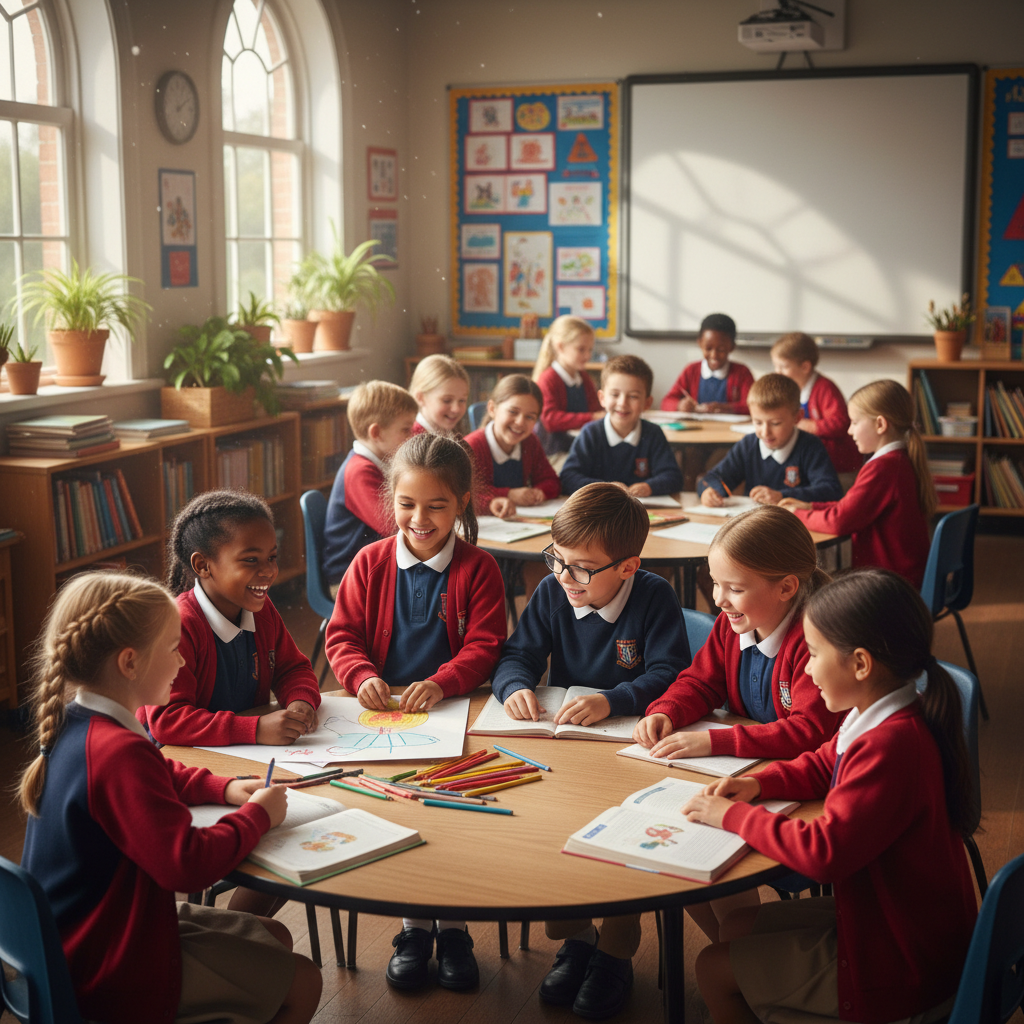
Humans are wired to seek belonging, and children are no exception. Social Identity Theory, developed by psychologists Tajfel and Turner, explains that shared visual markers -- like identical uniforms -- strengthen in-group identification and pro-social behavior. Schools with strong uniform cultures often report higher student engagement and a palpable sense of community pride.
But this benefit carries a tension: belonging through conformity can also suppress individuality, a concern we explore in the next section.
Simplifying Decision Fatigue for Young Minds
Children have limited executive function resources, and mornings are when those resources are most precious. Every clothing decision -- "Which shirt? Which pants? Do they match?" -- consumes cognitive bandwidth that could be directed toward learning, play, or emotional regulation.
For busy families with multiple children, uniforms eliminate a daily friction point. The stress reduction is practical, but it has genuine mental health implications too. Fewer morning conflicts mean calmer transitions to school, which sets a more positive emotional tone for the entire day.
The Psychological Case for Free Clothing Choice
Self-Expression as a Developmental Need
Here is something that often gets lost in the uniform debate: self-expression through clothing is not a luxury for children -- it is a developmental necessity. Psychologist Erik Erikson's stages of development show that children between ages 3 and 12 are navigating "initiative vs guilt" and "industry vs inferiority," both of which depend on building a sense of personal agency.
Clothing is one of the earliest domains where children can assert their identity. Research published in Nature found that children who are given age-appropriate choices develop stronger intrinsic motivation. This is not about vanity or being "fashionable." It is about a child learning to answer the question, "Who am I?" -- one outfit at a time.
Building Decision-Making Skills Through Daily Choices
Every morning outfit selection is a low-stakes decision that exercises planning, forecasting (will it rain?), aesthetic judgment, and self-presentation. According to Self-Determination Theory, autonomy is one of three fundamental psychological needs -- alongside competence and relatedness. Clothing choice directly supports two of these needs.
The practical evidence supports this too. Research on childhood autonomy milestones shows that letting toddlers choose between two outfits builds confidence, while by ages 8-10, most children can manage their wardrobes with minimal guidance. Understanding how kids develop their own style helps parents support this process at every age.
How Free Dress Nurtures Identity in Tweens
Ages 10 to 12 represent a critical window for identity exploration. Clothing becomes a primary tool for "trying on" different identities -- sporty one week, artistic the next, bookish the week after. As AAP's guidance on self-esteem and identity in school-age children notes, suppressing this kind of exploration during a formative period can delay identity consolidation. Free dress gives tweens a safe laboratory for figuring out who they are becoming.
What Does the Research Actually Say? Key Studies Reviewed
Both sides of the school uniform debate cite "the research" -- but what does the evidence actually show? The honest answer: it is more mixed than either camp suggests.
The Ohio State Longitudinal Study
One of the most rigorous investigations to date tracked over 6,300 students from kindergarten through fifth grade. The finding? No significant behavioral improvements were attributable to school uniform policies. This is an important study because of its size and longitudinal design, but it measured behavior specifically -- not broader psychological well-being or sense of belonging.
PMC Meta-Analyses on Uniform Outcomes
Two key analyses published in the National Library of Medicine paint a complicated picture. One review examining uniforms through a public health lens found that some studies report modest positive effects on attendance and discipline, while others find no effect -- or even negative effects on self-esteem. A major challenge is that most studies are cross-sectional, making it difficult to determine whether uniforms cause improvements or merely correlate with other school characteristics.
The Self-Esteem Question
A Rowan University thesis on uniforms and self-esteem concluded that uniforms alone do not significantly boost or harm self-esteem. School culture and teacher-student relationships turned out to be far more powerful predictors. The takeaway? Clothing policy is one variable among many, and its effect is moderated by dozens of contextual factors.
| Study | Sample Size | Key Finding | Limitation |
|---|---|---|---|
| Ohio State Longitudinal | 6,300+ students (K-5) | No significant behavioral improvement from uniforms | Measured behavior only, not well-being |
| PMC Public Health Review | Multiple studies reviewed | Mixed results; modest attendance gains in some studies | Cross-sectional designs limit causal claims |
| Rowan University Thesis | Single-school sample | No significant self-esteem impact from uniforms alone | Small sample, limited generalizability |
| PMC Behavior Link Study | Multiple studies reviewed | Some negative effects on self-esteem reported | Geographic bias (US/UK/Australia) |

Age-by-Age Guide to Clothing Autonomy
Whether your child wears a uniform or free dress, clothing autonomy is a spectrum -- not a switch you flip at a certain age. Here is a developmental roadmap grounded in child psychology.
Toddlers and Preschoolers (Ages 2-5): Guided Choices
- Offer two pre-selected options: "Do you want the red shirt or the blue shirt?"
- This satisfies the child's emerging need for autonomy without overwhelming limited decision-making capacity.
- Lay out options the night before to avoid morning time pressure.
- Developmental basis: at this stage, children think concretely and benefit from constrained choices.
Early Elementary (Ages 6-8): Expanding the Wardrobe Voice
- Children can select from a pre-approved drawer or closet section.
- Introduce weather-appropriateness and occasion-appropriateness as decision factors.
- "Costume-like" choices -- superhero capes, princess accessories -- are developmentally normal and should be gently guided rather than forbidden.
- Growing executive function allows multi-factor decision-making at this age.
Tweens and Pre-Teens (Ages 9-12): Significant Autonomy
- Children at this stage can manage most daily clothing decisions independently.
- Introduce budgeting and wardrobe planning as practical life skills.
- Parents shift from decision-maker to consultant -- available when asked, not imposing.
- This aligns with Erikson's "industry vs inferiority" stage, where feeling competent in personal domains builds self-worth.
For parents looking to simplify choices while still offering variety, pre-coordinated kids outfit sets can serve as a middle ground between full autonomy and structured dressing.
Gender, Body Image, and Inclusive Dress Policies
The Rise of Gender-Neutral Uniform Options
The school uniform conversation is evolving. Increasingly, schools are adopting gender-inclusive policies that allow all students to wear any item from the uniform catalog -- skirts, trousers, or shorts -- regardless of gender. AAP guidance on gender identity development in children suggests this approach reduces gender-based stress and supports children who are exploring gender identity without dress-code friction.
This matters psychologically. When a uniform system forces binary clothing categories, it can become a daily source of discomfort for children whose identity does not fit neatly into those boxes. Gender-neutral options remove that barrier while maintaining the structure that uniform advocates value.
Sensory Needs and Neurodivergent Children
For children with autism, ADHD, or sensory processing differences, the texture, fit, and feel of clothing can profoundly affect concentration, mood, and school performance. Rigid uniform policies mandating specific fabrics or fits can cause genuine daily distress.
Free-dress policies offer more flexibility for sensory needs but can introduce social-comparison anxiety. The best approach is a middle path: schools offering sensory-accommodating uniform options -- tagless labels, soft fabrics, flexible waistbands -- alongside standard pieces.
Body Image Across Both Systems
Uniforms can reduce body-related teasing by standardizing appearance, but ill-fitting uniforms can actually amplify body consciousness. Free dress allows children to wear what feels comfortable, but exposes them to brand and size comparisons. As one analysis of uniforms and body image points out, the dress system itself matters less than how adults model body acceptance and how schools address body-based teasing.
Practical Strategies for Parents: Supporting Your Child in Any Dress System
Encouraging Self-Expression Within Uniform Policies
If your child wears a uniform, self-expression does not have to disappear. Consider these strategies:
- Offer choice within the guidelines: let your child pick their shoe style, sock color, or hair accessories.
- Create a robust after-school and weekend wardrobe where free expression thrives.
- Channel creative energy into non-clothing outlets: art, writing, music, and imaginative play.
- Reframe the uniform positively -- "This is your school team outfit" rather than "You have to wear this."
Turning Free-Dress Mornings Into Confidence Builders
- Avoid criticizing outfit choices unless there is a genuine safety or weather concern.
- Ask open-ended questions: "What made you pick that outfit?" rather than "You're not wearing THAT."
- Set clear, minimal boundaries (weather-appropriate, school-appropriate) and let your child own the rest.
- Celebrate personal style -- acknowledge when your child puts together something that reflects their personality.
Building a versatile school wardrobe with mix-and-match pieces like back to school clothes for kids can reduce morning stress while giving children room to express preferences. For free-dress schools, comfortable and expressive options like girls dresses for school and everyday let children feel confident in their choices.
When Clothing Battles Signal Something Deeper
Most morning outfit disagreements are developmentally normal. But persistent, intense resistance to wearing certain clothes may signal something worth paying attention to:
- Sensory sensitivities (tags, seams, fabrics causing physical distress)
- School anxiety disguised as clothing refusal
- Body image concerns, especially in older children
- Peer conflicts that make certain clothing feel "unsafe"
If clothing conflicts are daily, escalating, and affecting school attendance or family well-being, consider consulting a pediatrician or child psychologist. There is no shame in seeking guidance -- it is simply good parenting.
Conclusion: It Is Not About the Clothes -- It Is About the Child
The school uniform vs free dress psychology debate does not have a winner. Uniforms offer simplicity, equity, and belonging. Free dress offers autonomy, creativity, and identity exploration. Neither system is psychologically superior in absolute terms.
What the research consistently shows is that the dress system itself matters less than the intentionality behind it. How you talk about clothing with your child. How schools implement their policies. How individual needs -- sensory, emotional, developmental -- are accommodated. These factors shape outcomes far more than whether your child wears a polo or a favorite graphic tee.
So focus on what you can control: fostering self-expression in whatever system your family operates within. Whether your child heads to school in a crisp uniform or a wildly creative ensemble, what matters most is that they feel seen, respected, and free to become who they are. At PatPat, we are here to support that journey with clothing that helps every child feel confident, comfortable, and ready to take on the world. Explore our kids collections for versatile, confidence-building options.
Frequently Asked Questions
Do school uniforms affect children's mental health?
Research shows mixed results. Uniforms can reduce social-comparison anxiety and clothing-related bullying, supporting mental well-being. However, overly rigid policies may increase stress for children with sensory sensitivities or strong needs for self-expression. The overall school environment and teacher-student relationships have a stronger impact on mental health than dress code alone.
At what age should kids start choosing their own clothes?
Children can begin making guided clothing choices as early as age 2-3 by selecting between two parent-approved options. By ages 6-8, they can choose from a pre-set section of their wardrobe. Most children are ready for significant clothing autonomy by ages 9-12, with parents serving as consultants rather than decision-makers.
Do school uniforms actually reduce bullying?
Some studies suggest uniforms reduce appearance-based teasing by removing visible markers of socioeconomic status. However, the largest longitudinal study (Ohio State, 6,300+ students) found no significant behavioral improvement from uniforms. Anti-bullying culture, staff training, and peer mediation programs are more effective than dress code policies alone.
Does wearing a uniform limit a child's creativity?
Not necessarily. Creativity extends far beyond clothing. While free dress provides one outlet for creative expression, children in uniform schools develop creativity through art, play, writing, music, and problem-solving. The key is whether the child has sufficient creative outlets overall, not whether one specific outlet is restricted.
What is the psychological effect of letting kids pick their own outfits?
Allowing children to choose their own outfits supports autonomy, builds decision-making skills, and strengthens identity formation. According to Self-Determination Theory, autonomy is a core psychological need. Daily clothing choices give children a low-stakes opportunity to practice independence and develop personal competence.
How do school uniforms affect self-esteem in children?
Research from Rowan University found that uniforms alone do not significantly boost or harm self-esteem. Self-esteem is more strongly influenced by family relationships, peer acceptance, and school culture. Uniforms may help children anxious about clothing comparisons but may frustrate those who draw confidence from personal style.





