


It is 7:15 a.m. and you are already running late. Your toddler is sitting on the floor, one sock half on and one shoe across the room. You wonder: should they be doing more of this on their own? If you have ever searched "what age can kids dress themselves," you are not alone. It is one of the most common developmental questions parents ask, and the answer is more nuanced than a single number.
Here is the short version: most children begin participating in dressing around 18 months by pulling off socks and hats. By age 3-4, many kids can put on simple clothing like pull-on pants and t-shirts. Full dressing independence -- including buttons, zippers, and shoe-tying -- typically develops between ages 6 and 8.
But those ages are just guideposts. Every child moves through self-dressing milestones at their own pace, and the clothing you choose plays a bigger role than most parents realize. In this kids dress themselves age guide, we will walk through exactly what to expect at each age, share proven teaching strategies, and help you find clothes that set your child up for success. Whether you are shopping at PatPat for your toddler's next wardrobe refresh or simply looking for reassurance that your child is on track, this guide has you covered.
Why Self-Dressing Is a Key Developmental Milestone for Children
Getting dressed may look simple, but for a young child, it is one of the most skill-dense activities of the entire day. Self-dressing milestones represent the intersection of physical development, thinking skills, and emotional growth.
Fine Motor and Cognitive Skills Behind Getting Dressed
Think about what it takes to button a shirt. Your child needs a pincer grasp to hold the button, bilateral coordination to use both hands together, and sequencing skills to know which hole the button goes through. According to the American Occupational Therapy Association, dressing requires a combination of fine motor, gross motor, and cognitive skills working together simultaneously.
Pulling a shirt overhead demands motor planning. Stepping into pants requires balance and body awareness. Even deciding which garment goes on first is a cognitive sequencing task. When your child wrestles with a zipper, they are literally building neural pathways.
How Independent Dressing Builds Confidence and Autonomy
The developmental payoff goes beyond motor skills. When a 3-year-old pulls on their own pants, that "I did it myself" moment builds self-efficacy. Research from the American Academy of Pediatrics shows that when children successfully complete tasks independently, they develop competence and a healthy sense of self-esteem. Allowing your child to dress themselves -- even imperfectly, even with mismatched socks -- fosters resilience and personal agency. PatPat explores this further in articles on how clothes affect your child's self-esteem and life skills kids learn through getting dressed.
Dressing Milestones by Age: What to Expect from Toddler to School-Age
So when do kids start dressing themselves? The truth is, it starts earlier than most parents expect -- and it takes longer to fully complete than you might hope. Here is your comprehensive dressing milestones by age chart, followed by detailed breakdowns for each stage.
| Age Range | What They Can Do | Parent Help Needed |
|---|---|---|
| 12-18 months | Pull off socks, hats, loose shoes | Full help dressing |
| 18-24 months | Push arms through sleeves, pull down unfastened pants | Most help dressing |
| 2-3 years | Pull on elastic-waist pants, put on loose t-shirts, remove coat | Help with fasteners |
| 3-4 years | Dress in most clothing, attempt front zippers, put on shoes (wrong feet common) | Help with buttons and back fasteners |
| 4-5 years | Dress fully, manage large buttons and front zippers, put on socks | Help with small buttons and laces |
| 5-6 years | Handle snaps, all buttons, choose weather-appropriate clothing | Minimal help (shoe-tying) |
| 6-8 years | Full independence including tying shoes, selecting outfits | No help needed |
Ages 1-2: Undressing Comes First (And That Is Progress)
If your toddler keeps ripping off their socks the moment you put them on, congratulations -- that is actually a developmental milestone. Undressing is always learned before dressing. According to NIH MedlinePlus, children typically learn to undress before they learn to dress, because pulling things off requires less coordination than putting them on.
At 12-18 months, expect your child to:
- Pull off socks and loose shoes
- Remove a hat
- Push down loose pants (once unfastened)
- Cooperate by lifting arms or stepping into clothing
When your 18-month-old lifts their arms for a shirt, they are actively participating -- and that cooperation is the foundation everything else builds on.
Ages 2-3: Pulling On Simple Clothes and Gaining Momentum
Between ages 2 and 3, your toddler transitions from passive participant to active dresser. What can a 2-year-old put on by themselves? More than you might think:
- Pull elastic-waist pants up and down
- Push arms into sleeves when you hold the shirt
- Put on shoes (often on the wrong feet -- totally normal)
- Pull a loose t-shirt over their head with help getting started
By age 3, the 3-year-old dressing themselves milestones expand further. Most can remove a coat, pull on elastic-waist pants independently, and attempt to put on a shirt alone. This is where clothing design matters most -- toddler elastic waist pants from PatPat eliminate the fastener barrier entirely. The range of "normal" here is wide, so do not worry if your 2-year-old is not interested yet.
Ages 3-4: Managing Most Clothing with Some Help
Should a 3-year-old be able to dress themselves? Not completely, but they should be making real progress. By 3-4, most children can:
- Dress and undress for bathroom trips (pulling pants up and down)
- Manage front zippers when given a starter tab
- Put on shoes (still may confuse left and right)
- Pull on most clothing items independently
Buttons and back fasteners still need your help. Here is a key detail: most preschool programs expect children to manage toileting clothing on their own. Practicing pants-up-pants-down is one of the most practical things you can do before preschool starts.
Ages 4-5: Dressing Independently with Practice
By 4-5, your child should handle daily dressing with only occasional help -- large front buttons, zippers, distinguishing front from back, and putting socks on correctly. The NIH MedlinePlus preschool development guide notes that fine motor milestones around age 4 include putting on clothes properly and managing large buttons.
Is it normal for a 5-year-old to not dress themselves completely? Yes -- small buttons, back closures, and shoe-tying are still developing at this age. If your child handles the basics but needs help with tricky fasteners, that is squarely within normal range.
Ages 5-8: Full Independence Including Shoe-Tying
Between ages 5 and 6, children master snaps, all button sizes, and begin choosing their own outfits. The final frontier? Shoe-tying -- most children learn between ages 6 and 7, though some do not fully master it until 8. The CDC milestone tracker lists the ability to dress and undress independently as a recognized marker for this age range.
By 7-8, your child should handle all dressing tasks independently. This is also when kids develop strong style preferences -- PatPat's guide on how kids develop their own style is worth reading at this stage.
What Clothing Items Are Easiest for Kids to Put On by Themselves?
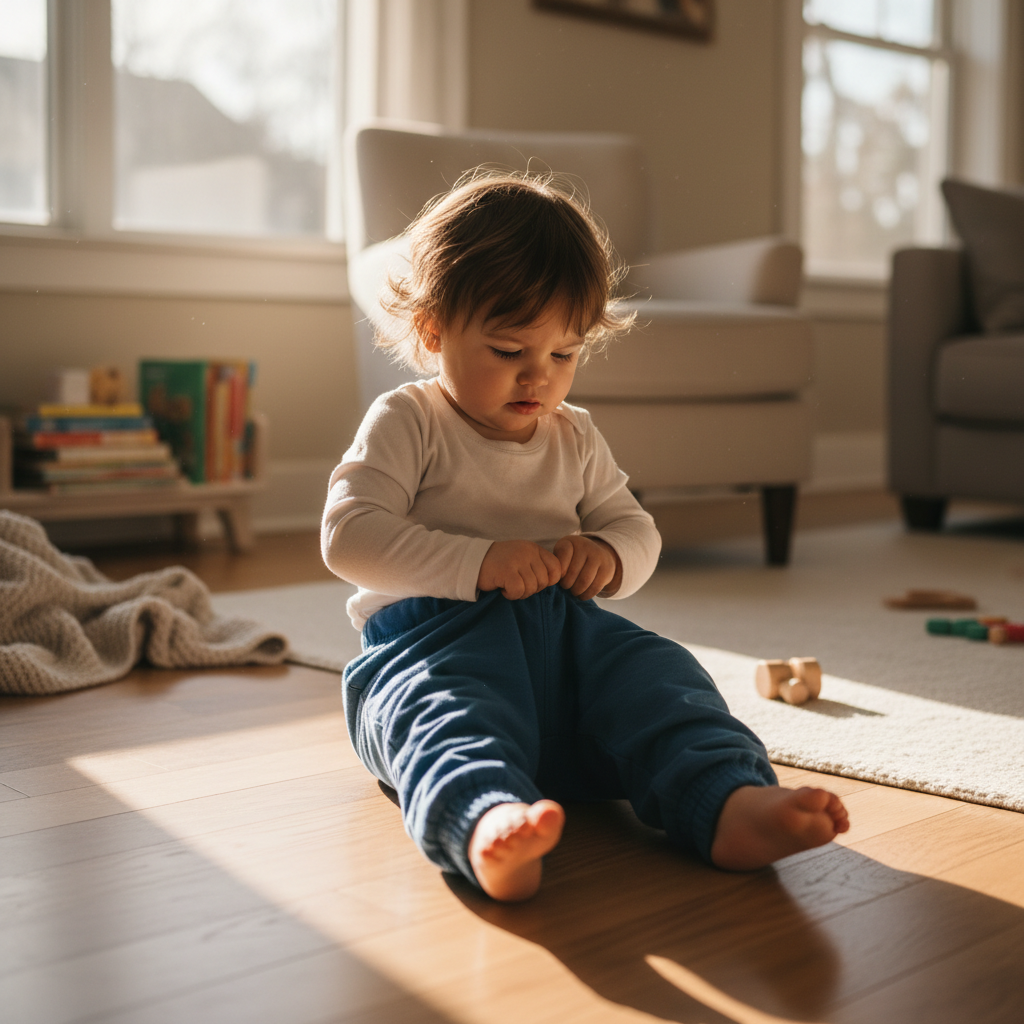
Here is a counterintuitive truth: the clothes themselves can be a bigger factor than your child's skill level. A 3-year-old who struggles with button-fly jeans might do perfectly fine with elastic-waist pants. The right clothing removes barriers and lets your child practice skills they already have.
Pull-On Pants with Elastic Waistbands for Toddlers
Elastic waistbands eliminate every fine motor challenge -- no buttons, no zippers, no snaps. Your child only needs the gross motor skill of pulling up, which develops much earlier than fastener skills. Look for soft, stretchy cotton blends with a wide elastic waistband. PatPat's toddler elastic waist pants are designed exactly this way.
Velcro Shoes and Slip-Ons That Kids Can Manage Alone
Since shoe-tying is the very last dressing skill to develop (typically age 6-7), your child's footwear independence depends on shoe design for years. Velcro closures require a simple press-and-stick motion most 3-year-olds can handle, while slip-ons remove even that step. PatPat offers easy velcro shoes for kids that bridge the gap before lace-tying develops.
Loose T-Shirts, Wide-Neck Tops, and Pull-Over Layers
Tops with wide neck openings, no buttons, and stretchy fabric let kids pull them on overhead without frustration. Button-up shirts require fine motor skills most children lack until age 5+. Pullover tees, raglan sleeves, and wide-neck designs are your best bet. Browse PatPat's toddler and kids pullover tops for easy-dressing styles.
How to Teach Your Child to Dress Themselves Step by Step
The right clothes are half the equation. The other half is teaching strategy. Occupational therapists have developed proven methods for teaching kids to dress themselves -- none involving nagging or power struggles. For more ideas, see PatPat's tips for teaching toddlers to dress themselves.
Backward Chaining: Let Your Child Finish What You Start
Backward chaining is the gold-standard technique recommended by occupational therapists. Here is how it works: you complete most of the dressing task, and your child does only the last step. Once they master that step, you add the second-to-last step, and so on.
Practical examples:
- Pants: Pull pants up to your child's thighs, then let them pull them up the rest of the way
- Shirts: Guide the shirt over their head and through both arms, then let them tug it down over their belly
- Jackets: Start the zipper for them, then let them pull it up
This works because your child experiences success immediately. That "I finished it!" feeling motivates them to try again tomorrow. Over weeks, you gradually hand over more steps until they handle the entire task solo.
Building a Dressing Routine That Encourages Independence
Consistency beats instruction every time. Here are the environmental and routine changes that make the biggest difference:
- Lay out clothes the night before -- reduces morning decision fatigue
- Offer two choices, not ten -- "Do you want the blue shirt or the red shirt?" preserves autonomy without overwhelm
- Build in buffer time -- a child learning to dress needs 10-15 extra minutes that most morning routines do not have
- Use a visual schedule -- a simple picture chart showing underwear, then pants, then shirt, then socks, then shoes helps with sequencing
- Praise the effort, not just the result -- "You worked so hard pulling that shirt on!" matters more than "You did it right!"
The Montessori Approach to Independent Dressing
The Montessori philosophy centers on the "prepared environment" -- making the physical space support your child's independence. Key principles:
- A child-height wardrobe or low drawer so they can access their own clothes
- Limited clothing options to prevent overwhelm
- Child-led selection (yes, even if the outfit does not match)
- No rushing or correcting -- the process matters more than the result
One Montessori parent shared that switching to a low bookshelf with two bins -- tops and bottoms -- cut morning dressing from 20 minutes of struggle to 8 minutes of independence within two weeks.
Clothing Features That Make Self-Dressing Easier for Every Age
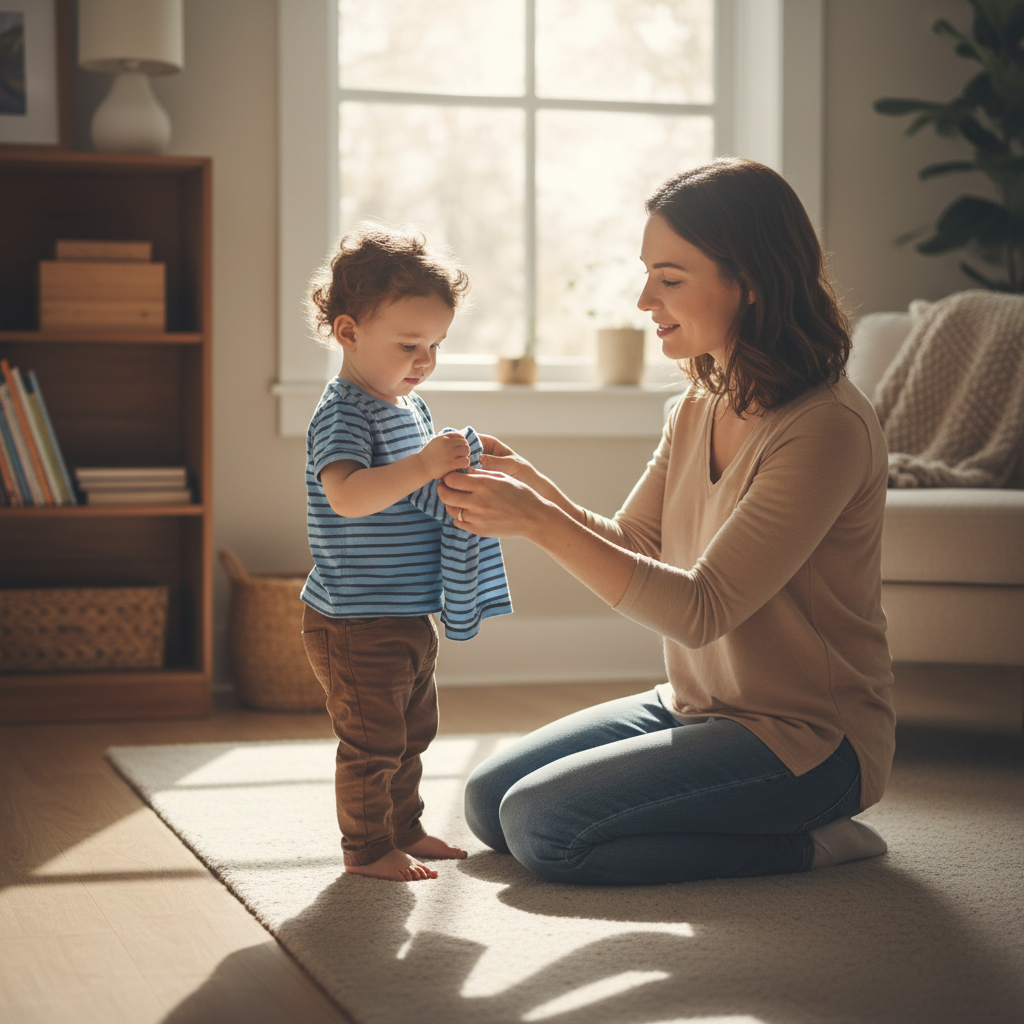
Certain design features make any piece of clothing easier for kids to manage. Knowing what to look for helps you support your child's independence regardless of brand or style.
Elastic Waists, Magnetic Closures, and Other Easy Fasteners
Not all fasteners are created equal. Here is how they rank from easiest to hardest for developing hands:
| Fastener Type | Difficulty Level | Typical Age to Manage |
|---|---|---|
| No fastener (elastic, pull-on) | Easiest | 2-3 years |
| Velcro | Easy | 2.5-3 years |
| Large snaps | Moderate | 3-4 years |
| Front zippers | Moderate | 3.5-4.5 years |
| Large buttons | Challenging | 4-5 years |
| Small buttons | Hard | 5-6 years |
| Hooks and back zippers | Hard | 6-7 years |
| Shoelaces (tying) | Hardest | 6-8 years |
Magnetic closures are worth knowing about too. Originally designed as adaptive clothing, magnetic buttons and snaps now appear in mainstream children's clothing -- they look like regular fasteners but close with a simple press. The key takeaway: match fastener difficulty to your child's current skill level. PatPat's toddler jackets and coats with zippers let preschoolers manage outerwear well before they can handle buttons.
Choosing Fabrics and Fits That Support Independent Dressing
Fabric and fit matter just as much as fasteners. Here is what to look for:
- Stretchy blends (cotton-spandex) are easier than rigid fabrics because small hands can grip and pull them
- Loose fits are easier than slim fits, giving more room for imperfect arm-threading and leg-stepping
- Tagless designs reduce sensory irritation that can derail the entire dressing process
- Soft waistbands prevent the discomfort that makes kids resist putting on pants
These features benefit all young children, not just those with sensory processing differences. PatPat's toddler outfit sets pair coordinated tops and bottoms with soft, stretchy fabrics ideal for independent dressing.
What to Do When Your Child Struggles or Refuses to Get Dressed
Even children who have the skills sometimes refuse to use them. If your child resists getting dressed, take a breath -- morning dressing battles are extremely normal and usually temporary.
Morning Dressing Battles: Why They Happen and How to Solve Them
When a 4-year-old refuses to dress themselves, it rarely means they cannot. The root causes usually fall into a few categories:
- Power struggles -- your child wants control over their body and choices
- Sensory overwhelm -- the clothing feels wrong (itchy tags, tight waistbands, rough seams)
- Time pressure -- they sense your stress and shut down
- Choice overload -- too many options creates decision paralysis
- Genuine skill difficulty -- the clothing is harder than their current abilities
Practical solutions that work:
- Offer exactly two outfit options to preserve autonomy without overwhelm
- Build in 10-15 minutes of buffer time so dressing does not feel rushed
- Use a visual timer to make the time boundary concrete and less emotional
- Turn dressing into a game -- "Can you get your pants on before I count to ten?"
- Keep emotional stakes low -- if they end up at daycare in pajamas once, the world does not end
One parent on a popular forum shared: "We put out two acceptable outfits the night before. Whichever one she picks, she wears. Mornings went from 25 minutes of crying to 7 minutes of calm." Sometimes the simplest systems work best. PatPat's kids clothes collection offers easy-to-wear options that reduce friction during tough mornings.
When Sensory Issues or Motor Delays Affect Getting Dressed
Sometimes dressing struggles point to something beyond normal resistance. Consider talking to your pediatrician or an occupational therapist if you notice:
- Persistent difficulty with tasks that are age-appropriate based on the milestone chart above
- Avoidance of specific textures, tags, or fabric types that seems extreme
- Frustration disproportionate to the difficulty of the task
- Significantly lagging behind the milestone ranges across multiple skills
The CDC's "Learn the Signs. Act Early." program offers free milestone checklists, and the American Occupational Therapy Association can help you find a pediatric OT. Remember: most children fall within a wide range of normal, and early support, when needed, is incredibly effective.
Seasonal Dressing Tips for Kids Who Are Learning Independence
The season changes the difficulty level of self-dressing. Here is how to help in every season.
Summer: Easy Outfits Kids Can Handle on Their Own
Summer is the easiest season for self-dressing practice. Stick with:
- Pullover t-shirts and tank tops
- Elastic-waist shorts
- Slip-on sandals or Velcro sneakers
- Simple one-piece swimsuits over two-piece sets
Summer is the ideal time to build confidence before cold-weather layers add complexity.
Cold-Weather Layers, Zippers, and Boots Made Simple
Winter is the hardest season for self-dressing. These strategies help:
- Teach the "flip trick" for coats -- lay the coat on the floor face-up with the hood toward the child, have them slide their arms in, then flip it over their head. Many preschool teachers use this method successfully.
- Choose boots with wide openings and pull tabs -- narrow boot shafts are the enemy of independence
- Use mittens instead of gloves for children under 5 -- individual finger placement is too advanced for most preschoolers
- Opt for zipper jackets over pullovers -- even if your child needs help starting the zipper, they can pull it up themselves
Back-to-school season is another key moment. When choosing preschool clothes easy for kids to manage, prioritize elastic waists, pullover tops, and Velcro shoes so your child can handle bathroom trips and recess gear on their own.
FAQs: Kids Dressing Themselves by Age
Answers to the most common questions parents ask about self-dressing milestones.
What age should a child be able to dress themselves completely?
Most children can dress themselves in simple clothing -- pull-on pants, t-shirts -- by age 3-4 with minimal help. Full dressing independence, including all fasteners and shoe-tying, typically develops between ages 6 and 8. Every child develops at their own pace, so a range of 1-2 years in either direction is normal.
Is it normal for a 5-year-old to still need help getting dressed?
Yes. It is within the normal range for a 5-year-old to need occasional help, especially with small buttons, back zippers, and shoe-tying. Most 5-year-olds can handle the majority of dressing tasks independently. If your child struggles with all dressing tasks, consider consulting a pediatrician or occupational therapist.
Should a 3-year-old be able to dress themselves for preschool?
A 3-year-old should be able to pull on elastic-waist pants, put on a loose shirt, and remove their coat. They will still need help with buttons, zippers, and getting shoes on the correct feet. Most preschools expect children to manage toileting clothing -- pulling pants up and down -- independently.
What is backward chaining and how does it help with dressing?
Backward chaining is a teaching method where the parent completes most of a dressing task and the child finishes the last step. For example, pull a shirt over the child's head and arms, then let them tug it down. Gradually add earlier steps until the child can do the entire task alone. It works because it gives the child an immediate sense of accomplishment.
What clothes are easiest for toddlers to put on by themselves?
The easiest clothes are pull-on pants with elastic waistbands, loose t-shirts with wide neck openings, Velcro-closure shoes, and zipper jackets rather than button coats. Avoid small buttons, snaps, and laces for children under 4. Stretchy, soft fabrics also make it easier for small hands to grip and pull.
When can kids tie their own shoes?
Most children learn to tie their shoes between ages 6 and 7, though some do not master it until age 8. Shoe-tying requires advanced fine motor skills, bilateral hand coordination, and the ability to follow a multi-step sequence. In the meantime, Velcro shoes and slip-ons provide footwear independence without the frustration.
When should I stop helping my child get dressed?
There is no single cutoff age. Gradually reduce your help as your child masters each skill. By age 4-5, most children can handle daily dressing with only occasional assistance. By age 6-8, they should be fully independent. Focus on stepping back one task at a time rather than withdrawing all help at once.
How long should it take a child to get dressed in the morning?
A preschooler (ages 3-5) learning to dress independently may take 10-15 minutes. A school-age child (ages 6-8) who is fully independent typically takes 5-10 minutes. If dressing consistently takes longer than 20 minutes with significant frustration, consider whether the clothing is too complex or whether a skill gap needs attention.
Setting Your Child Up for Dressing Success
Learning to get dressed is one of those quiet milestones that does not get a cake or a photo op, but it matters deeply. When your child pulls on their own pants or ties their own shoes for the first time, they are building fine motor skills, confidence, and independence they will carry into every challenge ahead.
Every child moves through self-dressing milestones at their own pace. Some 3-year-olds dress head-to-toe while others still need help at 5 -- and both are okay. Your job is to provide patience, proven strategies like backward chaining, and clothing that works with your child's abilities rather than against them.
At PatPat, we design children's clothing with growing independence in mind -- elastic waistbands, pull-on designs, stretchy fabrics, and kid-friendly closures that let little ones take the lead. Explore our collections to find clothes that make self-dressing easier and your child prouder of what they can do all by themselves.





