


Scrolling through parenting forums at 2 AM, you have probably seen the heated debates: BLW vs purees. One camp insists finger foods from day one will raise an adventurous eater. The other warns you are risking choking. Neither side mentions the third option most families actually use -- the combination approach.
Here is the truth: choosing between baby led weaning vs spoon feeding feels like a test with a single correct answer. Social media amplifies the pressure. Family members share strong opinions. And you just want to do what is best for your baby. We get it. At PatPat, we believe that informed, confident parents make the best feeding decisions -- and that starts with evidence, not influencer anecdotes.
This comparison draws from the BLISS randomized controlled trial published in Pediatrics, systematic reviews from peer-reviewed journals, and expert feeding therapist guidance. You will find clear definitions of both methods, an honest side-by-side comparison table, what published research says about safety and nutrition, and a detailed guide to combination weaning -- the approach approximately 80% of parents naturally adopt. No judgment. Just facts and practical advice for starting solids with confidence.
What Is Baby-Led Weaning and How Does It Work?
Core Principles of the Baby-Led Approach to Solids
Baby-led weaning (BLW) is a method of introducing solid foods in which your baby feeds themselves soft, whole finger foods from approximately 6 months of age. There are no purees and no spoon-feeding by the parent. The concept was coined by UK health visitor Gill Rapley in the early 2000s, who observed that babies developmentally ready to sit upright and grasp food could bypass purees entirely.
The core principles are straightforward:
- Baby-led autonomy: Your baby decides what to eat, how much, and at what pace
- Finger food format: Food is offered in soft, graspable shapes that baby picks up and brings to their mouth
- Family meal participation: Baby sits at the table and eats modified versions of what everyone else is eating
- No separate preparation: You do not need to blend, strain, or purchase special baby food
An important evolution of BLW is the BLISS method (Baby-Led Introduction to Solids). This research-backed modification adds three guidelines: offer an iron-rich food at every meal, offer an energy-dense food at every meal, and avoid high-choking-risk foods. The BLISS randomized controlled trial demonstrated that this modification addressed concerns about iron intake and choking risk effectively.
While BLW has become mainstream through social media and apps like Solid Starts, strict BLW (no purees at all) is practiced by a minority of parents. Most families blend approaches -- which brings us to the second method.
What Is Traditional Weaning with Purees and Spoon-Feeding?
Texture Stages and the Gradual Progression from Smooth to Solid
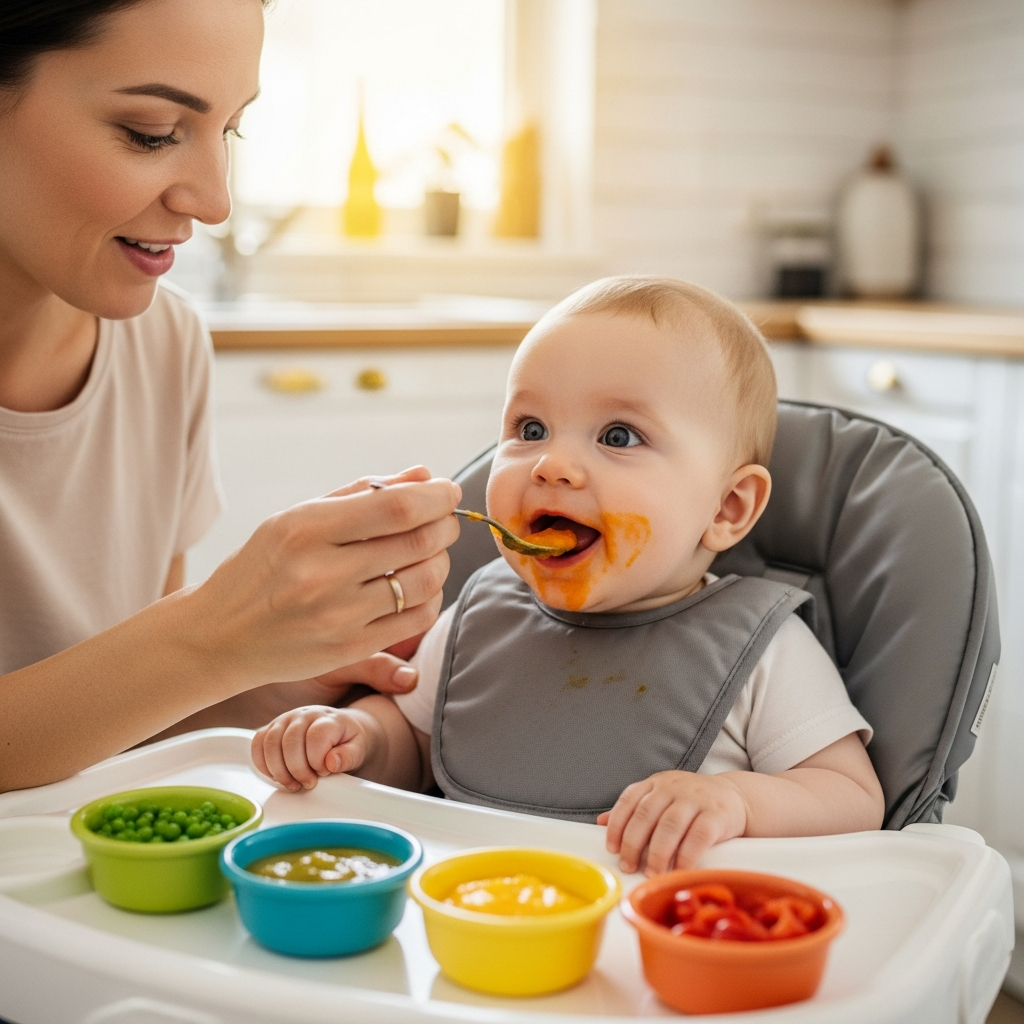
Traditional weaning (also called conventional or parent-led weaning) involves you spoon-feeding your baby smooth purees starting around 4 to 6 months, then gradually progressing through increasingly textured foods. Think of it as a texture staircase:
| Stage | Age Range | Texture | Examples |
|---|---|---|---|
| Stage 1 | 4-6 months | Thin, smooth single-ingredient purees | Sweet potato puree, apple puree, rice cereal |
| Stage 2 | 7-8 months | Thicker purees with soft lumps | Chicken and vegetable blend, banana oat puree |
| Stage 3 | 9-10 months | Chunkier mashed foods with small soft pieces | Mashed beans, minced meat, soft pasta |
| Table foods | 11-12+ months | Soft family foods, self-feeding with fingers and utensils | Modified family meals |
Spoon-feeding purees has been the standard recommendation globally for decades. Fortified infant cereals, introduced in the mid-20th century, became a cornerstone of this approach because they provided reliable iron supplementation at a time when iron deficiency in infants was a significant concern.
An important reframing: "traditional" does not mean outdated or inferior. This method is what most pediatricians worldwide still reference. Responsive spoon-feeding -- following your baby's hunger and fullness cues rather than forcing the spoon -- is considered safe and effective by every major pediatric organization including the WHO.
BLW vs. Purees Side-by-Side: Pros, Cons, and Key Differences
Complete Comparison Table -- Every Factor Parents Want to Know
Rather than scattering pros and cons across separate sections, here is the definitive at-a-glance comparison of baby led weaning vs purees pros and cons. This table covers every factor parents ask about when deciding between starting solids with purees or finger foods.
| Factor | Baby-Led Weaning (BLW) | Traditional Purees / Spoon-Feeding |
|---|---|---|
| Starting Age | Around 6 months (all readiness signs present) | 4-6 months (pediatrician guided) |
| Who Controls Feeding | Baby self-feeds entirely | Parent spoon-feeds; baby receives |
| Texture Exposure | Varied textures from the first meal | Gradual progression: smooth to lumpy to solid |
| Motor Skills | Develops hand-eye coordination and pincer grasp early | Develops oral motor skills through spoon acceptance |
| Mess Level | High -- food on floor, walls, and baby | Lower -- spoon-feeding is more contained |
| Food Waste | Higher initially -- more exploration than eating | Lower -- parent controls portions |
| Convenience | No separate prep; more cleanup time | Requires blending or purchasing; feeding is faster |
| Cost | Lower -- uses regular family food | Moderate to higher -- equipment or pouches add up |
| Daycare Compatibility | May require adaptation; not all daycares accommodate | Easily accommodated at most daycares |
| Family Meal Integration | Baby eats what the family eats (modified) | Baby often eats separately from family meals |
| Choking Risk | No increased risk when safety guidelines followed (BLISS trial) | Similar risk level; gagging occurs during texture transitions |
| Picky Eating Outcomes | May modestly reduce food fussiness (very small effect) | No significant long-term difference |
| Nutritional Adequacy | Adequate with iron-rich food focus; harder to track intake | Easier to monitor; fortified cereals provide reliable iron |
| Parental Anxiety | Higher initially (gagging concerns); decreases with experience | Lower initially; may increase during texture transitions |
What the Comparison Reveals -- Neither Method Is Superior
The table shows trade-offs, not a winner. BLW offers advantages in motor skill development, family meal integration, and cost. Traditional weaning offers advantages in intake monitoring, lower mess, and daycare compatibility.
A Nutrition Reviews systematic review examining infant growth, choking risk, and iron status concluded that current evidence does not support the claim that either BLW or traditional spoon-feeding is significantly superior. Choking incidents and hemoglobin levels appeared comparable across approaches.
The practical truth? The "best" method depends on your family's circumstances. This is exactly why approximately 80% of parents end up combining both methods -- and why the next sections explore safety, nutrition, and the combination approach in detail.
Safety Comparison: Is There More Choking with BLW or Purees?
What Published Research Says About Choking Frequency
This is the question that keeps parents up at night. Here is the answer: research does not show an increased choking risk with baby-led weaning compared to traditional spoon-feeding when appropriate safety guidelines are followed. Three key studies support this:
- BLISS Randomized Controlled Trial (2016, Pediatrics): Among 206 infants, 35% choked at least once between 6 and 8 months -- but there were no significant group differences in choking events between BLW and spoon-fed groups.
- Fangupo et al. (2016): The same research team confirmed that while gagging was more frequent in BLW babies (especially early on), actual choking episodes did not differ significantly between groups.
- Nutrition Reviews Systematic Review: The most recent comprehensive analysis found that choking risk was comparable across BLW and traditional feeding approaches when food is prepared safely.
Important nuance: Unmodified BLW (without BLISS safety guidelines) may carry slightly higher risk if parents offer inappropriate food shapes or high-risk items. The BLISS modification specifically addresses this concern.
Gagging vs. Choking -- How to Tell the Difference
Gagging is normal and protective with both methods. It is the body's way of moving food away from the airway before it becomes a hazard. Here is how to tell the difference:
| Gagging (Normal) | Choking (Emergency) |
|---|---|
| Loud retching sounds | Silent -- no sound |
| Watery eyes, face turns red | Lips or skin turning blue |
| Tongue pushes food forward | Inability to cry or cough |
| Baby resolves it on their own | Requires immediate first aid |
Remember this: "Loud and red, let them go ahead. Silent and blue, they need help from you."
Universal safety practices regardless of method:
- Always supervise meals -- never leave baby unattended with food
- Baby must be seated upright in a high chair (not reclined)
- Avoid high-risk foods: whole grapes, whole nuts, popcorn, raw carrot sticks, hot dog rounds
- All parents should take an infant CPR course before starting solids
- Apply the squish test: if you can mash a food between two fingers, baby can handle it

Nutrition and Development: How Each Feeding Method Affects Growth
Iron, Calories, and Weight Gain -- What the Studies Found
The primary nutritional concern with BLW is iron. Fortified infant cereals -- a staple of traditional weaning -- provide a reliable, measured dose. In unmodified BLW, babies may consume less iron because they eat smaller quantities initially. However, the BLISS trial demonstrated that when parents were counseled to offer iron-rich foods at every meal, BLW infants had iron intake comparable to spoon-fed infants with no significant differences.
On caloric intake, studies show no clinically significant difference between methods. BLW babies may eat less at individual meals early on (more food ends up on the floor), but they compensate through breastmilk or formula throughout the day. The BLISS trial and subsequent systematic reviews found no significant difference in BMI, weight-for-age, or growth trajectories at 12 or 24 months.
Key recommendation regardless of method: Offer iron-rich foods at every meal, pair them with vitamin C sources for enhanced absorption, and continue breastmilk or formula as the primary nutrition source through at least 12 months.
Motor Skills, Picky Eating, and Long-Term Eating Behaviors
BLW babies develop fine motor skills -- particularly the palmar grasp and pincer grasp -- earlier because they manipulate food from the start. Traditional weaning develops oral motor skills through spoon acceptance and texture management. Both skill sets are important and are eventually acquired regardless of method.
On picky eating, here is the honest assessment:
- The BLISS trial found BLW babies showed slightly less food fussiness at 12 months, but researchers described the difference as "very small"
- A systematic review noted that BLW may reduce picky eating tendencies, but the evidence is not strong enough to recommend BLW over traditional weaning for this reason alone
- Parental pressure, variety of foods offered, and overall mealtime environment are larger predictors of picky eating than the specific weaning method
BLW may support appetite self-regulation because baby controls their own intake. But responsive spoon-feeding -- where you follow baby's cues and never force extra bites -- achieves similar outcomes. This is the responsive feeding principle in action: what matters most is the responsiveness of the parent, not whether food arrives via spoon or baby's own hand.
The Combination Weaning Approach: Why Most Parents Choose Both Methods
What Is Combination Weaning and Why Do 80% of Parents Use It?
Combination weaning (also called mixed weaning or hybrid weaning) involves offering both soft finger foods for self-feeding and purees via spoon during the same meals or across different meals throughout the day. It is the approach the binary online debate almost never mentions -- yet it is what the vast majority of parents actually do, with surveys showing approximately 80% using some blend of both methods.
Here is why combination weaning works so well:
- Nutritional insurance: Purees (especially iron-fortified cereals) ensure baby gets key nutrients while still learning to self-feed
- Motor skill development: Finger foods build fine motor skills alongside spoon-feeding
- Reduced parental anxiety: You can offer purees for nutrition confidence while gradually introducing finger foods
- Daycare flexibility: Purees at daycare during the day, BLW at home during family dinner
- Baby's preference: Some babies gravitate toward finger foods; others prefer the spoon. Combination weaning follows your baby's lead
Feeding therapists and pediatric dietitians from New Ways Nutrition, 101 Before One, and




