


Understanding BLW food shapes is the single most important skill you will learn as a parent starting baby-led weaning. The first time you set a strip of sweet potato in front of your six-month-old, every instinct screams that it is too big. But here is the counterintuitive truth: in baby-led weaning, bigger is actually safer, and the shape you choose matters even more than the specific food. If you have been searching for how to cut food for baby led weaning at every stage, this guide was built for you.
Your baby's ability to pick up and eat food depends entirely on their grasp development. A six-month-old with a palmar grasp needs finger-length strips. A nine-month-old developing a pincer grasp is ready for chickpea-sized pieces. Get the shape wrong, and your baby cannot eat. Get it right, and you unlock confident self-feeding from the first meal. At PatPat, we created this complete baby led weaning food cutting guide covering BLW food sizes by age, safe shapes for common foods, dangerous cuts to avoid, and essential tools for faster food prep.
Why Food Shape and Size Matter More Than You Think in Baby-Led Weaning
The Counterintuitive Science Behind Bigger Food Being Safer
Most parents assume smaller pieces are safer. It feels logical. But for babies under nine months, the opposite is true. A baby's airway is approximately the diameter of a drinking straw. Small, round, or coin-shaped pieces lodge perfectly in that tiny opening.
When food is cut into long strips, only the end protruding above your baby's fist enters the mouth. Your baby controls how much they bite off. But scattered small pieces? Young babies rake multiple pieces into their mouth simultaneously, overstuffing and increasing choking risk. Research from Nationwide Children's Hospital found that more than 12,000 children are treated each year in U.S. emergency departments for food choking injuries, with over 60 percent involving children under five.
How Food Shape Supports Self-Feeding Independence
Food shape also determines whether your baby can actually eat. If food is the wrong shape for your baby's current grasp, they physically cannot pick it up, leading to frustration and food rejection. Matching BLW food shapes to grasp stage empowers your baby to explore at their own pace. Understanding food shapes for BLW by age is important because a properly cut carrot stick is safer than an improperly served banana coin, no matter which food you think is "easier."
Understanding Your Baby's Grasp Development: From Palmar to Pincer
Palmar Grasp (6-8 Months): The Whole-Fist Stage
Your baby wraps their entire hand around food, gripping with four fingers against the palm. Only the portion sticking out above the fist is accessible to the mouth, so food must be long enough that a significant piece extends beyond the closed hand. The rule of thumb: food should be the length of your adult pinky finger and roughly two finger widths wide. According to the Cleveland Clinic, babies at around six months use a raking grasp, bringing fingers toward the palm to pick up objects.
Raking Grasp (7-9 Months): The Messy Transition
Your baby begins using fingers to rake food toward the palm rather than grabbing. Food gets knocked off the tray and crumbled constantly. Continue offering strips, but you can introduce softer foods in shorter, thicker formats like steamed broccoli florets. This stage is short-lived and messy -- completely normal.
Pincer Grasp (9-12+ Months): The Small-Piece Stage
Now your baby picks up food using thumb and forefinger with increasing precision. The Cleveland Clinic notes that babies develop a fully mature pincer grasp around 12 months, though an immature version often appears around nine months. Your baby is now ready for chickpea-sized pieces, shredded meats, and diced soft fruits. Quick readiness test: place a small puff on the tray. If your baby picks it up between thumb and forefinger instead of raking, the pincer grasp has arrived.

How to Cut Food for Baby Led Weaning at 6 to 8 Months (Finger-Length Strips)
The Pinky Finger Rule for First Food Strips
The simplest BLW food sizes guide is the pinky finger rule. Food should be roughly the length and width of your adult pinky finger -- about 2 to 3 inches long and 1 to 2 finger widths wide. When your baby grips the food, at least half must extend above the closed hand. Too short? Baby cannot reach it. Too narrow? Baby crushes it. Solid Starts recommends food be large enough for baby to hold with pieces sticking out above and below the fist.
Best Starting Shapes for the Palmar Grasp Stage
| Shape | Description | Best For | Examples |
|---|---|---|---|
| Strips/Sticks | Long rectangular pieces, pinky finger size | Most fruits and vegetables | Sweet potato sticks, avocado strips, zucchini spears |
| Spears | Tapered pieces with thicker handle end | Naturally tapered produce | Steamed carrot spears, pear wedges, asparagus |
| Wedges | Thick triangular slices | Round or oval fruits | Mango wedges, peach wedges, ripe melon wedges |
| Whole with Handle | Intact food with built-in grip | Foods with stems or peels | Broccoli florets (stem handle), half-peeled banana |
| Large Flat Pieces | Wide, thin pieces baby can palm | Grains and proteins | Toast fingers, omelet strips, pancake strips |
How to Make Slippery Foods Easier for Baby to Grip
Slippery foods like avocado and mango slide right out of tiny hands. Five proven grip-enhancement techniques:
- Use a crinkle cutter: The ridged texture gives tiny fingers traction on avocado, mango, melon, and cucumber.
- Leave partial peel on: Serve banana with the bottom half of peel intact, or avocado with skin on one side for grip.
- Roll in coatings: Dip slippery strips in ground infant cereal, hemp hearts, ground flax, or finely crushed puffs.
- Choose ripe but firm produce: Overripe avocado disintegrates; slightly firm-ripe holds its shape while staying soft.
- Dry the surface: Pat steamed vegetables with a paper towel before serving to reduce slipperiness.
BLW Food Sizes for 9 to 12 Months: Transitioning to Bite-Sized Pieces
Signs Your Baby Is Ready for Smaller Pieces
The transition is not a hard switch. Watch for these readiness signs:
- Baby consistently picks up small items (puffs, cereal Os) between thumb and forefinger.
- Baby is no longer raking multiple pieces into the mouth at once.
- Baby can bite off a piece of a strip and chew it confidently.
- Baby shows frustration with strips and wants more control over bites.
If your baby is still raking with their whole hand past nine months, continue with strips. Grasp development, not age, is the true indicator.
Chickpea-Sized Pieces and Shredded Foods
| Food Category | How to Cut at 9-12 Months | Size Reference |
|---|---|---|
| Soft fruits | Dice into chickpea-sized cubes; smash blueberries; quarter grapes lengthwise | About 1/2 inch cubes |
| Cooked vegetables | Dice into pea-to-chickpea sized pieces | 1/4 to 1/2 inch pieces |
| Meat and poultry | Shred into thin strands or dice very small | Pencil eraser size |
| Cheese | Thin shreds or tiny cubes | Pea-sized cubes |
| Pasta | Small shapes whole (orzo, ditalini, mini shells) | Individual pasta piece |
| Eggs | Diced scrambled or quartered hard-boiled | Chickpea-sized pieces |
Mixing Strips and Small Pieces During the Transition
Most guides skip this: the transition is gradual, not instant. Give strips of familiar foods alongside small pieces of new foods at the same meal. By 11 to 12 months, most meals can be primarily small pieces with occasional strips. You can also introduce a pre-loaded spoon for yogurt and mashed foods alongside finger food pieces.
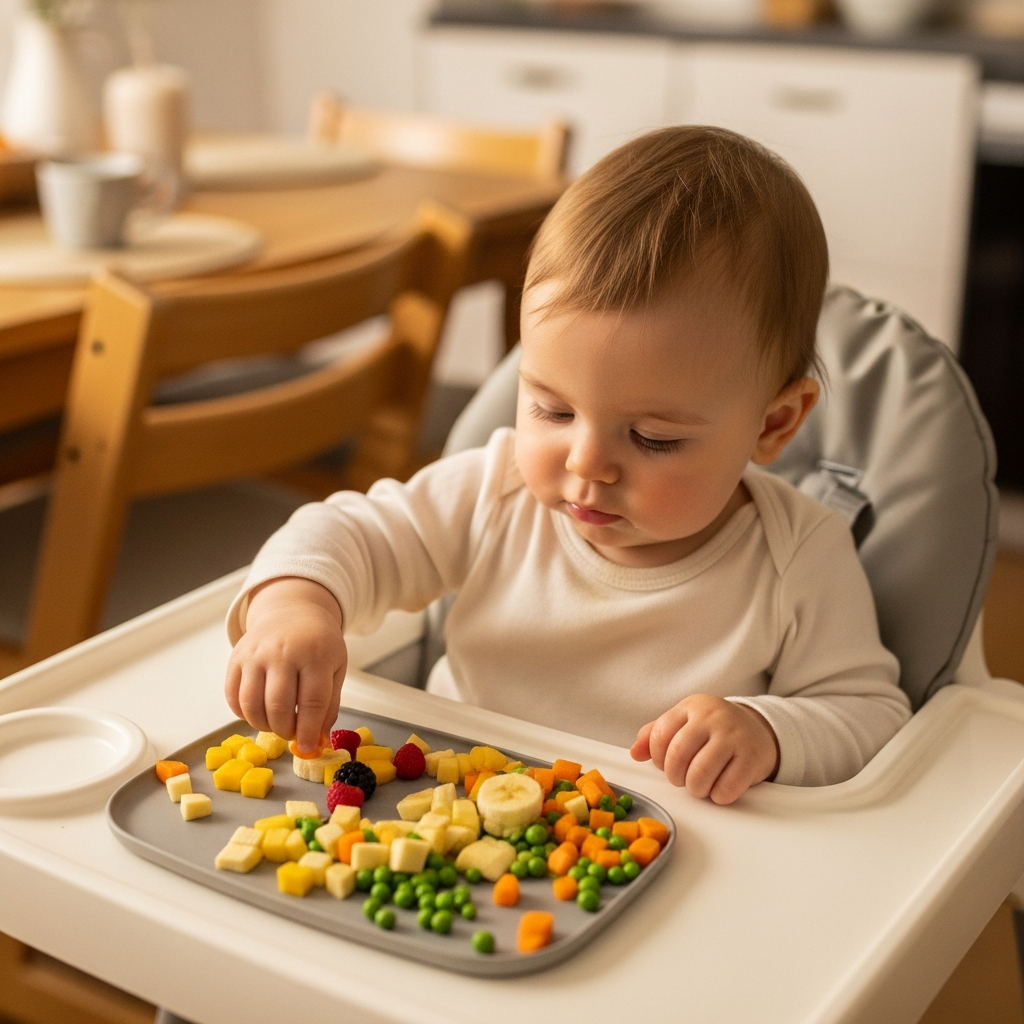
How to Cut Common BLW Foods: Visual Guide by Age
Fruits: Cutting Guide from 6 to 12+ Months
| Fruit | 6-8 Months (Strips) | 9-11 Months (Small Pieces) | 12+ Months |
|---|---|---|---|
| Avocado | Thick wedge strips, leave skin on one side for grip | 1/2 inch cubes or mashed on spoon | Sliced or cubed |
| Banana | Half-peeled with peel handle, or rolled in cereal | Thin coins halved or small chunks | Sliced rounds |
| Strawberry | Whole large berry (stem removed) or halved lengthwise | Quartered or diced | Whole if small, halved if large |
| Blueberry | Smash flat or quarter each berry | Smash or halve each berry | Halved until age 4 |
| Mango | Thick long spears, peeled | Diced 1/2 inch cubes | Sliced or cubed |
| Watermelon | Thick sticks, all seeds removed | Small seedless cubes | Larger triangles |
| Grapes | Too firm; omit or smash flat | Quartered lengthwise (never whole) | Quartered until age 4+ |
| Apple | Steam or roast until very soft, thick wedge | Soft-cooked small cubes | Thin raw slices after molars arrive |
Vegetables: Cutting Guide from 6 to 12+ Months
| Vegetable | 6-8 Months (Strips) | 9-11 Months (Small Pieces) | 12+ Months |
|---|---|---|---|
| Sweet potato | Finger-length sticks, steamed or roasted until fork-tender | Diced 1/2 inch cubes, soft | Cubed or wedge-shaped |
| Broccoli | Whole floret with long stem handle, steamed very soft | Small floret pieces, broken apart | Bite-sized florets |
| Carrot | Steamed until very soft, thick stick (must pass squish test) | Soft-cooked small dice | Cooked sticks (never raw until 4+) |
| Zucchini | Thick spear-shaped strips, lightly steamed | Diced or small half-moons | Sliced rounds or cubed |
| Green beans | Whole steamed bean (natural strip shape) | Halved or short segments | Whole or halved |
| Bell pepper | Roasted until very soft, thick strip (never raw) | Soft-roasted small pieces | Roasted strips or raw thin strips |
| Butternut squash | Thick wedges, roasted until very soft | Diced soft cubes | Cubed, can fork-spear |
Proteins and Grains: Cutting Guide from 6 to 12+ Months
| Food | 6-8 Months (Strips) | 9-11 Months (Small Pieces) | 12+ Months |
|---|---|---|---|
| Chicken | Slow-cooked drumstick on bone or shredded moist strips | Shredded or finely diced | Bite-sized pieces |
| Salmon | Large soft flake, skin removed, bones checked | Smaller flakes or shredded | Flaked or bite-sized |
| Eggs | Omelet strips or scrambled egg strips | Diced scrambled, quartered hard-boiled | Scrambled pieces, halved hard-boiled |
| Tofu | Thick strips, pan-fry lightly for grip | Cubed (1/2 inch) | Cubed, can fork-spear |
| Toast | Finger-width strips with thin toppings | Smaller strips or torn pieces | Larger pieces baby bites from |
| Pasta | Large shapes (rigatoni, fusilli) or flat noodles | Small shapes whole (orzo, ditalini) | Any shape, can practice fork |
| Meatballs | Flattened into oval patties (not round) | Quartered or crumbled | Halved or whole if small and soft |
| Cheese | Thin flat strips (not cubes at this stage) | Very thin shreds or tiny flat pieces | Small cubes when chewing is confident |
Dangerous Food Shapes to Avoid: Safe Food Sizes to Prevent Choking
The Five Most Dangerous Food Shapes for Babies
The CDC emphasizes that food preparation, including cutting into appropriate shapes and sizes, is critical for choking prevention. Here are the five most dangerous shapes and how to fix each one:
- Round shapes (whole grapes, cherry tomatoes, blueberries) -- Plug a baby's airway completely. Fix: Quarter grapes lengthwise. Smash blueberries flat. Cut melon into sticks.
- Coin shapes (carrot coins, banana coins, hot dog rounds) -- Disc shape seals against the airway. Fix: Cut cylindrical foods into strips lengthwise, never rounds.
- Hard, raw chunks (raw apple, raw carrot, whole nuts) -- Cannot be gummed by a baby without molars. Fix: Cook until very soft. Smear nut butters thin on toast. Avoid whole nuts until age 4+.
- Thick globs (spoonfuls of nut butter, sticky rice clumps) -- Adhere to the roof of mouth or throat. Fix: Spread nut butter paper-thin. Form sticky rice into flat patties.
- Stringy or fibrous foods (raw celery, pineapple fibers, cheese strings) -- Wrap around the throat or clump in the airway. Fix: Cook until fibers break down. Shred tough meat.
The Squish Test: Your Most Important Safety Check
Perform this test before every meal. Take the prepared food between your thumb and forefinger. Press gently. If it mashes easily, it is safe for baby. If it resists, cook it longer.
- Common squish test failures: Raw carrot, raw apple, undercooked sweet potato, firm cheese cubes, dry meat.
- Common squish test passes: Ripe avocado, steamed sweet potato, ripe banana, soft-cooked pasta, scrambled egg.
A landmark study published in the journal Pediatrics found that infants following a baby-led approach with guidance on minimizing choking risk do not appear more likely to choke than infants following traditional spoon-feeding. Safe food shapes are a key part of that guidance.
Best BLW Food Cutting Tools and Kitchen Essentials
Essential Tools That Make BLW Food Prep Faster
| Tool | What It Does | Why It Helps | Cost |
|---|---|---|---|
| Crinkle cutter | Creates wavy, ridged edges | Ridges give fingers traction on slippery produce | $5-8 |
| Grape/tomato cutter | Quarters small round foods in one press | Eliminates the most common choking hazard shape | $8-12 |
| Kitchen shears | Cuts cooked meat, pasta, and soft foods on the plate | Faster than a knife, works at the table | $10-15 |
| Egg slicer | Slices hard-boiled eggs into uniform strips | Creates perfect even strips for palmar grasp | $5-8 |
| BLW cutting board with size guide | Printed lines show pinky-length and chickpea-size references | Removes guesswork for new parents | $12-20 |
Do You Actually Need Special Tools?
Honestly, a sharp knife and a vegetable steamer are the only true essentials. The crinkle cutter is the most worthwhile upgrade because ridged texture genuinely helps slippery foods stay in baby's hand. Skip "BLW starter kits" that bundle items you already own. Instead, invest in a high-quality high chair with a footrest -- it has a bigger impact on safe eating posture than any cutting tool.
Common Food Cutting Mistakes That Increase Choking Risk
Eight Mistakes to Stop Making Today
- Cutting too small for babies under 9 months -- Small pieces scatter, and babies rake multiple pieces in at once. Stick with strips until pincer grasp develops.
- Serving raw hard produce -- Raw apple and carrot sticks are among the top choking hazards identified by the AAP. Cook until they pass the squish test.
- Halving grapes instead of quartering -- Halved grapes still plug an airway. Always quarter lengthwise into four pieces.
- Cutting food into coin shapes -- Carrot coins and hot dog rounds are disc-shaped hazards. Cut lengthwise into strips.
- Skipping the squish test -- Never assume food is soft enough. Press between fingers before every serving.
- Serving food too hot -- Babies cannot blow on food. Test on your wrist first.
- Giving dry, tough meat -- Overcooked chicken breast is nearly impossible to chew. Slow-cook, braise, or shred instead.
- Rushing to small pieces too early -- Transitioning before pincer grasp develops leads to overstuffing. Watch for the grasp milestone, not the calendar.
How to Know If You Are Cutting Food the Right Size
Use this four-question mental checklist at every meal:
- Can your baby pick it up without frustration? If they cannot grasp it, adjust the shape.
- Does it pass the squish test? If not, cook it longer.
- Is the exposed portion above the fist a reasonable bite? If the strip disappears into the fist, it is too short.
- Is it a round or coin shape? If yes, re-cut immediately.
When in doubt, offer a slightly larger piece. You can always cut smaller at the next meal.
Frequently Asked Questions About BLW Food Shapes and Cutting
How big should food be for baby led weaning at 6 months?
Cut food into finger-length strips about the size of an adult pinky finger -- roughly 2 to 3 inches long and 1 to 2 finger widths wide. The strip must extend well above your baby's closed fist, since babies at this stage use a palmar grasp and can only eat the protruding part.
When should I switch from strips to small pieces in BLW?
Switch when your baby develops a pincer grasp, typically between 8 and 10 months. Test by placing a puff on the tray. If baby picks it up between thumb and forefinger rather than raking, they are ready for chickpea-sized pieces.
Can my baby eat finger food strips without teeth?
Yes. Baby gums are firm enough to mash soft foods. Molars do not appear until 12 to 18 months, yet babies safely eat soft finger foods from 6 months. As long as food passes the squish test, teeth are not required.
What is the squish test for baby food?
Press prepared food between your thumb and forefinger. If it mashes easily with gentle pressure, it is soft enough for baby. If it resists, cook it longer. This applies to every food at every age.
Why are bigger pieces safer than small pieces for young babies?
Babies aged 6 to 8 months cannot pick up small items individually. They rake multiple pieces into the mouth at once, overstuffing and increasing choking risk. Longer strips let baby control how much they bite off.
Do I need a crinkle cutter for baby led weaning?
Not essential, but the single most useful BLW food prep tool. The ridged edges help slippery foods like avocado and mango stay in baby's hand. It costs about five to eight dollars. Rolling food in ground cereal or leaving partial peel on also improves grip.
How do I cut grapes safely for my baby?
Always quarter grapes lengthwise into four long pieces -- never in half. Whole and halved grapes can block a baby's airway. Continue quartering until your child is at least 4 years old.
My baby just throws the food strips. What should I do?
Food throwing is normal. Babies learn about gravity, texture, and cause-and-effect. Offer only two to three strips at a time. If baby throws everything, they may be full or overtired. Stay calm and offer food again at the next meal.
Your BLW Food Shapes Cheat Sheet
Mastering BLW food shapes comes down to three principles: match the shape to the grasp, perform the squish test, and never serve round or coin-shaped foods. Start with finger-length strips at six months, transition to chickpea-sized pieces when the pincer grasp arrives, and use the tables above as your kitchen reference for how to cut food for baby led weaning.
A study in Pediatrics confirmed that baby-led weaning with proper food preparation does not increase choking risk. When you cut food safely, your baby gains independence and a positive relationship with eating. For a complete overview of when and how to begin solids, see the CDC's guide to introducing solid foods, and the AAP's recommendations on starting solid foods. Before starting BLW, consider taking an infant CPR course through the Red Cross, and always consult your pediatrician with individual concerns.
At PatPat, we support your family through every feeding milestone. Explore our collection of easy-care baby clothing designed for the messy reality of baby-led weaning, and bookmark this BLW food shapes guide for safe, stress-free mealtimes.




