


You want your baby to eat more fruits and vegetables. You also want to encourage self-feeding independence. But here is the frustrating reality: store-bought baby smoothie pouches are often loaded with hidden sugars and train babies to suck rather than practice spoon skills. A recent study found that 71% of baby food products sold in U.S. grocery stores are classified as ultra-processed. That statistic alone is reason enough to start making your own baby smoothie recipes and yogurt bowls at home.
The good news? Homemade smoothie bowls and loaded yogurt bowls solve both problems at once. They deliver concentrated nutrition with no added sugar while giving your little one the perfect thick texture for spoon practice. This guide from PatPat walks you through 15 easy recipes, dairy introduction timing, hidden vegetable tricks, and a freezer meal prep system that saves you hours every week. Whether you are looking for a smoothie for baby who is just starting solids or a loaded yogurt bowl for baby led weaning, you will find everything you need right here.
When Can Babies Have Smoothies and Yogurt (Age-by-Age Guide)
One of the most common questions new parents ask is when to introduce smoothies and yogurt. The short answer: babies can start thick smoothie bowls at around 6 months, when they show signs of readiness for solid foods like sitting upright with support and showing interest in what you eat.
Dairy introduction follows a specific timeline. The AAP supports yogurt introduction at 6 months, but whole cow milk as a primary drink should wait until after 12 months. Why the difference? The fermentation process in yogurt breaks down milk proteins, making them easier for young digestive systems to handle. Yogurt also does not interfere with iron absorption the way liquid cow milk can.
Smoothie for 6-Month-Old Babies (First Introduction)
For a first smoothie for baby, keep it ultra-thick -- think applesauce consistency. Use breast milk, formula, or water as the liquid base. Plain, unsweetened, full-fat yogurt is safe to introduce at this age. Start with single-ingredient blends like banana only or avocado only to monitor for allergies. Serve 1-2 tablespoons on a pre-loaded spoon.
Smoothie for 8-9-Month-Old Babies
At this stage, your baby can start holding the spoon with assistance. Increase complexity to 3-4 ingredient combinations and introduce nut butters for allergen exposure. Serve 2-4 tablespoons per bowl. Yogurt bowls with soft mashed fruit toppings and ground seeds work well now.
Smoothie and Yogurt Bowl for 1-Year-Old Toddlers
After 12 months, the full range of dairy options opens up, including whole cow milk in smoothie recipes. Your toddler can use a spoon independently with thick bowls. Expand toppings to finely chopped soft fruit, thin nut butter drizzles, and small seed toppings. Serve 1/4 to 1/3 cup per sitting.
How Much Smoothie Can a Baby Have Per Day
| Age | Consistency | Serving Size | Frequency | Serving Method |
|---|---|---|---|---|
| 6-7 months | Ultra-thick, applesauce texture | 1-2 tbsp | 1-2x per week | Pre-loaded spoon |
| 8-9 months | Thick, slightly spoonable | 2-4 tbsp | 2-3x per week | Baby holds spoon with help |
| 10-12 months | Thick with soft toppings | 3-5 tbsp | 2-3x per week | Self-feeding with spoon |
| 12+ months | Standard bowl consistency | 1/4-1/3 cup | Up to 3x per week | Independent spoon use |
Limiting frequency matters because smoothies should complement, not replace, textured solid foods. Your baby needs chewy finger foods for proper oral motor development alongside these smooth bowls.
Thick Smoothie for Baby Spoon Feeding: Consistency and Self-Feeding Techniques
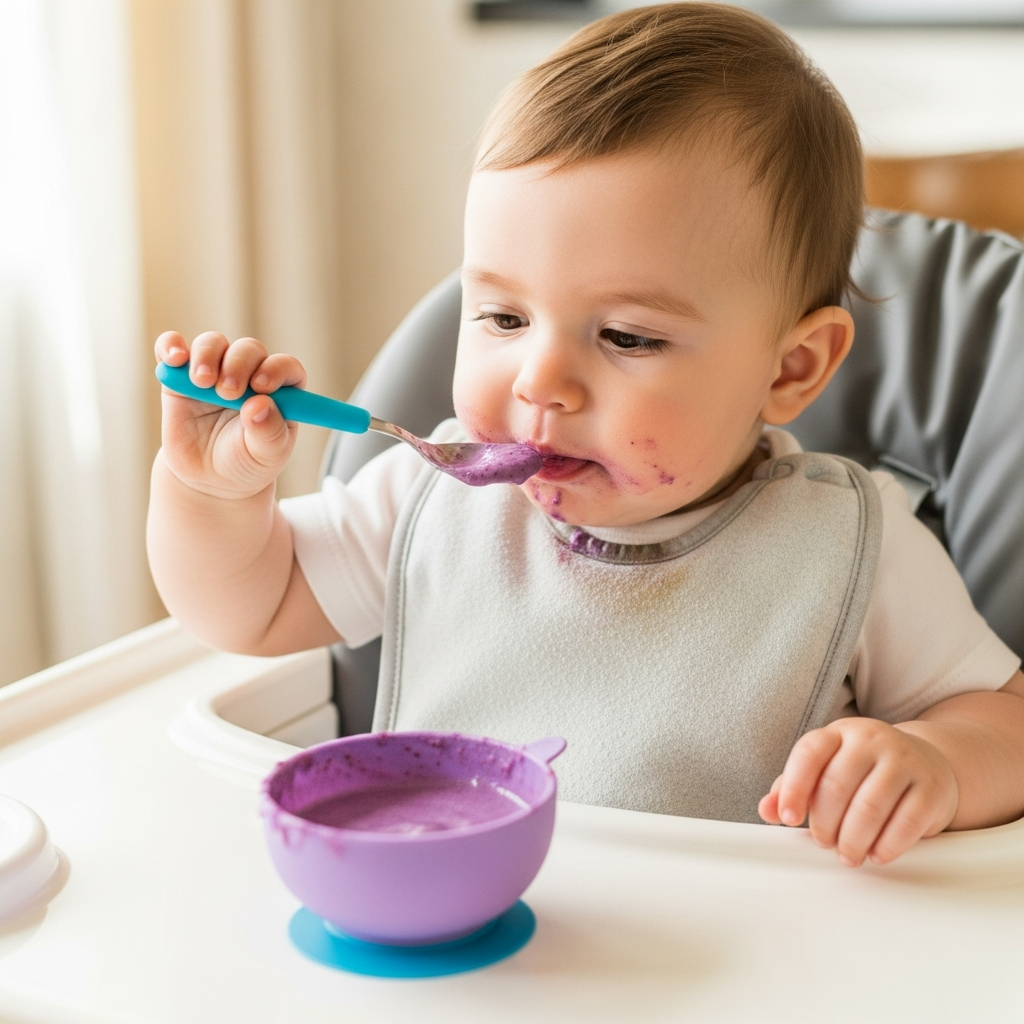
The whole point of serving a smoothie bowl instead of a drinkable smoothie is spoon practice. Thick, spoonable smoothie bowls develop fine motor skills, hand-eye coordination, and wrist rotation in ways that squeezing a pouch never can.
How to Make Smoothie Thick Enough for Baby Bowl
Getting the right consistency is simpler than you think. Here are the key techniques:
- Use frozen banana -- this is your number one natural thickener. One frozen banana per serving creates a creamy, ice-cream-like base.
- Add avocado -- it provides creaminess and healthy fats without dominating the flavor.
- Reduce the liquid -- use only 1-2 tablespoons of liquid per serving. Less liquid means thicker results.
- Use frozen fruit, not fresh -- frozen fruit blends thicker and eliminates the need for ice.
- Try the spoon flip test -- if the smoothie stays on an inverted spoon for 3 seconds, the consistency is right for baby bowl eating.
Pre-Loaded Spoon Technique and Self-Feeding Progression
Self-feeding develops in stages. Here is the progression your baby will follow:
- Stage 1 (6-7 months): You pre-load a flat spoon with thick smoothie and place it on the high chair tray. Baby picks it up and brings it to mouth.
- Stage 2 (8-9 months): Place the yogurt bowl with a spoon in it. Baby begins dipping and scooping with your assistance.
- Stage 3 (10-12 months): Baby scoops independently from a suction bowl. Accuracy improves with practice.
- Stage 4 (12+ months): Independent eating with varied toppings and textures in the bowl.
Use silicone suction bowls to prevent tipping and flat pre-spoons for beginners, progressing to standard baby spoons as coordination improves.
10 Baby Smoothie Recipes No Added Sugar
Every recipe below uses naturally sweet ripe fruit instead of added sugar. Each yields 1-2 baby servings with a 5-minute prep time. Choose breast milk, formula, water, or yogurt as your liquid base depending on your baby's age and dietary needs.
1. Banana Berry Baby Smoothie (Beginner-Friendly Starter)
- Ingredients: 1 frozen ripe banana, 1/4 cup frozen mixed berries, 2 tbsp breast milk or formula
- Why start here: Banana provides natural sweetness and a creamy base; berries add antioxidants and vitamin C
- Nutrition highlight: Rich in potassium and vitamin C for iron absorption
- Age: 6+ months
2. Avocado Blueberry Baby Smoothie (Healthy Fat Boost)
- Ingredients: 1/4 ripe avocado, 1/4 cup frozen blueberries, 1/2 frozen banana, 2 tbsp liquid base
- Nutrition highlight: Avocado delivers brain-building monounsaturated fats; blueberries provide anthocyanin antioxidants
- Age: 6+ months
3. Green Spinach Baby Smoothie (Hidden Vegetable Recipe)
- Ingredients: 1 handful baby spinach, 1 frozen banana, 1/4 cup frozen mango, 2 tbsp liquid base
- Nutrition highlight: Iron-rich recipe. Pair spinach's iron with mango's vitamin C for maximum absorption
- Age: 6+ months
- Tip: Batch-freeze spinach in ice cube trays for quick smoothie additions
4. Strawberry Banana Smoothie for Baby (Classic Combination)
- Ingredients: 1/4 cup frozen strawberries, 1 frozen banana, 2 tbsp yogurt or liquid base
- Nutrition highlight: Strawberries pack more vitamin C per serving than oranges
- Age: 6+ months (introduce strawberries separately first to check for reactions)
5. Peanut Butter Banana Smoothie for Allergen Introduction
- Ingredients: 1 frozen banana, 1/2 tsp smooth peanut butter, 2 tbsp yogurt or liquid base
- Why this matters: The landmark LEAP study demonstrated that early peanut introduction reduced peanut allergy risk by 86.1% in at-risk infants
- Safety: Introduce plain peanut butter mixed with yogurt first in a small amount. Wait 2 hours to observe for reactions before combining in smoothies
- Age: 6+ months (after initial isolated peanut exposure)
6. Carrot Banana Smoothie for Baby (Hidden Veggie Combo)
- Ingredients: 2 tbsp steamed carrot puree, 1 frozen banana, 1/4 cup frozen mango, 2 tbsp liquid base
- Nutrition highlight: Carrots provide beta-carotene, essential for vision and immune development
- Age: 6+ months
7. Mango Peach Baby Smoothie (Tropical Vitamin C Powerhouse)
- Ingredients: 1/4 cup frozen mango, 1/4 cup frozen peach, 1/2 frozen banana, 2 tbsp liquid base
- Nutrition highlight: Highest vitamin C content of all recipes, supporting immune function
- Age: 6+ months
8. Sweet Potato Cinnamon Baby Smoothie (Fall-Inspired Hidden Veggie)
- Ingredients: 2 tbsp cooked sweet potato puree, 1 frozen banana, pinch of cinnamon, 2 tbsp yogurt or liquid base
- Nutrition highlight: Sweet potato delivers beta-carotene and fiber; cinnamon adds warmth without sugar
- Age: 6+ months
- Note: Use true cinnamon (Ceylon), not cassia, which has lower coumarin content and is safer for babies
9. Iron-Rich Spinach and Berry Smoothie (Brain Development Blend)
- Ingredients: 1 handful baby spinach, 1/4 cup frozen blueberries, 1/4 cup frozen strawberries, 1/2 frozen banana, 2 tbsp liquid base
- Nutrition highlight: Maximized iron from spinach paired with dual vitamin C sources for optimal absorption during the critical 6-12 month brain development window
- Age: 6+ months
10. Tropical Baby Smoothie (Mango, Kiwi, and Coconut)
- Ingredients: 1/4 cup frozen mango, 1/4 ripe kiwi (peeled), 1 tbsp coconut cream, 1/2 frozen banana, 2 tbsp liquid base
- Nutrition highlight: Kiwi provides vitamin C and the actinidin enzyme for protein digestion; coconut cream adds MCTs for energy
- Age: 8+ months (kiwi can be mildly acidic -- introduce after initial fruits)
- Dairy-free note: Coconut cream makes this naturally dairy-free
5 Loaded Yogurt Bowl Recipes for Baby Led Weaning
While smoothie bowls start with blended fruit, yogurt bowls use plain yogurt as the base and layer toppings for added texture and nutrition. This format offers a dual developmental benefit: spoon practice plus texture exposure from the toppings. All bowls below start with plain, unsweetened, full-fat yogurt.
1. Classic Fruit and Seed Yogurt Bowl (Everyday Staple)
- Base: 3 tbsp plain, full-fat whole milk yogurt
- Toppings: Mashed banana, mashed blueberries, 1/2 tsp ground flaxseed
- Theme: Balanced everyday nutrition with calcium, probiotics, omega-3, and antioxidants
- Age: 6+ months (mash all toppings); 10+ months (finely dice fruit)
2. Peanut Butter Banana Yogurt Bowl for Allergen Introduction
- Base: 3 tbsp plain, full-fat yogurt
- Toppings: Thin swirl of smooth peanut butter (1/4 tsp to start), mashed banana, sprinkle of ground hemp seeds
- Theme: Early allergen exposure with protein and healthy fats
- Safety: Mix 1/4 teaspoon peanut butter into yogurt for first exposure. Observe for 2 hours before increasing the amount
- Age: 6+ months (after initial isolated peanut introduction)
3. Berry Blast Yogurt Bowl with Hemp Seeds (Antioxidant Powerhouse)
- Base: 3 tbsp plain, full-fat Greek yogurt
- Toppings: Mashed mixed berries, 1/2 tsp hemp seeds, sprinkle of ground chia seeds
- Theme: Antioxidant-rich with plant-based omega-3 and complete protein from hemp
- Age: 6+ months
4. Tropical Mango Coconut Yogurt Bowl (Dairy-Free Option)
- Base: 3 tbsp unsweetened coconut yogurt (for CMPA babies) or full-fat dairy yogurt
- Toppings: Mashed ripe mango, thin coconut cream drizzle, puffed quinoa (10+ months)
- Theme: Dairy-free tropical nutrition with MCTs and vitamin A from mango
- CMPA note: Fully dairy-free when using coconut yogurt base, suitable for babies with cow milk protein allergy
5. Green Smoothie Yogurt Bowl (Hybrid Hidden Veggie Bowl)
- Base: 2 tbsp plain yogurt swirled with 1 tbsp green smoothie puree (spinach, banana, avocado blend)
- Toppings: Mashed avocado, ground flaxseed, mashed soft pear pieces
- Theme: Hidden vegetable bowl with iron, folate, healthy fats, and fiber
- Technique: Blend spinach with banana in advance, freeze in ice cube portions, thaw one cube and swirl into yogurt at serving time

Best Yogurt for Baby: Greek vs Regular and Dairy-Free Alternatives
Choosing the right yogurt for your baby's smoothie bowl or yogurt bowl matters more than you might think. The three non-negotiable criteria: it must be plain (no flavors), unsweetened (no added sugar), and full-fat (whole milk). Why full-fat? Young children need fat to comprise roughly 50% of their total caloric intake to support healthy brain myelination, making full-fat dairy essential during the first two years.
Greek Yogurt vs Regular Yogurt for Baby
| Feature | Greek Yogurt | Regular Whole Milk Yogurt |
|---|---|---|
| Protein per cup | 12-18g | 5-9g |
| Consistency | Very thick, tangy | Smooth, mild |
| Best for baby age | 8+ months (tangier flavor) | 6+ months (mild introduction) |
| Calcium | Moderate (straining removes some) | High |
| Best use | Protein-dense bowls, thick base | Mild first introduction, mixing with purees |
Both are excellent choices. Greek yogurt works best for protein-dense baby yogurt bowls, while regular yogurt is ideal for younger babies who prefer a milder flavor.
Best Dairy-Free Yogurt for Babies with CMPA
Cow milk protein allergy affects 2-3% of infants under one year, and most outgrow it by age 3. If your baby has CMPA, here are the best dairy-free alternatives for smoothie bowls:
- Coconut yogurt: Naturally creamy with mild flavor and MCTs, but lower in protein (1-2g per serving). Must be unsweetened.
- Soy yogurt: Highest plant-based protein (6-8g per serving) with complete amino acids, but soy is a top allergen -- introduce carefully.
- Oat yogurt: Mild and slightly sweet with good fiber, but lowest in protein (1-3g per serving).
All plant-based yogurts lack the vitamin B12 and calcium naturally found in dairy unless fortified. Consult your pediatrician about supplementation if using dairy-free options exclusively.
Best Yogurt for Baby No Sugar (Label Reading Guide)
The ingredient list should contain only milk and live cultures. Watch for hidden sugar names like evaporated cane juice, fruit juice concentrate, honey, agave, corn syrup, and dextrose. Flavored yogurt marketed "for babies" often contains 8-12g of added sugar per serving -- more than a cookie. Your healthiest, most affordable option is buying large tubs of plain yogurt and adding your own fresh fruit at home.
Smoothie Bowl Toppings and Nutrition Boosters for Baby (By Age)
Toppings serve a dual purpose: extra nutrition and texture exposure for oral motor development. Here is your age-tiered reference guide for what to put on top of both smoothie bowls and yogurt bowls.
| Topping Category | 6-8 Months | 9-12 Months | 12+ Months |
|---|---|---|---|
| Fruit | Mashed or pureed only | Finely diced soft pieces | Small chopped pieces |
| Seeds | Ground only (flax, hemp) | Ground or whole hemp hearts | Whole seeds (soaked chia) |
| Nut butters | Thin smear mixed in | Drizzle on top | Swirl or small dollop |
| Grains | None | Puffed quinoa, puffed rice | Crushed low-sugar cereal |
| Other | Smooth purees only | Shredded coconut | Homemade granola bits |
Nutrition-Boosting Add-Ins
These simple additions transform a basic bowl into a nutrient powerhouse:
- Ground flaxseed (1/4-1/2 tsp): ALA omega-3 fatty acid and fiber
- Hemp hearts (1/2-1 tsp): Complete plant protein with all 9 essential amino acids, plus iron and omega-3
- Chia seeds, soaked or ground (1/4-1/2 tsp): Fiber and calcium; forms a gel that naturally thickens the bowl
- Wheat germ (1/4 tsp): Vitamin E, folate, and zinc
Always grind flaxseeds and chia seeds for babies under 12 months to prevent choking and improve nutrient absorption.
Baby Smoothie Meal Prep and Freezer Guide
The biggest barrier to making homemade baby smoothie recipes consistently is time. This freezer prep system solves that problem. Spend 15 minutes on Sunday, and you have smoothie bowls ready for the entire week.
How to Make Frozen Smoothie Packs for Baby
- Choose 3-4 smoothie recipes from the list above for the week.
- Measure pre-portioned fruit, vegetable, and seed combinations into small freezer bags or silicone containers.
- Label each pack with recipe name, date, and age range.
- When ready to serve, empty one pack into a blender, add your liquid base, and blend for 30-60 seconds.
This approach yields 5-7 smoothie packs in a single prep session. Buying frozen fruit in bulk and portioning at home is significantly cheaper than purchasing commercial baby smoothie products.
Baby Smoothie Popsicles for Teething
Pour any thick smoothie recipe into silicone popsicle molds and freeze for 4+ hours. For babies 9+ months who can grip the handle, these frozen treats numb sore gums while providing nutrition. Always supervise popsicle eating and remove if large chunks break off. For younger babies (6-8 months), place frozen smoothie chunks inside a reusable mesh feeder instead.
How Long Do Baby Smoothies Last
- Refrigerator: 24 hours maximum (oxidation degrades nutrients quickly)
- Freezer (packs, popsicles, or ice cube portions): 2-3 months when properly sealed
- Thawing: Move to refrigerator the night before, or blend directly from frozen
- Rule: Never refreeze a thawed smoothie. Discard after 24 hours if not consumed
Safety Tips and Ingredients to Avoid in Baby Smoothies
Safety comes first with every baby smoothie recipe. Knowing what to leave out is just as important as knowing what to put in.
Ingredients to Avoid in Baby Smoothies
- Honey -- not until 12 months due to infant botulism risk
- Cow milk as a drink base -- not until 12 months (yogurt as an ingredient is fine at 6+)
- Added sugar, maple syrup, or agave nectar
- Whole nuts or unchewed seeds -- always grind or use smooth nut butter
- Protein powders or adult supplements -- inappropriate for infants
- Artificial sweeteners (sucralose, aspartame, stevia)
- Raw egg whites or unpasteurized dairy
Choking Prevention and Safe Textures
Use the spoon flip test: if the smoothie stays on an inverted spoon for 3 seconds, it is thick enough for safe self-feeding. No unblended chunks for babies under 9 months. Always serve in a secure suction bowl on a flat surface, and never leave your baby unattended during self-feeding.
Balancing Smoothie Bowls with Textured Solid Foods
Here is a counterintuitive point many parents miss: too many smoothie bowls can actually slow your baby's eating development. Smoothie bowls should make up no more than 10-20% of weekly meals. Your baby's oral motor system needs varied textures -- soft solids, meltable solids, and eventually chewy foods -- to develop properly. Pair each smoothie bowl meal with a finger food like a toast strip or steamed vegetable stick to maintain texture variety.
Frequently Asked Questions About Baby Smoothies and Yogurt Bowls
Can I put breast milk or formula in baby smoothie?
Yes, breast milk and formula are excellent liquid bases for baby smoothies, especially for babies under 9 months. Use 2-3 tablespoons per serving. A baby smoothie with breastmilk or formula helps baby accept new flavors through a familiar-tasting base.
Are smoothies bad for baby teeth?
Smoothie bowls are not harmful to baby teeth when served 1-3 times per week and followed by water to rinse the mouth. Natural fruit sugars are far less damaging than added sugars in commercial products. Avoid letting baby hold a smoothie cup for extended sipping.
What is the difference between a smoothie and a smoothie bowl for baby?
A regular smoothie is thin enough to drink through a straw, while a smoothie bowl is blended extra thick so baby eats it with a spoon. The bowl format encourages spoon practice and allows for nutrient-boosting toppings. Use less liquid and more frozen fruit for the right consistency.
Can babies have smoothies every day?
Pediatric dietitians recommend limiting smoothie bowls to 1-3 servings per week. Daily smoothies can reduce your baby's exposure to the firmer textures they need for oral motor development. Think of smoothie bowls as one piece of a varied diet, not the daily go-to.
Can babies have peanut butter in smoothies?
Yes, and current pediatric guidelines actively encourage early peanut introduction starting at 6 months. Start with 1/4 teaspoon smooth peanut butter mixed into yogurt, observe for 2 hours, then gradually add to smoothie recipes. Always use smooth peanut butter, never chunky.
Can I use frozen fruit in baby smoothie?
Research shows frozen fruit is nutritionally comparable to fresh because it is flash-frozen at peak ripeness. Frozen fruit is actually ideal for baby smoothies because it creates the thick, spoonable consistency you need without adding ice. It is also more affordable when buying in bulk.
Is Greek yogurt too thick for baby?
Greek yogurt is not too thick for most babies and offers higher protein content. If your baby finds the tangy flavor challenging, mix it with mashed banana to soften the taste. Start with regular whole milk yogurt, then transition to Greek yogurt for baby as they adjust.
What vegetables can I hide in baby smoothies?
The best vegetables for a hidden veggie smoothie for baby are baby spinach, steamed cauliflower, avocado, steamed sweet potato, and steamed zucchini. These mild flavors are easily masked by banana and berries. Use a 1:3 vegetable-to-fruit ratio to keep the flavor naturally sweet.
Start Simple and Build From There
Making homemade baby smoothie recipes and loaded yogurt bowls for baby is one of the easiest ways to pack nutrition into your little one's diet while building self-feeding skills. Every recipe in this guide uses no added sugar, relying entirely on naturally sweet ripe fruit. You just need a blender, frozen fruit, and plain yogurt.
Start with the banana berry smoothie and one basic yogurt bowl this week. As your baby gets comfortable with spoon practice, explore the hidden veggie smoothies and loaded bowls with toppings. Bookmark the freezer meal prep section to batch-prep on weekends and have healthy baby smoothie bowls ready in minutes.
Looking for more baby-friendly recipe ideas? PatPat has a growing collection of guides covering everything from first finger foods to toddler snacks. The goal stays the same: real food, no unnecessary sugar, and plenty of chances for your baby to explore, practice, and enjoy eating.
Always consult your pediatrician before introducing new foods, especially if your baby has known allergies or dietary restrictions.
Additional Resources:




