


Picture this cozy December evening: the tree lights are twinkling, hot cocoa is cooling on the counter, and your entire family is gathered around the kitchen table – all wearing matching Christmas pajamas from PatPat. But instead of watching another holiday movie, you're creating "snow" that erupts like a volcano and growing crystal ornaments that sparkle like real ice. Welcome to your family's new favorite tradition: Christmas Lab Night!
If you're looking for ways to keep kids engaged during winter break while sneaking in some educational value, Christmas science experiments offer the perfect solution. Research shows that hands-on science activities support children's cognitive development and create lasting memories. These 25 easy Christmas STEM activities use common household items you probably already have, making them accessible for families of all backgrounds.
Whether you have toddlers who love sensory exploration or middle schoolers ready for advanced challenges, this guide organizes experiments by age and difficulty level. You'll discover how simple science experiments can transform your living room into a festive laboratory, complete with erupting Christmas trees, dancing cranberries, and glowing circuits. Best of all? Each activity becomes a photo-worthy moment when everyone's dressed in coordinating holiday sleepwear.
Why Christmas Science Experiments Make Perfect Family Activities
The winter holiday season presents unique challenges for parents. Kids are home from school, excitement levels are through the roof, and screen time tends to skyrocket. Christmas STEM activities offer an engaging alternative that combines education with entertainment. According to the National Science Foundation, family engagement in STEM activities significantly improves children's academic achievement and interest in science careers.
Building Holiday Traditions with STEM Education
Creating annual family science nights during the Christmas season establishes traditions that children anticipate year after year. When you combine these educational moments with the cozy comfort of matching family pajamas, you're building memories that go beyond the experiment itself. Imagine the photo opportunities – your family in festive sleepwear, gathered around a bubbling Christmas volcano or holding up sparkling crystal snowflakes they created together. These images become treasured keepsakes that document both your children's growth and their expanding understanding of scientific concepts.
The beauty of establishing a Christmas Lab Night tradition lies in its progressive nature. What starts as simple color-mixing experiments with your three-year-old evolves into complex circuit-building projects as they grow. Each year, you can revisit favorite experiments while adding new challenges, creating a sense of continuity and advancement that mirrors your children's development.
Benefits Beyond the Experiment
Holiday science activities develop crucial skills that extend far beyond the kitchen table laboratory. When children follow step-by-step instructions to create a candy cane dissolving experiment, they're practicing patience and attention to detail. As they predict whether hot or cold water will dissolve candy canes faster, they're developing hypothesis-testing skills essential for critical thinking.
The collaborative nature of family science experiments also builds communication skills and teamwork. Siblings learn to share materials, take turns, and celebrate each other's successes. Parents model curiosity and demonstrate that learning doesn't stop when school's out. These shared experiences strengthen family bonds while fostering a love of discovery that can last a lifetime.

Essential Preparation for Your Christmas Lab Night
Before diving into your first Christmas science experiment, a little preparation goes a long way toward ensuring success and minimizing stress. Creating the right environment and gathering materials in advance allows you to focus on the fun and learning rather than scrambling for supplies mid-experiment.
Creating Your Home Christmas Laboratory
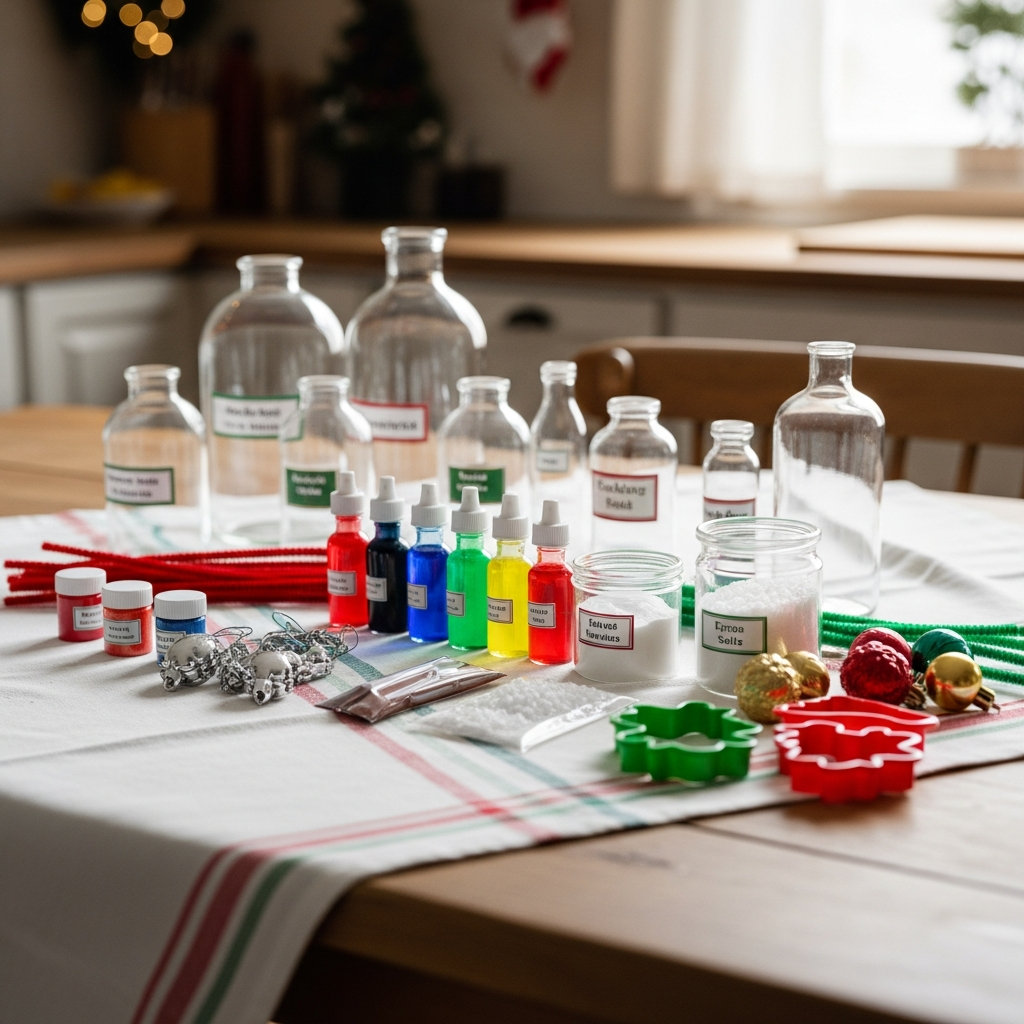
You don't need a fancy setup to conduct Christmas STEM activities. Your kitchen table or dining room works perfectly as a home laboratory. Cover surfaces with plastic tablecloths or old newspapers for easy cleanup – bonus points if you find festive patterns! Position your workspace near good lighting for visibility and photography. If you're planning to document your Christmas Lab Night (and you should!), consider setting up near a window for natural light or adding some string lights for ambiance.
Storage solutions help maintain organization throughout your experiments. Use holiday cookie tins or decorative boxes to sort materials by experiment type. Label everything clearly so older children can help with setup and cleanup. Having a designated "science supplies" area prevents materials from getting mixed with regular household items and makes future lab nights easier to prepare. For more ideas on creating engaging family activities, explore our guide on screen-free Christmas activities.
Must-Have Supplies for Christmas Science Experiments
Most Christmas science experiments use surprisingly common household items. Here's what you'll need for the majority of activities in this guide:
| Category | Items Needed | Where to Find |
|---|---|---|
| Basic Supplies | Baking soda, white vinegar, food coloring, dish soap, salt, sugar | Kitchen pantry |
| Craft Materials | Pipe cleaners, coffee filters, paper plates, cotton balls | Dollar store |
| Special Ingredients | Borax, contact lens solution, clear glue, shaving cream | Pharmacy/grocery store |
| Safety Equipment | Safety goggles, aprons, paper towels, plastic containers | Online or craft store |
Safety First: Guidelines for Different Age Groups
Safety should always be your top priority during Christmas Lab Night. The Consumer Product Safety Commission emphasizes that adults should always supervise children during science activities, regardless of age. For toddlers (ages 2-3), focus on sensory-safe experiments that don't involve small parts or potentially harmful substances. Keep all materials at table height to prevent reaching and spilling.
Elementary school children (ages 6-10) can handle more independence but still require close supervision, especially when using materials like borax or creating chemical reactions. Middle schoolers (ages 11-13) can take the lead on many experiments but should still follow safety protocols, including wearing protective eyewear when appropriate. Establish clear rules: no tasting unless specifically instructed, wash hands frequently, and always clean up spills immediately.
Quick & Easy Christmas Chemistry Experiments
Chemistry experiments capture children's imagination with dramatic reactions and colorful transformations. These Christmas-themed chemical activities combine festive fun with fundamental scientific concepts like acid-base reactions, crystallization, and dissolution.
Fizzing Christmas Tree Volcano (Ages 3+)
Transform a simple chemical reaction into holiday magic with this erupting Christmas tree experiment. You'll need a small plastic Christmas tree (or cone-shaped container), baking soda, white vinegar, green food coloring, and dish soap.
Instructions:
- Place your Christmas tree shape on a tray or large plate
- Mix 3 tablespoons of baking soda with a few drops of green food coloring
- Add the colored baking soda to your tree container
- In a separate cup, mix 1/2 cup vinegar with 1 tablespoon dish soap
- Pour the vinegar mixture over the baking soda and watch your tree "erupt"!
The science behind this reaction involves sodium bicarbonate (baking soda) reacting with acetic acid (vinegar) to produce carbon dioxide gas. The dish soap traps the gas, creating festive green foam that flows like lava. For older children, discuss how this same reaction helps baked goods rise in the oven.

Crystal Snowflake Ornaments (Ages 5+)
Growing crystal snowflakes combines chemistry with patience, teaching children about supersaturated solutions and crystallization. This overnight experiment creates stunning decorations you can hang on your tree.
Materials needed: Borax, hot water, pipe cleaners, string, pencils, wide-mouth jars
Process:
- Shape pipe cleaners into snowflake designs (keep them small enough to fit in your jar)
- Tie a string to one point of the snowflake and the other end to a pencil
- Mix 3 tablespoons of borax per cup of very hot water (adult supervision required)
- Suspend the snowflake in the solution without touching sides or bottom
- Leave undisturbed overnight in a cool place
- Remove carefully in the morning to find crystal-covered snowflakes
The crystallization occurs as the hot water cools and can no longer hold all the dissolved borax. The excess borax molecules attach to the pipe cleaner, forming beautiful crystals. Crystals form when a saturated solution cools and solute particles arrange in regular patterns, creating stunning ornaments perfect for your holiday tree.

Candy Cane Dissolving Race (Ages 4+)
This simple experiment explores how temperature affects the rate of dissolution while incorporating a beloved Christmas treat. Gather several candy canes, clear cups, and water at different temperatures.
Set up three cups with cold water, room temperature water, and warm water (supervised). Place identical candy cane pieces in each cup simultaneously. Children observe and time how quickly the candy dissolves, noting color changes and patterns. The warm water dissolves candy canes fastest because higher temperatures increase molecular movement, speeding up the dissolution process.
Extend this experiment by testing other variables: Does stirring speed up dissolution? What about crushing the candy cane first? These variations teach children about controlling variables and making fair comparisons in scientific investigations.
Festive Physics and Engineering Challenges
Physics and engineering experiments bring Christmas science to life through motion, forces, and construction challenges. These hands-on activities help children understand fundamental principles while developing problem-solving skills.
Balloon-Powered Santa Sleigh Race (Ages 4+)
Newton's third law of motion comes alive when children build and race balloon-powered sleighs. This engineering challenge combines creativity with scientific principles, perfect for competitive families!
Building materials: Lightweight cardboard, straws, tape, balloons, bottle caps or buttons for wheels
Start by constructing a simple sleigh base from cardboard. Attach straws as axles with bottle cap wheels. The key innovation: tape a balloon to the back of the sleigh with the opening facing backward. When you inflate the balloon and release it, the escaping air propels the sleigh forward – demonstrating that every action has an equal and opposite reaction.
Challenge older children to improve their designs. Does a longer or shorter sleigh work better? How does weight distribution affect speed? Creating multiple iterations teaches the engineering design process while keeping the activity engaging. Set up race tracks with masking tape and time each run, recording data to determine the most effective design.

Jingle Bell Magnetism Mystery (Ages 3+)
Most jingle bells contain steel, making them perfect for exploring magnetism during the holidays. Provide various magnets and a collection of bells and other small holiday items (plastic ornaments, aluminum tinsel, brass bells).
Young children can sort items into "magnetic" and "non-magnetic" categories, developing classification skills. Create magnetic mazes by placing bells under paper and using magnets above to guide them through paths. Older children can investigate magnetic field strength by testing how many paper sheets a magnet can work through while still moving a bell.
For an advanced challenge, suspend a bell from string and use magnets to make it "dance" without touching it. This demonstrates invisible forces and can lead to discussions about the Earth's magnetic field and how compasses work.
Christmas Light Circuit Cards (Ages 6+)
Combine art with electrical engineering by creating light-up Christmas cards. You'll need copper tape, LED lights, coin batteries, and cardstock.
Step-by-step process:
- Draw a simple circuit path on your card (like a Christmas tree outline)
- Apply copper tape along the path, leaving a gap for the battery
- Place the LED with legs touching separate tape sections
- Add the battery to complete the circuit – the LED lights up!
- Decorate around your glowing creation
This activity introduces basic circuit concepts: electricity needs a complete path to flow, and LEDs only work with correct polarity. Children learn through trial and error, discovering that reversing the LED or battery orientation changes whether the light works. Hands-on circuit activities help students understand electricity concepts better than theoretical learning alone, making this a perfect blend of art and science education.

Winter Wonder: Ice and Snow Science
Winter provides unique opportunities to explore states of matter, freezing points, and crystallization. These experiments bring outdoor winter phenomena inside, perfect for both snowy and snow-free climates.
Frozen Bubble Crystal Gardens (Ages 3+)
When temperatures drop below freezing, bubble solution transforms into delicate crystal spheres. Mix 1 cup warm water, 2 tablespoons sugar, 2 tablespoons dish soap, and let it chill. On a cold day (below 32°F/0°C), blow bubbles outside and watch them freeze mid-air or on cold surfaces.
The sugar strengthens the bubble film, giving ice crystals time to form before popping. Observe how crystalline patterns spread across the bubble surface, creating intricate designs. For indoor alternatives, place bubble solution in the freezer briefly, then blow bubbles over a tray of dry ice (with strict adult supervision) to see similar effects.
Document the formations with photography – these ephemeral sculptures make stunning winter memories. Discuss how water molecules arrange themselves in hexagonal patterns when freezing, creating the six-sided symmetry we see in both bubbles and snowflakes.

Melting Snowman Science Race (Ages 4+)
Build identical "snowmen" using ice cubes stacked with toothpicks, then test variables affecting melting rate. Create multiple snowmen and place them in different conditions: under a lamp, wrapped in foil, covered with salt, or insulated in a sock.
Children predict which will melt fastest, then observe and record results every five minutes. Salt lowers the freezing point, accelerating melting. The lamp adds heat energy. Insulation slows heat transfer. This experiment introduces concepts of heat transfer, insulation, and chemical properties while maintaining holiday charm.
Graph results using simple bar charts, helping younger children visualize data. Older kids can calculate melting rates and discuss real-world applications, like why we salt icy roads or how animals stay warm in winter.

Instant Snow from Diapers (Ages 5+)
Sodium polyacrylate, the super-absorbent polymer in diapers, creates realistic fake snow when mixed with water. Carefully cut open a clean diaper and shake the powder into a bowl. Add water slowly while stirring – watch it expand into fluffy "snow"!
This polymer can absorb up to 300 times its weight in water. The long molecular chains trap water molecules, creating a snow-like texture. Children explore ratios: too much water creates slush, too little leaves powder. This sensory-rich activity is perfect for areas without real snow, bringing winter wonder indoors.
Discuss how polymers appear in everyday items from hair gel to contact lenses. Superabsorbent polymers like sodium polyacrylate effectively demonstrate important chemistry concepts about molecular structure and water absorption, making this a memorable hands-on learning experience for children of all ages.
Age-Specific Christmas STEM Activities Guide
Not all experiments suit every age group. Understanding developmental stages helps you choose activities that challenge without frustrating, ensuring everyone enjoys Christmas Lab Night.
Toddler-Safe Christmas Science (Ages 2-3)
Toddlers learn through sensory exploration and simple cause-and-effect observations. Focus on safe, mess-friendly activities with immediate results. Try color-mixing with ice cubes: freeze water with food coloring in ice trays, then let toddlers "paint" on paper towels as the ice melts. They'll watch colors blend and patterns emerge.
Create "snow dough" by mixing 2 cups cornstarch with 1 cup hair conditioner and glitter. This moldable, cloud-soft substance provides hours of sensory play while being taste-safe (though not tasty!). Add small holiday toys for hide-and-seek games that develop fine motor skills.
Simple magnetic bottle discovery uses a clear plastic bottle filled with oil, water, and small magnetic objects. Toddlers move magnets outside the bottle to manipulate objects inside, developing hand-eye coordination while exploring invisible forces.
Preschool Christmas Experiments (Ages 4-5)
Preschoolers can follow simple procedures and make basic predictions. Introduce the concept of hypotheses with questions like "What do you think will happen if...?" The dancing cranberry experiment works perfectly: fill a clear glass with carbonated water, drop in cranberries, and watch them bob up and down. Bubbles attach to the cranberries, making them float; when bubbles pop at the surface, cranberries sink again.
Create Christmas slime using clear glue, water, and liquid starch or contact lens solution. Add glitter, sequins, or small jingle bells for festive flair. Measuring ingredients introduces math concepts while kneading develops strength and coordination. Discuss how ingredients change from liquid to solid-like states.
Preschoolers love the "magic milk" experiment: pour whole milk in a shallow dish, add drops of different food coloring, then touch the surface with a cotton swab dipped in dish soap. Colors swirl and dance as soap breaks surface tension, creating a mesmerizing display perfect for developing observation skills.
Elementary Christmas STEM Projects (Ages 6-10)
Elementary students can work more independently, record data, and understand deeper scientific concepts. Challenge them with the crystal candy cane experiment: create a supersaturated sugar solution, suspend a string in it, and grow rock candy over several days. They'll observe crystallization daily, measuring growth and sketching crystal formations.
Build catapults from popsicle sticks and rubber bands to launch mini marshmallow "snowballs." Students modify designs to improve distance and accuracy, learning about potential and kinetic energy, angles, and force. Create targets with point values, turning physics into a competitive game.
The invisible ink experiment uses lemon juice to write secret Christmas messages. Once dry, holding paper near a heat source (under supervision) reveals the message as the juice oxidizes and turns brown. This introduces chemical changes and connects to historical spy techniques.
Middle School Christmas Science Challenges (Ages 11-13)
Middle schoolers can handle complex procedures and abstract concepts. Challenge them to design and build a gingerbread house that can withstand an "earthquake" (shaking table test). They'll explore architectural principles, load distribution, and structural integrity while maintaining holiday themes.
Create a Christmas-themed Rube Goldberg machine to light up a tree or ring bells. This engineering challenge requires planning, problem-solving, and understanding of energy transfer. Students calculate angles, test materials, and iterate designs – real engineering processes.
Advanced chemistry comes through making bath bombs as gifts. Precise measurements of citric acid, baking soda, and oils teach stoichiometry basics. Students can experiment with ratios to achieve different fizz intensities and durations, connecting chemistry to practical applications.
| Age Group | Best Experiments | Skills Developed | Safety Notes |
|---|---|---|---|
| 2-3 years | Sensory snow, color mixing, magnetic bottles | Fine motor, cause-effect, sensory exploration | No small parts, taste-safe materials only |
| 4-5 years | Dancing cranberries, slime, magic milk | Predictions, measuring, following procedures | Adult mixing of solutions, supervised tool use |
| 6-10 years | Crystal growing, catapults, circuits | Data recording, hypothesis testing, design | Protective eyewear for projectiles |
| 11-13 years | Structural engineering, Rube Goldberg, chemistry | Complex problem-solving, calculations, iteration | Heat source supervision, chemical handling |
Making Christmas Lab Night a Cherished Family Tradition
Transforming Christmas science experiments from one-time activities into beloved family traditions requires intentionality and creativity. When you establish Christmas Lab Night as an annual event, complete with special rituals and meaningful touches, it becomes something children eagerly anticipate alongside other holiday traditions.
Choosing Your Special Lab Night Pajamas
The magic begins with selecting perfect matching family science pajamas from PatPat's collection. Look for designs featuring playful science themes – atoms, planets, or fun equations – combined with festive holiday elements. Some families choose classic Christmas patterns and add DIY iron-on patches with science symbols. Others coordinate colors and personalize with embroidered names and "Lab Night 2025" for annual documentation.
Consider creating simple lab coats from white button-down shirts decorated with fabric markers. Children can add their "scientist name" and draw their favorite experiments from previous years. These become keepsakes that track growth and evolving interests. Store them with holiday decorations, bringing them out each December to reminisce about past discoveries while planning new adventures.
Documenting Your Scientific Journey
Create a dedicated family science journal that lives with your holiday decorations. Each year, add photos from your matching pajama lab nights, record favorite experiments, and include children's drawings and observations. Have everyone write predictions before experiments and reflections afterward. Young children can dictate their thoughts while older ones write independently.
Start a social media tradition using #ChristmasLabNight to connect with other science-loving families. Share your successes and hilarious failures – that volcano that erupted too enthusiastically or the slime that turned out more like soup. These authentic moments often become the most cherished memories. Create an annual video montage set to holiday music, showing your family's scientific adventures throughout the years.
Consider gifting each child a personal lab notebook at the start of the season. They can sketch experiment setups, paste photos, and track their hypotheses and results. Educational research indicates that keeping science journals significantly improves student engagement and retention of scientific concepts, making documentation an integral part of the learning process.

Growing the Tradition Year by Year
Build complexity gradually as children grow. What starts as simple baking soda volcanoes with preschoolers evolves into calculating optimal ratios for maximum eruption height with elementary students. By middle school, they're designing experiments independently and teaching younger siblings or cousins.
Extend your tradition beyond immediate family. Host a neighborhood Christmas Lab Night where families rotate hosting duties. Create experiment advent calendars, revealing a new simple activity each December day leading to the grand Lab Night finale. Share successful experiments with teachers who might incorporate them into classroom holiday parties.
Some families connect virtually with grandparents or distant relatives, conducting the same experiment simultaneously over video calls. This creates shared experiences despite physical distance and gives children opportunities to explain their scientific discoveries to interested audiences.
Quick 5-Minute Christmas Science Experiments for Busy Families
Not every family has hours for elaborate experiments. These quick Christmas science activities deliver immediate satisfaction with minimal setup, perfect for maintaining momentum during busy holiday seasons or when attention spans run short.
Dancing Cranberries
Fill a tall, clear glass with carbonated water or clear soda. Drop in fresh cranberries and watch them dance! Bubbles attach to the cranberry's rough surface, making it float. At the surface, bubbles pop, and the cranberry sinks, only to collect more bubbles and rise again. This continues until the carbonation depletes – usually about 5-10 minutes of entertainment. Discuss density and buoyancy while enjoying the mesmerizing dance.
Peppermint Oil Plate Racing
Pour milk into a plate until it covers the bottom. Place drops of different food coloring around the edge. Dip a cotton swab in peppermint extract (or dish soap) and touch the milk's center. Colors explode outward in swirling patterns! The soap or oil breaks milk's surface tension, causing currents that carry the colors. This takes just two minutes but creates Instagram-worthy art perfect for holiday cards.
Static Electric Tinsel
Inflate a balloon and rub it on hair or wool fabric to build static charge. Hold it near lightweight tinsel or tissue paper cut into small pieces – watch them jump and stick to the balloon! Move the balloon slowly and make tinsel "dance" without touching. This demonstrates static electricity in under three minutes while decorating your space with flying sparkles.
Color-Changing Christmas Milk
Mix a small amount of milk with crushed red cabbage juice (a natural pH indicator). Add drops of lemon juice to turn it pink, or baking soda solution to turn it green – instant Christmas colors! The anthocyanin in red cabbage changes color based on acidity or alkalinity. This kitchen chemistry takes five minutes and introduces pH concepts with festive results.
Singing Glasses Carol
Line up glasses with varying amounts of water. Wet your finger and run it around each rim to produce different notes. With practice, play simple Christmas carols! The friction causes vibrations, and water amount determines pitch. This combines physics with music in minutes, creating a unique holiday performance that amazes younger children.
Additional Christmas STEM Experiments
To reach our goal of 25 experiments, here are more engaging activities organized by scientific principle, each offering unique learning opportunities and holiday connections.
Gingerbread House Engineering Challenge (Ages 6+)
Transform traditional gingerbread house making into an engineering lesson. Before decorating, test structural integrity using graham crackers and icing. Build various wall configurations – which shapes resist collapse best? Create spans between supports using pretzel logs or candy cane beams. Test weight-bearing capacity by adding penny stacks to roofs. Document which architectural features provide maximum stability while maintaining aesthetic appeal.
Christmas Color Chromatography (Ages 5+)
Separate the colors in markers to create beautiful holiday art. Cut coffee filters into tree or snowflake shapes. Use washable markers to draw dots or patterns near the center. Place the filter on a plate with a small amount of water in the middle. Watch colors separate and spread as water travels through the paper. Different pigments travel at different rates, revealing hidden colors within single markers. Green might separate into blue and yellow, creating natural ornament decorations.
Reindeer Toothpaste Explosion (Ages 4+)
Create a foamy eruption using hydrogen peroxide, dish soap, and yeast. In a bottle, mix 1/2 cup hydrogen peroxide (3% solution), several drops of dish soap, and food coloring. In separate cup, mix 1 tablespoon yeast with 3 tablespoons warm water. Pour yeast mixture into bottle and step back! The yeast catalyzes hydrogen peroxide decomposition, releasing oxygen that creates dramatic foam. Shape the bottle opening or use a funnel for directed "antlers" of foam.
Magnetic Snow Globe Science (Ages 3+)
Fill a clear plastic bottle 3/4 with baby oil or light corn syrup. Add glitter, small magnetic objects (paper clips, small bells), and secure the lid tightly. Use strong magnets outside to move objects through the liquid, creating swirling snow scenes. Discuss viscosity – thicker liquids create slower, dreamier movements. Compare movement speeds in different liquids while developing fine motor control.
Crystal Christmas Tree Farm (Ages 7+)
Grow multiple crystal formations simultaneously using different solutions. Set up jars with salt water, sugar water, alum solution, and Epsom salt solution. Suspend identical cardboard tree shapes in each. Over several days, observe different crystal structures forming. Salt creates cubic crystals, sugar forms larger chunks, alum produces octahedral shapes, and Epsom salt creates needle-like formations. This comparative experiment introduces mineralogy concepts.
Penny Frost Patterns (Ages 5+)
Explore frost formation using pennies and salt water. Freeze salt water in ice cube trays. Place frozen cubes on pennies and observe frost patterns forming on the metal. The salt lowers the freezing point, causing interesting crystallization patterns on the penny surface. Try different coin types and temperatures. Document patterns with magnifying glasses, connecting to real frost formation on windows.
Christmas Light Spectroscope (Ages 8+)
Build a simple spectroscope using a paper towel tube, CD, and razor blade (adult cuts a slit). Look at different Christmas lights through your device to see their color spectrums. LED lights show distinct color bands while incandescent bulbs show continuous spectrums. Compare colored lights to white lights, discovering how our eyes perceive color combinations. This introduces light wavelengths and electromagnetic spectrum concepts.
Jingle Bell Pendulum Patterns (Ages 6+)
Create pendulums of different lengths using string and jingle bells. Time how long each takes to complete ten swings. Discover that pendulum period depends on length, not weight. Add multiple bells to test this principle. Create pendulum art by attaching markers to swinging bells over paper. The resulting patterns demonstrate harmonic motion and can be turned into holiday cards.
Dissolving Candy Chemistry (Ages 4+)
Test how different liquids dissolve various Christmas candies. Use water, oil, vinegar, and soda with candy canes, chocolate, gumdrops, and hard candies. Create a chart tracking dissolution rates and patterns. Some candies dissolve quickly in water but not oil (polar vs. non-polar solvents). Others fizz in acidic vinegar. This introduces solubility concepts while satisfying sweet teeth with "scientifically tested" samples.
Pine Cone Weather Station (Ages 5+)
Pine cones naturally open and close based on humidity. Create a weather predictor by attaching a pine cone to a board with a pointer attached to one scale. Mark the pointer position on dry and humid days. The cone's scales close when humidity is high (protecting seeds from rain) and open when dry (allowing seed dispersal). This connects plant adaptations to weather patterns.
FAQ: Your Christmas Science Questions Answered
What Materials Do I Need for Christmas Science Experiments?
Most Christmas science experiments use common household items like baking soda, vinegar, food coloring, dish soap, and candy canes. You'll also need basic supplies like jars, bowls, and paper towels. Special ingredients like borax or contact lens solution can be found at grocery stores or pharmacies. Create a simple kit with these materials at the season's start, storing them in a festive container for easy access throughout December.
How Do I Make Crystal Snowflakes for Christmas Decorations?
Mix 3 tablespoons of borax with 1 cup of hot water, stirring until dissolved. Shape pipe cleaners into snowflake designs and suspend them in the solution using string tied to a pencil. Leave overnight without disturbing. Crystals form as the cooling solution becomes supersaturated. Remove carefully in the morning and let dry. The resulting crystal snowflakes can be hung as ornaments or window decorations, lasting for years when stored properly.
Are Christmas Science Experiments Safe for Toddlers?
Many Christmas science experiments can be adapted for toddlers with proper supervision and modifications. Focus on sensory-safe activities like color mixing with ice, playing with snow dough (cornstarch and conditioner), or exploring magnetic bottles. Avoid small parts, hot liquids, and chemicals like borax. Always supervise closely and choose experiments that don't require tasting unless ingredients are food-safe. The American Academy of Pediatrics emphasizes that adult supervision is essential for all toddler activities involving potential hazards.
What Christmas Experiments Can Preschoolers Do Independently?
With initial setup help, preschoolers can independently explore color mixing with ice cubes, create patterns with magnetic wands and metal objects, or observe dancing cranberries in carbonated water. Simple building challenges using marshmallows and toothpicks or sorting activities with magnetic and non-magnetic holiday items work well. Provide clear boundaries and safe materials, then let them explore while you supervise from nearby.
How Long Do Christmas STEM Activities Usually Take?
Christmas science experiments vary widely in duration. Quick demonstrations like dancing cranberries or static electricity with tinsel take 5-10 minutes. Medium-length activities like making slime or building balloon-powered sleighs require 20-30 minutes. Extended projects like growing crystals or creating Rube Goldberg machines can span several days. Plan a mix of quick and extended activities to maintain engagement while accommodating different attention spans and available time.
Can We Do Christmas Science Experiments Without Special Supplies?
Absolutely! Many engaging experiments use only kitchen items. Create volcanoes with baking soda and vinegar, explore density with oil and water, or make oobleck with cornstarch and water. Use ice, salt, and food coloring for colorful investigations. Build structures with spaghetti and marshmallows, or explore static electricity with balloons and paper. The key is creativity and understanding basic scientific principles that can be demonstrated with everyday materials.
What Science Concepts Do Kids Learn from Holiday Experiments?
Christmas STEM activities teach fundamental concepts across multiple disciplines. Chemistry experiments introduce reactions, states of matter, and solutions. Physics activities explore forces, motion, and energy. Engineering challenges develop problem-solving and design thinking. Children also learn the scientific method: making predictions, testing hypotheses, observing results, and drawing conclusions. These experiments build critical thinking, patience, and attention to detail while fostering natural curiosity about the world.
How Do I Store Materials for Next Year's Christmas Lab Night?
Organize supplies in labeled containers or zip-lock bags within a large storage box. Keep non-perishables like pipe cleaners, food coloring, and craft supplies together. Note expiration dates on items like hydrogen peroxide or contact lens solution. Create an inventory list and tape it inside the box lid. Store crystal ornaments carefully wrapped in tissue paper. Take photos of successful experiments and add them to the box for next year's inspiration. This organization makes starting traditions easier each year.
Start Your Magical Christmas Lab Night Tradition Today
As we wrap up this comprehensive guide to Christmas science experiments, remember that the magic isn't just in the bubbling volcanoes or sparkling crystals – it's in the moments of wonder shared with your family. When you gather around the kitchen table in your matching PatPat pajamas, you're not just conducting experiments; you're building memories that will last long after the holidays end.
These 25 Christmas STEM activities offer something for every family member, from toddlers mesmerized by dancing cranberries to middle schoolers engineering elaborate contraptions. By incorporating science into your holiday traditions, you're showing children that learning never stops being fun and that curiosity is a gift worth nurturing year-round.
Start small if you're feeling overwhelmed – choose just one or two experiments for your first Christmas Lab Night. As confidence grows and traditions solidify, you can expand your scientific celebrations. Document your journey with photos and journals, creating a legacy of discovery that your children will treasure and perhaps continue with their own families someday.
Science makes holidays more magical, not less. When children understand the how and why behind erupting snow or crystallizing ornaments, their sense of wonder actually deepens. You're not explaining away the magic – you're revealing that the real world is more amazing than any fantasy.
So grab those safety goggles, put on your coziest matching pajamas from PatPat, and transform your home into a festive laboratory. Your Christmas Lab Night tradition starts now, and the memories you create will sparkle brighter than any crystal snowflake you grow. Share your experiments using #ChristmasLabNight and join a community of families discovering that the best gift you can give is the joy of learning together.


