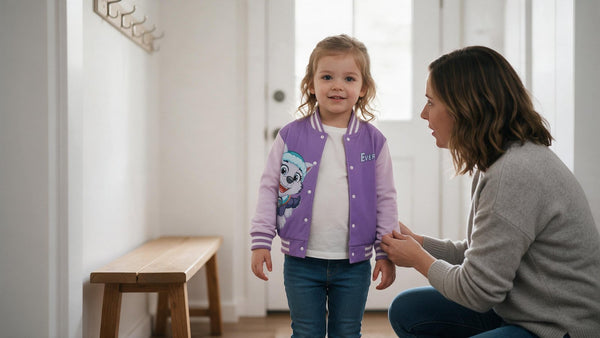
A kids' varsity jacket fits when it closes over the layer your child actually wears, the striped rib hem rests at the hip, the cuffs land at the wrist bone, and the seam where the contrast sleeve meets the body sits on the shoulder point rather than halfway down the arm. That last check is the one that gives a varsity away: on a jacket with white sleeves and a pink, navy or green body, a size that is too big shows up as a color line sliding toward the elbow. This guide puts numbers behind the two questions parents ask most about our kids varsity jackets, whether to buy a size up for a hoodie and whether it will still fit next year, using PatPat's official size chart and CDC growth data. If you are shopping by character rather than by size, you can also browse all of our officially licensed Disney jackets for kids.
The short answer
Measure height first, then decide on the layer. Most PatPat kids' sizes cover a band only 2 inches (5 cm) tall. At the median growth rate in CDC data, children between 3 and 10 grow about 2 to 3 inches a year, so a 2-inch size lasts roughly 9 to 12 months.
- Over a T-shirt: buy the size whose height band your child is in now.
- Over a hoodie, or in the top half of the band: buy one size up.
- Never two sizes up. The hem drops below the seat, the cuffs cover the hand and the sleeve seam slips off the shoulder.
- For next year: one size up is the size most children need 12 months later. Children near the top of 3Y, 4-5Y, 5-6Y or 11-12Y can outgrow even that within the year.
The rest of this guide shows where those rules come from, how the varsity cut changes them, and which styles have the sizes your child will need next. For general jacket fit checks that apply to any short jacket, see how a kids bomber jacket should fit; this article only covers what is different about a varsity and about layering.
How a varsity jacket should fit, check by check
A varsity jacket is built from parts that each show a fit problem in their own way. The jackets in our collection share the same anatomy: a striped rib-knit baseball collar, a snap or button front, contrast sleeves, and striped rib cuffs and hem. Several product pages, including the Hot Wheels and the embroidered Mickey and Minnie velvet styles, describe the length as hip length, and the Zootopia Judy Hopps style lists a regular fit and standard length. So the target is a short, straight jacket, not a long coat.
Shoulder: watch the color line
On a one-color jacket, a shoulder seam that sits an inch low is hard to see. On a varsity it is obvious, because the sleeve is a different color from the body. When the fit is right, the color change sits on the shoulder point, the bony edge where the top of the arm begins. When the jacket is too big, the white or cream sleeve starts below that point, and the body color creeps onto the upper arm. When it is too small, the seam sits on top of the shoulder and pulls toward the neck as your child reaches forward.
Check it with your child standing relaxed, arms at their sides, jacket snapped closed over the layer they will wear. Then ask them to hug themselves. If the back pulls tight across the shoulder blades and the snaps strain, the jacket is too small for that layer.

Cuffs: the stripes are the measuring tape
Varsity cuffs are rib knit with two or three stripes, and they grip the wrist. With arms down, the cuff should sit at the wrist bone. With arms straight out in front, it can ride up an inch or so but should not expose most of the forearm. A sleeve that is a little long is not a problem on a varsity, because the rib holds the cuff in place and the extra length gathers above it. A sleeve that is a lot too long is a problem, because the striped band ends up over the hand and the stripes, the most recognizable detail of the style, bunch into a roll.
One parent of a 10-year-old noticed exactly this on a Barbie Naia jacket in 9-10Y: the sleeves were a little long, and the parent expected their daughter to keep wearing it past 11. That is the kind of extra length worth having. A sleeve that has to be folded back twice is not.

Hem: the rib band should land at the hip
The striped band at the bottom is what gives a varsity its short, boxy shape. On a correct fit it rests at the top of the hip bone. Too small, and it rides up to the waist whenever your child bends or reaches, leaving a gap at the back. Too big, and it drops toward the seat, the body billows above it, and the jacket starts to look borrowed from an older sibling. Have your child sit cross-legged on the floor: the hem should not bunch up into the stomach.

Front: close every snap over the real layer
Most of our varsity styles close with snaps, and the Barbie fleece style lists a button-up front. Snaps are easy for small hands, and that is why so many toddler styles use them. They also make fit easy to read: if the placket gapes between snaps or the snaps pop open when your child reaches for a car-seat buckle, the chest is too tight for that layer. Close every snap, not just the middle two.
How to measure your child for a varsity jacket
PatPat's size chart describes the child, not the garment. It lists height, weight, chest, waist and hips for each size, and the same chart appears on each product page and on our kids size chart page. There is no separate garment measurement table for these jackets, so the most useful numbers you can bring to the chart are your child's own.
- Height, done properly. Follow the CDC's at-home method: shoes and bulky clothing off, child standing on a hard floor with heels against a wall, a flat book lowered until it touches the top of the head, then measure from the floor to the mark. Record it to the nearest 1/8 inch. Height is the column that decides the size.
- Chest, twice. Wrap a soft tape under the armpits around the fullest part of the chest, first over a T-shirt and then over the hoodie or sweatshirt your child will wear under the jacket. The difference between the two numbers is what the layer adds.
- Sleeve, at try-on. Because the chart has no sleeve column, sleeve length is checked when the jacket arrives: arms down, cuff at the wrist bone; arms forward, forearm mostly covered.

Use height to choose the size and chest as the tiebreaker. Weight is on the chart too, but it is the least useful number for a jacket, because two children of the same weight can be very different heights.
A real example from our reviews shows how this works. One parent described their daughter like this:
"She is tall for her age. She is 2 and 37 inches tall. I purchased size for a 3-4 year old and items fit but just a bit big"
— Marilu C., verified buyer · Daisy Duck lightweight jacket, size 3-4Y
Thirty-seven inches puts her near the middle of our 3Y band, which runs from 35 to 39 inches. She went one size up to 3-4Y, which starts at 39 inches, and got a jacket that was a bit big, which is what one size up should feel like. Another reviewer wrote that the 4-5Y lightweight Mickey Mouse style fit their 3-year-old son, who was 1.03 m tall. At 103 cm he was at the top of the 3-4Y band, which ends at 104.1 cm, so the next size up was simply his correct size. In both cases the age on the label told the parent less than the tape measure did.
PatPat kids' varsity jacket sizes by height
Here is the official kids chart that every varsity style in this guide uses, with one column we added: how long a child growing at the CDC median rate spends inside each size. We calculated it by finding the ages at which the median child reaches the bottom and the top of each height band on the CDC 2000 stature-for-age charts. Girls and boys share the same height bands up to 12-13Y; chest ranges are the same up to 6-7Y and differ by up to 1 inch after that.
| Size | US | Height | Chest, girls | Chest, boys | Months in this size at median growth (girls / boys) |
|---|---|---|---|---|---|
| 2Y | 2T | 33-35 in (83.8-88.9 cm) | 20.5-21 in | 20.5-21 in | 5 / 3 |
| 3Y | 3T | 35-39 in (88.9-99.1 cm) | 21-22 in | 21-22 in | 16 / 16 |
| 3-4Y | 4T | 39-41 in (99.1-104.1 cm) | 22-22.5 in | 22-22.5 in | 9 / 9 |
| 4-5Y | 5T | 41-44 in (104.1-111.8 cm) | 22.5-23 in | 22.5-23 in | 13 / 14 |
| 5-6Y | 6 | 44-46 in (111.8-116.8 cm) | 23-24 in | 23-24 in | 9 / 9 |
| 6-7Y | 7 | 46-48 in (116.8-121.9 cm) | 24-25 in | 24-25 in | 9 / 10 |
| 7-8Y | 8 | 48-51 in (121.9-129.5 cm) | 25-26 in | 25-26.5 in | 15 / 15 |
| 8-9Y | 9 | 51-53 in (129.5-134.6 cm) | 26-27.5 in | 26.5-27.5 in | 12 / 11 |
| 9-10Y | 10 | 53-55 in (134.6-139.7 cm) | 27.5-28.5 in | 27.5-28.5 in | 12 / 12 |
| 10-11Y | 11 | 55-57 in (139.7-144.8 cm) | 28.5-30 in | 28.5-30 in | 10 / 12 |
| 11-12Y | 12 | 57-60 in (144.8-152.4 cm) | 30-31 in | 31-31.5 in | 13 / 15 |
| 12-13Y | 13 | 60-62 in (152.4-157.5 cm) | 31-32.5 in | 31.5-33 in | 11 / 8 |
| 13-14Y | 14 | 62-64.5 in (157.5-163.8 cm) / boys: 62-65 in (157.5-165.1 cm) | 32.5-34 in | 33-35.0 in | — / — |
CDC 2–20 year charts start at age 2, so the 2Y figure counts from the second birthday. Chest is a body measurement, not the jacket.
Three things stand out. First, 2Y lasts only a few months at the median pace, because toddlers grow fast and the band is narrow. Second, 3Y is the widest band on the chart at 4 inches, which is why a 3Y jacket bought for a just-turned-two-year-old can last more than a year. Third, from 3-4Y up, most sizes are 2 inches tall, and 4-5Y, 7-8Y and 11-12Y are 3 inches. A child spends roughly a year in the 2-inch sizes and a little longer in the 3-inch ones.
Wearing a varsity jacket over a hoodie: how much room to leave
A hoodie under a varsity is how most families stretch a light jacket into colder months, and it is also the most common reason a jacket that fit in the living room feels tight on the first cold morning. The numbers on our chart explain why. From 2Y to 10-11Y, the chest range moves up by only half an inch to an inch and a half from one size to the next. A thick hoodie can add more than that around the chest on its own.
So the decision comes from your two chest measurements, not from a rule of thumb:
- If the over-hoodie chest still falls in your child's current size, buy that size. For example, a child 45 inches tall with a 23-inch chest over a tee is in 5-6Y on both counts; if the chest is still under 24 inches over the hoodie, 5-6Y will close over it.
- If the over-hoodie chest falls in the next size up, buy that size, even if height says otherwise. In the same example, a chest of 24.5 inches over a hoodie is in the 6-7Y range, and that is the jacket that will snap closed without straining.
- Pull the hood out over the collar. The rib-knit baseball collar on a varsity is low and stands up, so the hood of a hoodie sits on top of it and stays out of the way.
"I bought one size up to allow him to wear it for a little longer and use a hoodie underneath if desired."
— v**z, verified buyer · Mickey and Friends lightweight jacket, size 5-6Y

The fabric of the jacket matters as much as the hoodie. Our varsity styles fall into two groups:
- Stretch knits. The Barbie Naia styles list 6% spandex, and the Minnie Mouse, Daisy Duck and Mickey Mouse lightweight styles list 96% polyester and 4% spandex. These give across the back when your child reaches, so a hoodie is more forgiving underneath. Several parents describe them as closer to a sweatshirt than a coat, which is also why they work as a layer.
- Brushed fleece, polar fleece and velvet. The Hot Wheels, Barbie fleece, Stitch polar fleece and embroidered Mickey and Minnie velvet styles are 100% polyester with a brushed or plush interior and no stretch listed. They are thicker, so there is less room left inside for a bulky layer. Many children will wear these over a long-sleeve tee instead of a hoodie, and that changes the size you need.
"I ordered my child's usual size, and it fits just right, not too tight and not too loose."
— Aria, verified buyer · Hot Wheels varsity jacket, size 7-8Y
One more case: some styles in the collection already have a hood, including the Moana hooded jacket, the Elsa sequin hooded jacket and the Mickey and Friends Christmas sequin jacket. Putting a hoodie under a hooded jacket means two hoods stacked at the neck. For those, plan on a long-sleeve top or a thin crewneck sweater underneath, and size for that.
 Barbie Naia lightweight colorblock jacket, roseShop now
 Minnie Mouse lightweight varsity jacket, hot pinkShop now
These two stretch-knit styles have the most fit reviews of any jacket in the collection, and both run from 3Y to 9-10Y. In the rose Barbie Naia style, every size was in stock when we checked, with 6-7Y the lowest at 19 pieces.
Should you buy a varsity jacket one size up?
One size up is the right call more often than not, but it has a cost on a varsity that it does not have on a puffer or a hoodie. Here is the trade, point by point.
What you gain: room for a hoodie, roughly one more season of wear, and a jacket that still closes when your child's chest grows faster than their height, which often happens between growth spurts.
What you give up:
- Sleeves. One size up usually adds a little sleeve length that the rib cuff absorbs. Two sizes up and the striped cuff sits on the hand.
- Hem. The rib band moves down from the hip toward the seat. On a short varsity cut, that is the change people notice first in photos.
- Shoulder. The contrast seam slides down the arm. One size up is barely visible; two sizes up looks like a hand-me-down.
Reviews of our Barbie Naia style show both sides. Among the 781 reviews on that style, 28 say it runs small or that the parent sized up, and 10 say it runs big or roomy. For the Minnie Mouse, Daisy Duck and Mickey Mouse lightweight styles, 13 of 552 reviews lean small and 7 lean big, while 55 say the size was right. Most reviews do not mention fit at all. Read that as true to size with a slight lean toward snug on the Barbie Naia style, not as a reason to go up two sizes. One parent learned that the hard way:
"I read reviews that said it ran small, so I ordered my 4.5 daughter the 7/8 size when her dresses are 5/6 right now. It's definitely way too big now"
— Jennifer S., verified buyer · Barbie Naia jacket, size 7-8Y
A child who wears 5/6 in dresses is most likely around our 5-6Y band. A 7-8Y jacket is two sizes above that, which is too much for a hip-length jacket. She will grow into it, but probably over two years, not one.
Our rule: size up one when your child will wear a hoodie under it, when they are in the top half of their height band, or when both are true. Stay in the measured size when the jacket will go over a T-shirt and your child has just moved into the band. Do not size up twice to make one jacket last two winters; buy the next size when the time comes.
Will it still fit next year?
This is the question behind most size-up decisions, and the answer depends on where your child sits inside the band today. We ran the numbers on the CDC 2000 stature-for-age charts: for a child at the bottom, the middle and the top of each PatPat height band, we kept their growth percentile the same and projected their height 12 months later. The table shows which size they would need by then.
| Size now | 12 months later, starting at the bottom of the band | starting in the middle | starting at the top |
|---|---|---|---|
| 2Y | 3Y | 3Y | 3Y |
| 3Y | 3Y | 3-4Y | 4-5Y |
| 3-4Y | 4-5Y | 4-5Y | 4-5Y |
| 4-5Y | 4-5Y | 5-6Y | 6-7Y |
| 5-6Y | 6-7Y | 6-7Y | 7-8Y |
| 6-7Y | 7-8Y | 7-8Y | 7-8Y |
| 7-8Y | 7-8Y | 8-9Y | 8-9Y (boys: 9-10Y) |
| 8-9Y | 9-10Y | 9-10Y | 9-10Y |
| 9-10Y | 10-11Y | 10-11Y | 11-12Y (boys: 10-11Y) |
| 10-11Y | 11-12Y | 11-12Y | 11-12Y |
| 11-12Y | 11-12Y | 12-13Y | 13-14Y |
| 12-13Y | 13-14Y | 13-14Y | 13-14Y |
For most children in most sizes, the answer is one size up: whether they start at the bottom, the middle or the top of 3-4Y, 6-7Y, 8-9Y, 10-11Y or 12-13Y, they need the next size a year later. That is why one size up is the usual buy-ahead choice. There are two exceptions, and both come from the bands that are wider than 2 inches.
- Bottom of a wide band: a child who has just moved into 3Y, 4-5Y, 7-8Y or 11-12Y may still be in the same size a year later. Buying one size up for them gives you more than a year.
- Top of some bands: a child near the top of 3Y, 4-5Y, 5-6Y or 11-12Y grows past the next size within the year and needs two sizes up 12 months later. The same happens at the top of 9-10Y for girls and the top of 7-8Y for boys. For these children, one size up lasts most of a year, but probably not all of next winter.

Two practical ways to use this:
- Measure height twice, three months apart, before buying ahead for next year. If your child grew more than about an inch, they are on a faster track than the median and the next-year column above is optimistic.
- Check percentiles if you have them. Our growth percentile calculator uses the same CDC data and shows which size your child is likely to need in three and six months.
Growth also slows down and speeds up. In the CDC median, girls grow about 2 inches a year between 8 and 10 and then speed up again; boys slow to about 2 inches a year around 9 to 11 and speed up later. A size-up plan that works at 6 may last longer at 9 and fall short at 12.
2Y to 13-14Y: how the size range changes what you can buy
Our varsity jackets as a group run from 2Y to 13-14Y, but no single style covers that whole range. The style you choose decides whether there is a next size at all, and how big the step to it is. Here is how the styles in stock on November 28, 2026 break down.
Toddler styles: 2Y to 5-6Y
The Frozen Elsa snap varsity, Toy Story Buzz Lightyear, Cars Lightning McQueen with Cruz Ramirez, the Disney Princess styles and PAW Patrol stop at 5-6Y. This is the group where "will it fit next year" matters most. A 5-6Y band is 2 inches tall, and a child in the middle of it at age 5 is likely to need 6-7Y within the year, which none of these styles offers. If your child is already in 4-5Y or 5-6Y and you want two winters out of one jacket, pick from the next group instead.
Stock is thin at the top of some toddler runs. The Moana varsity with striped trim had one 4-5Y left and no 5-6Y, and the Belle and Rapunzel styles had three or fewer in 4-5Y and 5-6Y when we checked.
 Frozen Elsa snap varsity jacket, light blueShop now
 Toy Story Buzz Lightyear snap varsity jacket, navyShop now
 Cars Lightning McQueen and Cruz Ramirez snap jacket, blueShop now
Kid styles: 3Y to 9-10Y
Barbie, Minnie Mouse, Daisy Duck, Mickey Mouse and the embroidered Mickey and Minnie velvet styles are made in every size from 3Y through 9-10Y, though a few colorways have gaps: the pink Barbie Naia was sold out from 4-5Y through 7-8Y when we checked, so the rose version is the one to buy in those sizes. The Hot Wheels styles start at 3-4Y and run to 9-10Y, but they skip 8-9Y: the sizes are 3-4Y, 4-5Y, 5-6Y, 6-7Y, 7-8Y and 9-10Y. A child in the 8-9Y band, 51 to 53 inches tall, would be choosing between a jacket that is a size small and one that is a size up. For most children wearing a hoodie, 9-10Y is the better choice.
The red and black Hot Wheels style was sold out in 7-8Y when we checked, and the green velvet Mickey and Minnie style had four left in 6-7Y.
 Hot Wheels snap varsity jacket, navy and creamShop now
 Barbie fleece varsity jacket, hot pinkShop now
 Mickey and Minnie embroidered velvet varsity jacket, greenShop now
Styles that reach 12-13Y and 13-14Y
The longest runs come with a catch. The Zootopia Judy Hopps varsity jacket, the Stitch polar fleece and the Mickey and Friends polka dot style are stocked in alternating sizes: 3Y, 4-5Y, 6-7Y, 8-9Y, 10-11Y and 12-13Y. (The Judy Hopps page also lists 5-6Y and 7-8Y, but both were sold out when we checked.) Each step skips one row of the chart, so the next size up is about 4 inches of height away instead of 2. That is useful for buying ahead: one size up in these styles covers a lot of growth. It also means a child between two sizes has a bigger gap to fall into, so measure carefully and lean up rather than down if your child will wear a hoodie.
The two Stitch tie-dye styles start at 6-7Y and are the only varsity jackets that reach 13-14Y, the largest kids' size on our chart (62 to 65 inches for boys). For a tall 8-year-old, the top of the range comes sooner than parents expect:
"She's a tall child and after reading the reviews I ordered the 13-14 year old size. She may get a year out of it at MOST."
— Taurus Moon, verified buyer · Stitch tie-dye jacket, size 13-14Y
The Stitch polar fleece had one piece left in 10-11Y and one in 12-13Y when we checked, and the purple Stitch tie-dye was sold out in 13-14Y. The Judy Hopps style was in stock in every one of its sizes up to 12-13Y.
 Zootopia Judy Hopps varsity jacket, pinkShop now
 Stitch polar fleece varsity jacket, blueShop now
 Stitch tie-dye varsity jacket for big kids, blueShop now
Varsity styles compared: fabric, weather and price
Fit and fabric go together, so here are the styles mentioned in this guide side by side. Weight and lining come from each product page. We have not put a temperature on any style, because we have no tested temperature rating for these jackets; the weather column is a plain guide based on fabric: lightweight knits for mild days, brushed fleece and velvet for cooler days. None of them is a winter coat. On cold days they work as a middle layer under one, which is covered in more detail in our fabric-by-fabric warmth guide.
| Style | Fabric and weight | Weather | Price | Sizes in stock |
|---|---|---|---|---|
| Hot Wheels snap varsity jacket, navy and cream | 100% polyester, brushed fleece interior; hip length | Cool days | $18.99 | 3-4Y to 9-10Y; no 8-9Y |
| Hot Wheels fleece varsity jacket, red and black | 100% polyester, brushed fleece interior; hip length | Cool days | $18.99 | 3-4Y to 9-10Y; no 8-9Y; 7-8Y sold out |
| Barbie fleece varsity jacket, hot pink | 100% polyester fleece, brushed interior | Cool days | $23.09 | 3Y to 9-10Y |
| Mickey and Minnie embroidered velvet varsity jacket, green | Velvet with brushed interior, ribbed trim; hip length | Cool days | $28.69 | 3Y to 9-10Y; 6-7Y: 4 left |
| Stitch polar fleece varsity jacket, blue | 100% polyester polar fleece | Cool days | $36.89 | 3Y, 4-5Y, 6-7Y, 8-9Y, 10-11Y, 12-13Y; 10-11Y: 1 left; 12-13Y: 1 left |
| Zootopia Judy Hopps varsity jacket, pink | 100% polyester, mesh lining; regular fit | Mild days | $23.09 | 3Y, 4-5Y, 6-7Y, 8-9Y, 10-11Y, 12-13Y; 5-6Y, 7-8Y sold out |
| Barbie Naia lightweight colorblock jacket, rose | Naia knit (86.25% polyester, 7.75% acetate, 6% spandex) | Mild days | $25.19 | 3Y to 9-10Y |
| Minnie Mouse lightweight varsity jacket, hot pink | Sweatshirt knit, 96% polyester, 4% spandex | Mild days | $26.99 | 3Y to 9-10Y |
| Frozen Elsa snap varsity jacket, light blue | Midweight sweatshirt knit, 100% polyester | Mild days | $26.99 | 2Y to 5-6Y |
| Toy Story Buzz Lightyear snap varsity jacket, navy | Stretch knit, 44% cotton, 56% polyester | Mild days | $26.99 | 2Y to 5-6Y |
| Cars Lightning McQueen and Cruz Ramirez snap jacket, blue | Knit, 85% cotton, 15% polyester | Mild days | $29.69 | 2Y to 5-6Y |
| Stitch tie-dye varsity jacket for big kids, blue | Midweight sweatshirt knit, 100% polyester; hip length | Mild days | $26.99 | 6-7Y to 13-14Y; no 10-11Y, 12-13Y |
Prices and stock checked November 28, 2026.
If you are deciding between fleece types rather than sizes, our kids fleece jacket guide explains how brushed fleece, polar fleece and fleece-lined jackets differ.
Recommended sizes by height and layer
Putting the chart, the layering rule and the growth numbers together, this is what we would buy for each height band. "Over a tee" assumes a T-shirt or long-sleeve top underneath; "over a hoodie" assumes a midweight hoodie and should be confirmed with the over-hoodie chest measurement; the last column is the size a child in the middle of the band, growing at the median rate, will need 12 months from now.
| Height band | Over a tee | Over a hoodie | Needed in 12 months (middle of band) |
|---|---|---|---|
| 33-35 in (83.8-88.9 cm) | 2Y | 3Y | 3Y |
| 35-39 in (88.9-99.1 cm) | 3Y | 3-4Y | 3-4Y |
| 39-41 in (99.1-104.1 cm) | 3-4Y | 4-5Y | 4-5Y |
| 41-44 in (104.1-111.8 cm) | 4-5Y | 5-6Y | 5-6Y |
| 44-46 in (111.8-116.8 cm) | 5-6Y | 6-7Y | 6-7Y |
| 46-48 in (116.8-121.9 cm) | 6-7Y | 7-8Y | 7-8Y |
| 48-51 in (121.9-129.5 cm) | 7-8Y | 8-9Y | 8-9Y |
| 51-53 in (129.5-134.6 cm) | 8-9Y | 9-10Y | 9-10Y |
| 53-55 in (134.6-139.7 cm) | 9-10Y | 10-11Y | 10-11Y |
| 55-57 in (139.7-144.8 cm) | 10-11Y | 11-12Y | 11-12Y |
| 57-60 in (144.8-152.4 cm) | 11-12Y | 12-13Y | 12-13Y |
| 60-62 in (152.4-157.5 cm) | 12-13Y | 13-14Y | 13-14Y |
| 62-64.5 in (157.5-163.8 cm) | 13-14Y | 13-14Y (largest size) | 13-14Y (largest size) |
If your child is near the top of a band, look at the next row down for the 12-month column. In the alternating-size styles (Zootopia Judy Hopps, Stitch polar fleece and Mickey and Friends polka dot), when the size you want is not offered, round up to the next size that is.
Try it on at home before the tags come off
Every check above takes two minutes in the living room. Do them in this order, tags on:
- Put on the hoodie or top your child will really wear with the jacket.
- Close every snap or button. Look at the placket from the side for gaps between snaps.
- Check the color line at the shoulder with arms relaxed.
- Arms down: cuffs at the wrist bone. Arms straight forward: forearm mostly covered.
- Arms overhead: the hem should not ride up past the waist at the back.
- Sit cross-legged on the floor: the rib hem should not bunch at the stomach.
If two sizes both pass, keep the larger one only if your child is in the top half of their band or will wear a hoodie most days. Returns and exchanges follow our refund policy, so check it before you remove the tags. If you are comparing our sizes with a brand you already buy, does PatPat run small lines the charts up side by side, and outfit ideas for the jacket you settle on are in how to style a kids varsity jacket.
Once you know the size, choosing the jacket is the easy part. Start with the size run, then the fabric, then the character. Browse every style in our kids varsity jackets collection, or shop all officially licensed Disney jackets for kids if a favorite character matters most. For a coat to go over the varsity on the coldest days, see our kids jackets and coats.
Frequently asked questions
How should a varsity jacket fit on a child? The rib hem should rest at the hip, the cuffs at the wrist bone with arms down, and the seam where the contrast sleeve meets the body on the shoulder point. All snaps should close over the layer your child will wear without the placket gaping.
Should I size up a kids' varsity jacket so it fits over a hoodie? Measure your child's chest over the hoodie. If that number falls in the next size on PatPat's chart, buy one size up. If it still falls in the current size, keep the current size. Do not go up two sizes.
Will a varsity jacket bought one size up still fit next year? For most children, yes: in CDC median growth data, one size up is the size most children need 12 months later. Children near the top of 3Y, 4-5Y, 5-6Y or 11-12Y can outgrow it sooner.
What size varsity jacket does a 4-year-old need? Go by height, not age. On PatPat's chart, 3-4Y fits 39 to 41 inches and 4-5Y fits 41 to 44 inches. A child near 41 inches who will wear a hoodie underneath is better off in 4-5Y.
Can my child wear a hoodie under a hooded varsity jacket? It works, but two hoods stack up at the neck. For hooded styles, plan on a long-sleeve top or thin sweater underneath and choose the size for that layer.
Which PatPat varsity jackets come in sizes above 10? The Zootopia Judy Hopps style and the Stitch polar fleece reach 12-13Y, and the Stitch tie-dye styles run from 6-7Y to 13-14Y. Most other styles stop at 5-6Y or 9-10Y.
About this article
Written and fact-checked by the PatPat Editorial Team. How we research, source and review what we publish is set out on our editorial standards page.
Method. Size runs, stock by size, prices, fabrics and fit details were read from PatPat product data on November 28, 2026, for the 42 varsity-style jackets in stock at the time; stock changes daily. Height and chest bands are PatPat's official kids size chart (Toddler & Kids). Months per size and 12-month projections were calculated from the CDC 2000 stature-for-age LMS tables at the median and at constant percentile. Review counts come from the reviews shown on each product page; we counted a review as "runs small" or "runs big" only when it said so in words. No wear testing was done for this article, and PatPat sells the jackets discussed.
Sources. Growth data: CDC Growth Charts. Measuring height at home: CDC, Measuring Children's Height and Weight Accurately At Home. Size chart: PatPat size chart.
Last updated November 28, 2026