A winter day at Walt Disney World or Disneyland asks a lot of one outfit. Your child may start in a rope-drop line in a jacket, spend the afternoon in a T-shirt, and need that jacket back, plus something warmer, by the time the fireworks start. The jacket that comes off at noon has to ride in the bag all afternoon, and the one that goes on after dark ends up in most of the evening photos. This guide plans the layers around that day, using NOAA's climate normals for both resorts and Disney's own park rules. It also covers two jackets from PatPat's officially licensed Disney jackets for kids that suit the two ends of the day: a lightweight Mickey and Friends bomber that takes up little room in a backpack, and a padded Elsa jacket with a sequined hood for the cool evening.
The short version:
- Plan for a 21 to 22 degree swing. From December through February, the average gap between the daily high and the daily low is about 21 to 22°F at both resorts.
- The coldest moment is often the morning, not the fireworks. Daily lows usually come around sunrise, so the rope-drop line can be colder than the walk out at night.
- Dress in three pieces: a long-sleeve base, a light jacket you can carry, and a warmer layer for after sunset.
- Disneyland nights are cool more often. NOAA's Anaheim station drops to 50°F or below on about 17 to 22 nights a month in winter, against about 10 to 16 at Orlando International Airport. Orlando, though, gets the occasional freezing night.
How cold Disney World and Disneyland actually get in winter
"Florida" and "Southern California" make winter sound like a non-issue, and the afternoon highs back that up. The nights tell a different story. These are NOAA's 1991–2020 U.S. Climate Normals, the official 30-year averages, for the weather station at Orlando International Airport, about 15 miles east of the Walt Disney World parks, and for the station in Anaheim, California, the city the Disneyland Resort sits in.
| Month | Orlando Intl. Airport: avg. high / low | Anaheim: avg. high / low | Nights at 50°F or below (Orlando / Anaheim) | Nights at 40°F or below (Orlando / Anaheim) |
|---|---|---|---|---|
| December | 73.8°F / 52.9°F | 70.6°F / 48.2°F | 11.5 / 21.6 | 2.5 / 2.9 |
| January | 71.8°F / 49.5°F | 71.0°F / 48.9°F | 16.3 / 20.4 | 4.7 / 2.1 |
| February | 74.9°F / 52.4°F | 71.0°F / 49.3°F | 10.4 / 17.2 | 2.4 / 1.3 |

Three things in those numbers shape what your child should wear.
The swing is the same size at both resorts. Subtract the low from the high and you get about 21 to 22 degrees in every winter month at both stations. A child dressed for the high is underdressed for the low, and the other way around. No single jacket covers a 21-degree range comfortably, which is the whole argument for layers.
Anaheim's evenings are cool more often; Orlando has the sharper cold snaps. NOAA also counts how many days a month the low reaches a given temperature. At the Anaheim station, the low falls to 50°F or below on about 22 days in December, 20 in January and 17 in February. At Orlando International, it is about 12, 16 and 10. But Orlando averages about one night in January at or below freezing, and the Anaheim station averages none. In practice, a Disneyland trip almost always needs the evening layer, while a Disney World trip needs it most nights and occasionally needs a real cold-weather plan.
It gets dark early. Using NOAA's solar calculator equations for the two resorts, the sun sets around 5:30 p.m. at Walt Disney World and around 4:45 p.m. at Disneyland in December, and still before 6:30 p.m. and 6 p.m. at the end of February. Fireworks start after that, so a winter park day has a long stretch after sunset when the air is cooling and your child is mostly standing still: in a show line, at dinner, waiting for the fireworks.
Rain is the last piece. NOAA's normals put winter rainfall at about 2 to 2.5 inches a month in Orlando and 2.4 to 3.2 inches in Anaheim. That is not much, but a wet jacket on a cool evening is the fastest way to end a park day early, so the plan below includes a dry bag.
A winter park day, hour by hour
A family day at either resort follows a pattern that matters more for clothing than the date on the calendar does. Here is what each part asks of your child's layers.

Rope drop and the first hour. You are standing still in the cool part of the day. The child needs the long-sleeve base plus the light jacket, and on a cold morning the warm layer on top. Small children waiting in a stroller feel it more than the adults walking around them.
Late morning. The sun is up, the lines are moving, and your child is walking a lot. The warm layer comes off first, then the light jacket. This is the moment the light jacket earns its place, because it has to go somewhere, and "somewhere" is the backpack or the stroller basket for the next five or six hours.
Midday and afternoon. The warmest stretch. Most children are in their base layer, and many indoor shows and restaurants are air-conditioned. The light jacket is useful here too: it goes on for a long indoor show and comes off on the walk to the next land.
Late afternoon and sunset. In December, sunset comes before many families have eaten dinner. The light jacket goes back on as soon as the sun drops behind the buildings.
Waiting for the fireworks. This is the long, still part of the evening. Families often claim a spot well before the show and then wait. The warm layer goes on top of the light one, hoods come up, and this is when most of the night photos happen.
The walk out. Crowds, a parking lot, a bus, a monorail or a tram, and a tired child who may fall asleep on the way. Keep the warm layer on until you are in a heated vehicle or the hotel room.
The three-layer system
The American Academy of Pediatrics advises dressing children in several thin layers for cold weather and, for infants and young children, one more layer than an adult would wear in the same conditions. A winter park day is mild rather than cold for most of its hours, but the principle carries over: several thin pieces you can add and remove beat one thick coat that is either on or off. For a park day, that becomes three pieces.
- Base: a long-sleeve top, or a short-sleeve tee with a thin long-sleeve top in the bag. This is what your child wears in the afternoon.
- Carry layer: a light jacket that goes on and off several times a day and spends hours in the bag in between. It has to be light, quick to put on, and small enough not to crowd the snacks and water bottles.
- Night layer: something warmer for after sunset, ideally with a hood, because that is when your child is still for the longest and when you take most of the photos.
On most winter days the carry layer and the night layer are two different jackets. On a warm December day, the carry layer alone may cover the evening. On a cold-snap day, both go on in the morning and the night layer gets help from a fleece. We cover that case further down.
The carry layer: a lightweight Mickey and Friends bomber
PatPat's lightweight bombers come in three characters: Minnie Mouse in hot pink, Mickey Mouse in red and Daisy Duck in pink. They share the same pattern and fabric. The product page lists the piece as "1 Lightweight Jacket," the fabric as 96% polyester and 4% spandex, and the care as "Machine wash, do not bleach, and tumble dry low." The detail list adds "midweight sweatshirt knit construction." In the product photos, the jacket is a single layer of smooth knit: no lining, no padding, and no front pockets. It closes with snaps and has striped rib knit at the collar, cuffs and hem.
PatPat does not publish a weight for these jackets, so we can't give you ounces. What the construction tells you is enough for packing: a single, unlined layer of knit with no fill takes up far less room than a padded or fleece jacket, and it can be rolled into a backpack with the snacks and water. That is the job the carry layer has from late morning to sunset.
 Minnie Mouse lightweight bomber, hot pinkShop now
 Mickey Mouse lightweight bomber, redShop now
 Daisy Duck lightweight bomber, pinkShop now
Why this jacket for a winter park day and not, say, a hoodie? Three reasons from the page and the photos:
- The stretch. The 4% spandex lets the jacket go on over a long-sleeve top without fighting the sleeves. Over a day with six or seven changes, that matters.
- The front opening. A front-opening jacket comes off without going over your child's head, so hair, ear headbands and hats stay where they are. Snaps also open in one pull when a child gets hot in a line.
- The character is on the front. Mickey, Minnie or Daisy runs the full height of the left front panel, with the name in script on the right chest. In a photo with a jacket on, the character is in the picture. The back is plain.
The reviews on the Minnie jacket, the most-reviewed of the three with 338 reviews averaging 4.87 stars, include several from families buying for Florida and for Disney World specifically. Two reviews posted on the same December day mention a granddaughter's trip to Disney World; one reads simply, "Gift for granddaughter's trip to Disney World!" Another sums up the case for a warm-winter state:
"The perfect little jacket for my Florida girl!"
— PatPat Customer, verified buyer, Minnie Mouse lightweight bomber, size 3-4Y, 5 stars, January 2024
The same reviews are honest about the limit. This is a light layer, and families who expected a warm jacket said so:
"Good quality fabric, not very warm, more like a windbreaker!!"
— PatPat Customer, verified buyer, Minnie Mouse lightweight bomber, size 5-6Y, 4 stars, October 2024
For a park day, "not very warm" is part of the point. The afternoon is the longest stretch of the day, and a jacket that is cool enough to keep on through an indoor show or a shaded line does not need to come off and get carried. One parent of a 7-8Y child put it plainly: "the fabric is cool, not hot." When the sun goes down, the fix is to add a layer under it or over it, not to rely on it alone. One Minnie buyer described the most common setup:
"A little thin but can be worn with a hoodie under it on cooler days."
— Yahsmin B., verified buyer, Minnie Mouse lightweight bomber, size 3-4Y, 5 stars, October 2023
For a closer look at the Minnie jacket alone, including the snaps and the 11 reviews that gave it three stars or fewer, see our full Minnie Mouse bomber review.
The night layer: the Elsa sequin padded hooded jacket
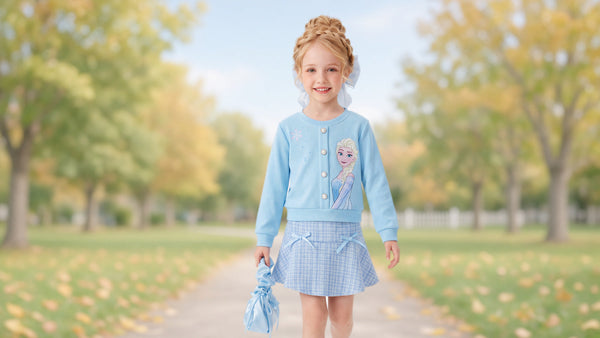
For children from 2Y to 5-6Y, the jacket we would plan the evening around is the Disney Frozen Elsa Sequin Padded Hooded Jacket. It is a different kind of jacket from the bomber, and the differences are what make it the evening piece.
- It is padded. The fabric line reads "96% polyester and 4% spandex; 100% polyester fiberfill." Fiberfill is insulation. Of the jackets in this guide, it is the only one with fill.
- It has a hood. A hood is the easiest piece of warmth to add and remove on a child who is sitting still, and it keeps a cool breeze off the neck during the wait for the fireworks.
- It zips. The product photos show a full front zipper rather than snaps, which closes the front completely on a breezy evening.
- The sequins are on the hood and the sleeves. The product page describes "shimmering fabric with character graphic." In the photos, the outside of the hood and both sleeves are covered in small iridescent sequins in pale blue and pink, while the body is smooth light blue with a large Elsa portrait, the name "ELSA" and a snowflake on the front. The cuffs and hem are striped rib knit in blue and white. The lining of the hood, visible when it is down, is plain.

The sequins are why this jacket earns a place in the evening plan as well as the warmth. Sequins are small reflectors, and a park after dark is full of point light sources: street lamps, lit shop windows, ride lights and, during the show, the fireworks themselves. A sequined sleeve or hood picks those up in a way a printed cotton jacket does not, and it does so in phone photos without any special setting. Because the sequins are on the hood and sleeves rather than the front panel, Elsa's face on the body stays clear in a straight-on photo, and the sparkle frames it.

Its reviews are few, four in total, all five stars. The comments are short, and one sizing note says it "feels like it runs small" in 5-6Y, which is worth knowing if you plan to put a sweater under it. One parent's verdict:
"Just as seen in the pictures... My toddler loves it."
— PatPat Customer, verified buyer, Elsa sequin padded hooded jacket, size 4-5Y, 5 stars, September 2024
Two practical notes for the park. First, because it is padded, this is not the jacket to stuff into a backpack at 10 a.m. If the morning is cool, let your child wear it to rope drop, then hang it on the stroller or tie it to the outside of the bag when it comes off. Second, it is a jacket, not a costume. Both resorts let children under 14 wear costumes, and Walt Disney World's rule reads: "Costumes may not be worn in our theme parks, water parks or ESPN Wide World of Sports Complex by Guests ages 14 or older." Disneyland's version is the same for its theme parks. A character jacket over everyday clothes is ordinary clothing, and for a toddler in the 2Y to 5-6Y range the costume rule does not come into play anyway.
If your Elsa fan is older than 5-6Y: when we checked in late November 2026, PatPat had no sequined Disney jacket available in larger sizes. Two older-girl sequin styles in the catalog could not be ordered on the U.S. site at the time of writing, so we have left them out. For an older child, the lightweight bomber plus a fleece for the evening, covered below, is the plan. For more everyday ways to wear the Elsa jacket at home, see our everyday Elsa outfits guide.
The jackets side by side
Here is every jacket in this guide on one table, including the two fleece options for cold snaps described in the next section. "Weather band" is our editorial judgment of where each fits in a winter park day, based on fabric and construction, not a temperature rating; PatPat does not publish warmth ratings for these jackets.
| Jacket | Weight and fabric (as listed) | Park-day job | Weather band | Sizes | Price (late Nov. 2026) |
|---|---|---|---|---|---|
| Minnie Mouse lightweight bomber, hot pink | Light: unlined knit, 96% polyester, 4% spandex; snaps; no pockets | Carry layer: rolls into the backpack from late morning to sunset | Mild; cool evenings with a layer under it | 3Y–9-10Y | List $29.99, now $26.99 |
| Mickey Mouse lightweight bomber, red | Light: unlined knit, 96% polyester, 4% spandex; snaps; no pockets | Carry layer: rolls into the backpack from late morning to sunset | Mild; cool evenings with a layer under it | 3Y–9-10Y | List $29.99, now $26.99 |
| Daisy Duck lightweight bomber, pink | Light: unlined knit, 96% polyester, 4% spandex; snaps; no pockets | Carry layer: rolls into the backpack from late morning to sunset | Mild; cool evenings with a layer under it | 3Y–9-10Y | List $29.99, now $23.99 |
| Elsa sequin padded hooded jacket, blue | Padded: 96% polyester, 4% spandex shell, 100% polyester fiberfill; zipper; hood with sequins; sequined sleeves | Night layer: evening wait, fireworks, night photos | Cool | 2Y–5-6Y | List $32.99, now $29.69 |
| Spider-Man ThermalHug™ fleece bomber, deep blue | ThermalHug™ brushed fleece; snaps; two welt pockets | Cold-front layer: worn from the morning, rides on the stroller | Cold snap | 2Y–8-9Y | List $40.99, now $36.89 |
| Elsa ThermalHug™ fleece jacket, light blue | ThermalHug™ brushed fleece; snaps; two welt pockets | Cold-front layer: worn from the morning, rides on the stroller | Cold snap | 2Y–5-6Y | List $39.99, now $35.99 |
Prices were checked on the product pages in late November 2026 and can change; the product page always shows the current price.
When a cold front comes through
NOAA's normals put the low at 40°F or below on about 2 to 5 nights a month at Orlando International in winter, and about 1 to 3 at the Anaheim station, with January the coldest month in Orlando. If your trip lands on one of those stretches, the light bomber and even the padded Elsa jacket need help. Check the forecast a few days out; the National Weather Service forecast for each resort is a search away on weather.gov.
For a cold front, swap the night layer for a fleece, or add one. PatPat's ThermalHug™ fleece jackets are the warm option in the Disney range. ThermalHug™ is PatPat's own name for a brushed fleece; the Elsa page describes it as a "soft brushed texture that feels plush against skin with lightweight warmth." Unlike the lightweight bombers, these jackets have two welt pockets, which is handy for small hands at the fireworks. The two below cover the widest age range between them: Spider-Man from 2Y to 8-9Y and Elsa from 2Y to 5-6Y.
 Spider-Man ThermalHug™ fleece bomber, deep blueShop now
 Elsa ThermalHug™ fleece jacket, light blueShop now
On a cold-front day, the order changes: the fleece goes on in the morning over the base layer, the lightweight bomber stays in the bag as the backup for the warmest hour, and both may be needed together after dark. A fleece is bulkier than the bomber, so on these days it usually rides on the stroller rather than in the backpack. How the lightweight bombers and the ThermalHug™ jackets compare across every U.S. climate, not just a park trip, is covered in our lightweight bomber vs. ThermalHug™ fleece guide.
What goes in the park backpack
The park bag does the work of a closet on a winter park day. Both resorts publish the same size limit. Walt Disney World's rules read: "Suitcases, bags, coolers or backpacks, with or without wheels, larger than 24" long x 15" wide x 18" high (61 cm x 38 cm x 46 cm) are not allowed in any theme park or water park." Disneyland's rule sets the same dimensions. An ordinary school-size backpack is well under that, and the limit is mostly a reason not to bring a rolling suitcase of layers.

For one child on a typical winter day, we would pack:
- The light jacket, rolled, once it comes off in the late morning.
- A thin long-sleeve top to add under the light jacket at sunset if the evening turns cooler than forecast.
- Spare socks. Wet socks from a splash ride or a puddle make a cool evening feel much colder.
- A resealable plastic bag or small dry bag for anything that gets wet, so it doesn't soak the dry layers.
- A rain poncho if the forecast shows rain. It covers the jacket and the bag, which matters more than keeping your child's head dry.
- A hat and light gloves for a cold-front evening. They take up almost no room and help most when your child is sitting still.
Two more tips. Write your child's name and your phone number inside every jacket, because jackets left on stroller handles and ride exits look alike in a lost-and-found bin. And expect that layered clothing may be checked at security: both resorts' rules say that "Clothing with multiple layers is subject to search." A jacket carried in the bag rather than worn in a stack through the entrance can make that step faster. Our Christmas travel packing list for families covers the suitcase side of a holiday trip.
Rides, lines, shows and the stroller
A few park situations change which layer your child should have on.
Water rides. A splash ride on a cool day can leave a child damp for the rest of the evening. Take the padded jacket off and put it in the dry bag before a water ride; fiberfill that gets soaked stays wet much longer than a thin knit. The light bomber is the better layer to risk, and a poncho over everything is better still.
Long indoor shows and restaurants. Many are cool inside. If your child is in a T-shirt in the afternoon, the light jacket goes on for the show and comes off at the exit. This is the most frequent change of the day, which is why the carry layer should be quick to open and close.
The stroller. A child riding in a stroller isn't generating heat by walking, so they feel cool earlier than you do. Check the back of the neck rather than the hands. When you park the stroller for a ride, take the jacket with you or tuck it underneath, because a character jacket on a stroller handle is easy to lose.
Drags and ties. Disneyland's rules state that "Clothing that drags on the ground is prohibited in theme parks." A jacket tied around a small child's waist can slip down and trail. A short jacket in the bag or on the stroller avoids the problem.
The drive. If you are driving or using a rental car seat, a padded jacket should come off before the harness is buckled; padding compresses under the straps. Put it on over the harness or as a blanket instead. Our toddler jacket guide explains car seats and coats in more detail.
Getting the photos you want
Most parents care about two sets of photos from a park day: the bright daytime ones in front of the landmarks, and the evening ones with lights behind the child. The layer plan affects both.
Daytime: the base layer and the light jacket are what show. If the character on the jacket matters to your child, keep the jacket open or closed so the front panel faces the camera; on these bombers the character is on the left front, so have your child stand slightly turned with their left side toward you. Hot pink, red and pink all stand out in bright daylight.
After dark: the night layer is what shows. Put warmth under the jacket you want in the picture, not over it. If your child is cold in the Elsa jacket, add the light bomber or a long-sleeve top underneath rather than a plain coat on top. With the Elsa jacket, have the hood down for a face shot and up for a picture from behind or the side with the lights in front; the sequins on the hood are most visible from those angles. Phone night modes work best when your child is still for a moment, which is easier when they are warm.
Coordinated family looks are covered in our family vacation ideas for 2026, which includes Orlando and Anaheim among its theme park destinations. This guide stays with what keeps a child comfortable enough to enjoy the day.
Christmas at the Parks: Coordinating the Whole Family

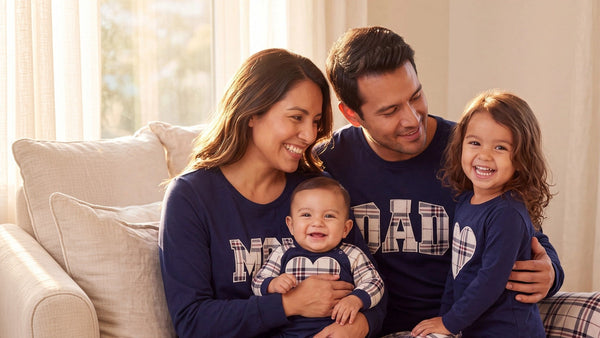
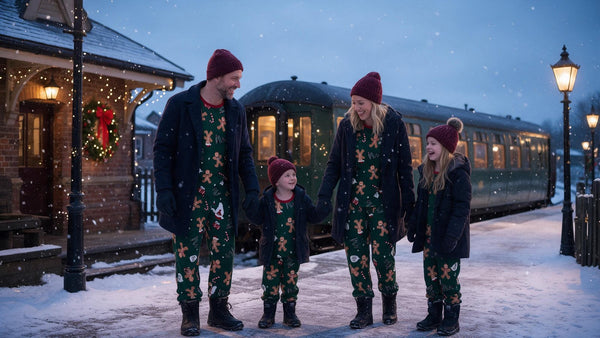
In December the photos usually include the adults too, so it helps if everyone's top works with the kids' jackets. You don't need a second set of layers for that. The plan above still does the work for your child; the only question is what the adults and siblings wear so the group looks like it belongs together in a picture in front of the castle or a lit-up tree.
Pick one color story, starting with the kids' jackets. The jackets are the pieces that show most, so build around them. The red, pink and hot pink Mickey and Friends bombers sit well next to red, which is also the easiest Christmas color for adults. If your child's evening layer is the blue Elsa jacket, let the blue be their accent and keep everyone else in red: one child in a contrasting color still reads as part of the family, while four different colors read as four separate outfits.
Match the tops, not the coats. Adults rarely need a character jacket. A family top in one print carries the match, and the adults' own plain coats go on top once the sun sets. These two Disney Christmas styles come in adult and kids' sizes from the same listing, so everyone's print and red are identical.
 Mickey and Friends Christmas family top, redShop now
 Mickey and Minnie snowflake fleece family sweatshirt, redShop now
Mickey and Friends Christmas family top, red. A long-sleeve top with a Christmas character print, in a 96% polyester and 4% spandex fabric the product page describes as moderate thickness, with a round neckline and a regular fit. In the three-layer plan, it is a base layer for a mild day. On November 29, women's S to XL and men's M to 2XL were $29.50, and girls' and boys' 2Y to 8-9Y were $21.99. The baby romper was sold out in every size, so families with a baby will want the sweatshirt below instead.
Mickey and Minnie snowflake fleece family sweatshirt, red. A crew-neck sweatshirt in 100% polyester coral fleece with a snowy Mickey and Minnie print, which the listing describes as thick. That makes it an evening piece rather than an afternoon one: on a typical December day in Orlando it belongs in the backpack until the temperature drops after sunset, the same way the night layer works for kids. On November 29, women's S to XL were $37.19, men's M to 2XL $39.59, girls' and boys' 2Y to 8-9Y $26.39 and baby 0-3M to 12-18M $15.59, so it is the one that covers a whole family including a baby.
Sizing for the adults. Adult tops are worn under a coat at night, so check the adult size chart on the product page and choose the size that leaves room for a layer on top rather than sizing up the top itself. For children, keep to the sizing advice in the sections below; a top that is too long bunches under a bomber.
In the photo, stand the children in front with their jackets open so the character panels show, and the adults behind in the matching red tops. If you want to compare a knit bomber with a fleece for a child who runs cold, our guide to Disney bomber jackets versus fleece covers the difference, and the full range of Disney jackets shows which colors are in stock before you choose your family color.
Disney World vs. Disneyland: what to change
The plan is the same at both resorts, with two adjustments based on the NOAA numbers.
- Disneyland: assume you will need the night layer every evening, because the low reaches 50°F or below on most winter nights at the Anaheim station, and sunset comes earlier. A January or February trip should also plan for rain, which averages about 3 inches a month in those months.
- Walt Disney World: evenings are mild a little more often, and the light bomber alone may cover a warm December night. But keep a fleece in the suitcase for a January trip, when Orlando averages about one freezing night and nearly five nights at 40°F or below.
Either way, Florida and California children may not own a cold-weather layer at all. If you are flying in from a colder state, the fleece your child already wears at home is the right night layer, and the lightweight bomber is the piece to add.
Sizing for a day of layers
All the jackets in this guide go over something. For the lightweight bombers, the 4% spandex gives a little room, and reviews mostly describe the fit as true to size, though not unanimously: one 3-4Y buyer said it "runs a little small," while another buyer found the sizes "a little roomy." If your child will wear a hoodie under it in the evening, as the parent above does, consider one size up. For the padded Elsa jacket, the only sizing note in its reviews says it feels small, so check your child's measurements against the size chart on the product page before ordering, and leave room for a long-sleeve top under the padding. Our guide to how a kids varsity jacket should fit covers measuring and sizing up for layers step by step.
Wash new jackets once before the trip, following the care line on each page, and check the snaps and zipper. For the sequined Elsa jacket, turning it inside out before washing protects the sequins; our jacket washing guide covers sequins and fleece in more detail.
The bottom line
A winter park day at either resort runs from a cool morning through a warm afternoon to an evening that cools by 20-plus degrees, and the coldest part is often the first hour in line. Dress your child in three pieces: a long-sleeve base, a light jacket you can roll into the backpack, and a warmer layer with a hood for the hours after sunset. For the carry layer, a lightweight Mickey, Minnie or Daisy bomber does the job without taking over the bag. For the evening, toddlers and preschoolers up to 5-6Y have the padded Elsa jacket with its sequined hood and sleeves, which shows up in night photos in a way a plain coat does not. On a cold-front trip, add a ThermalHug™ fleece. When you're ready, browse all Disney jackets for kids and check each product page for current sizes and prices before you pack.
For a Christmas trip, put the adults in a matching red Disney family top or sweatshirt and let the kids' jackets carry the color, as described in the family coordination section above.
Frequently asked questions
What should kids wear to Disney World in December? A long-sleeve base, a light jacket for the cool morning and the evening, and a warmer layer for after sunset. At Orlando International Airport, NOAA's normals for December are an average high of 73.8°F and an average low of 52.9°F, and the sun sets around 5:30 p.m.
Is Disneyland colder than Disney World in winter? Their average highs and lows are within about five degrees of each other, but the Anaheim station's low falls to 50°F or below on more nights, about 17 to 22 a month in winter against about 10 to 16 at Orlando International. Orlando has the occasional freezing night; the Anaheim station averages none.
Can my child wear an Elsa costume to the parks? Children under 14 can wear costumes at both Walt Disney World and Disneyland; guests 14 and older cannot (Walt Disney World makes exceptions at some separately ticketed events). Check the resort's official rules page before your visit, since policies can change.
Will a lightweight bomber be warm enough at night? On a mild evening, often yes, over a long-sleeve top. On most winter evenings, plan to add a hoodie under it or a warmer jacket over it. Reviewers describe it as a light, windbreaker-weight layer.
What size backpack can I bring into the parks? Both resorts do not allow bags larger than 24 inches long, 15 inches wide and 18 inches high. A regular school backpack is well within that.
What should a family wear to Disney World at Christmas? Dress the kids in the three-layer plan, then match the rest of the family to the kids' jackets with one color, usually red. A Disney Christmas top or a fleece sweatshirt that comes in adult and kids' sizes from the same listing gives everyone the same print, and the adults' plain coats go on top after sunset.
About this article
Written and fact-checked by the PatPat Editorial Team. How we research, source and review what we publish is set out on our editorial standards page.
Method. Fabric lines, detail lists, care instructions, authorization statements, sizes and prices come from the PatPat product pages and catalog data for the six jackets in this guide, checked in late November 2026. Construction details such as sequin placement, closures, pockets and linings come from the official product photos. Review counts come from the reviews shown on each product page, counted for each jacket on its own. Climate figures are NOAA's 1991–2020 U.S. Climate Normals for the Orlando International Airport and Anaheim, California stations; sunset times are calculated with NOAA's solar calculator equations for each resort. Park rules are quoted from the official Walt Disney World and Disneyland Resort rules pages as published in November 2026. PatPat sells these jackets, and we did not wear-test them in the parks. The layer plan and weather bands are editorial judgment, not temperature ratings. PatPat is not affiliated with the Walt Disney World Resort or the Disneyland Resort.
Sources. Climate: NOAA NCEI, Monthly Climate Normals 1991–2020, Orlando International Airport and Anaheim, CA. Sunset times: NOAA Global Monitoring Laboratory, Solar Calculator. Park rules: Walt Disney World Resort, Property Rules and Disneyland Resort, Park Rules. Dressing children in layers: American Academy of Pediatrics, Cold Weather Safety.
Update, November 29, 2026. We added a section on coordinating the whole family for a Christmas trip; sizes and prices for the two family tops were checked on the product pages that day.
Last updated November 2026 · Next review November 2027