The short answer
A bedtime routine for kids works over the holidays for the same reason it works the rest of the year: the steps come in the same order every night, so the child's body knows what comes next even when the day was nothing like normal. Keep the routine short, about 20 to 30 minutes, built around three things that can travel anywhere: the same kind of pajamas, the same book or story, and the same song or phrase at lights-out. Turn screens off an hour before bed, let bedtime drift by no more than you are willing to undo in January, and on the big nights (Christmas Eve and New Year's Eve) shorten the routine rather than skip it.
Below is a simple routine by age, how to protect it when relatives visit or you travel, a plan for Christmas Eve, and how to get back to a school schedule. PatPat sells the pajamas shown, so treat those as editorial suggestions; the routine itself costs nothing.
What a Bedtime Routine for Kids Actually Includes
The American Academy of Pediatrics sums up a young child's routine in three words: brush, book, bed. Most families already do something close to it. In a national poll of parents of children ages 1 to 6, the C.S. Mott Children's Hospital found that 90% had a bedtime routine, most often brushing teeth, reading stories and a bath. The same poll found that 27% of parents described getting their child to bed as difficult, and that those parents were less likely to have a routine and more likely to leave a video or TV show on.
A workable routine has four steps, always in the same order:
- Wash. A bath, or just a face wash and teeth on busy nights.
- Pajamas. The change into sleepwear is the clearest signal that the day is over.
- Book or story. One or two, agreed before you start, not negotiated at the end.
- Lights out with the same words. A song, a short prayer, or the same goodnight sentence every night.
How much sleep the routine is protecting depends on age. These are the CDC's recommended totals per 24 hours; the routine lengths are our suggestions.
| Age | Recommended sleep (CDC) | Routine length | Holiday tip |
|---|---|---|---|
| 1 to 2 years | 11 to 14 hours, including naps | 20 minutes | Protect the nap too, or bedtime falls apart |
| 3 to 5 years | 10 to 13 hours, including naps | 20 to 30 minutes | Give one warning 10 minutes before the routine starts |
| 6 to 12 years | 9 to 12 hours | 30 minutes | Let them choose the book, not the bedtime |
| 13 to 17 years | 8 to 10 hours | Their own | Agree on a phone-down time instead of a bedtime |
The sleep figures come from the Centers for Disease Control and Prevention. If a child naps, the nap counts toward the total.
Why the Holidays Break the Routine
It is rarely one thing. December stacks small changes: later dinners at relatives' houses, a school concert on a weeknight, cousins sleeping over, a different bed while traveling, more screens, more sugar and, for many kids, real excitement about what is coming. Each change pushes bedtime a little later, and after a week of that, a child who used to fall asleep at 7:30 is wide awake at 9:00.
You cannot control most of those changes, so control the part you can: the order of the last steps before sleep. A child who has had a strange day but still gets wash, pajamas, book and the same goodnight words has a familiar end to it.
Three Anchors That Travel: Same Pajamas, Same Story, Same Song
When the setting changes, keep three things the same. They are small enough to pack and they do most of the work.
The same kind of pajamas
The pajamas do not have to be the same pair every night, but they should feel the same: the same fabric, the same fit, nothing new and scratchy on a night that is already unusual. For young children, a soft two-piece that fits close to the body is a simple choice. Under US rules, children's pajamas from 9 months through size 14 have to be either flame-resistant or snug-fitting, as our guide to why kids' pajamas have to fit snugly explains, so buy snug-fitting sets in the true size, not one up.
The toddler set below is a good example of the everyday kind. It is a two-piece in bamboo viscose with spandex, labeled "Wear snug-fitting, not flame resistant," with a flat-seam tagless label, an elastic neckline and elastic cuffs. The print is capybaras and flowers rather than anything Christmas, which is the point: these are the pajamas that stay in the routine in January. When we checked it was in stock from 6-9M through 5T. More options are in our toddler pajamas and bamboo pajamas collections.

For children who notice every seam and tag, our guide to sensory-friendly pajamas covers what to check before a holiday trip.
The same story
Bring one familiar book even if you buy a new holiday one. On a night when everything is different, children often ask for the book they already know by heart. If space is tight, a story you tell from memory works the same way and weighs nothing.
The same song or words
The last thing said before lights-out is the strongest cue of all because it is the end of the routine. Pick something that works over a video call too, so a parent who is away can still say it.
Screens, Sugar and Late Dinners: What to Adjust
Some holiday changes are worth fighting and some are not. Our ranking, from most to least worth the effort:
- Screens off an hour before bed. The AAP advises turning off all screens at least 60 minutes before bedtime and keeping them out of children's bedrooms at night, on the same sleep page. On a family movie night, start the movie earlier rather than letting it run into bedtime; for short options, see our list of Christmas movies for toddlers sorted by length.
- The routine itself. On a late night, shorten each step instead of dropping any: a two-minute wash, one book instead of three, the same song.
- The bedtime. A half hour late a few times in December is easy to undo. Two hours late every night for two weeks is not.
- Treats. Hard to control at a party and not worth a standoff. Offer the treat earlier in the evening if you can, and brush teeth afterward.
Bedtime Away From Home: Relatives, Hotels and Sleepovers
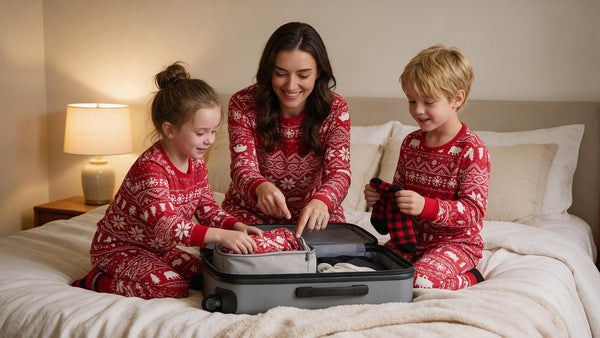
A new room is the hardest change for most children, so bring the routine with you. Pack the pajamas, the book and anything that goes in the bed every night in the same bag, and do the routine in the same order even if the bathroom is down the hall. Our Christmas travel packing list for families has the rest of the list.
The other problem with someone else's house is that you do not know how warm the bedroom will be. A set with more than one bottom helps. The kids' set below has three pieces: a short-sleeve top, long pants and shorts, so a child can sleep in pants in a cool room and shorts in a warm one without packing two sets. It is bamboo viscose with spandex, labeled snug-fitting, with a candy cane Christmas print, in sizes 2T through 12 when we checked. The kids pajamas collection has more choices.

For babies, follow the same safe sleep rules away from home as you do at home: on the back, on a firm, flat surface, with no pillows, blankets or soft toys in the crib. If you are borrowing a travel crib, check that it is set up with only its own fitted sheet.
Christmas Eve: Keep the Routine, Make It Special
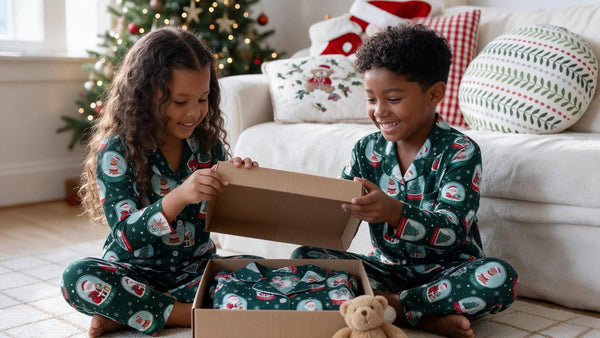
Christmas Eve is the night when the routine matters most and is hardest to keep. The trick is to turn the excitement into part of the routine instead of fighting it. Many families open new pajamas on Christmas Eve; if yours does, make that the "pajamas" step, done at the usual time rather than at 9 p.m. Then book, song, lights out, the same as every other night.
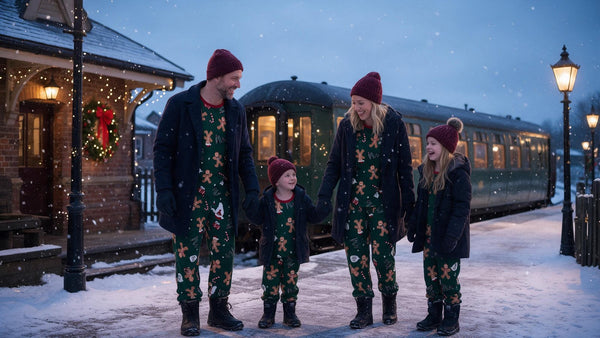
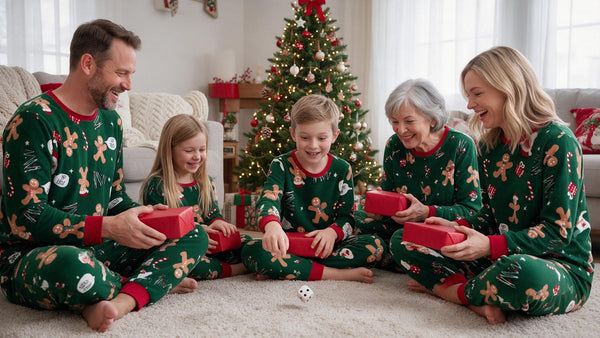
If the whole family is changing into matching pajamas, it helps to pick a fabric that feels like the everyday ones, so nobody is kept up by something new and stiff. The family set below is bamboo viscose with spandex, with a snug-fit two-piece cut for kids, contrast green trim, a tagless label and sizes for babies, kids and adults. It is a Christmas print, so it goes back in the drawer after the holidays, but it feels like the soft everyday pajamas above. Our family matching bamboo pajamas collection has other prints in the same kind of fabric, and our comparison of the softest Christmas pajamas explains the differences.

Two other things help on Christmas Eve. Give the waiting a job: leaving the plate for Santa or reading one particular story can be the last step before bed, as our guide to the waiting for Santa tradition describes. And if the family does a Christmas Eve box, open it about an hour before bed, not right before lights-out; the Christmas Eve box guide explains timing by age.
Getting Back on Schedule After the Holidays
Most families need a few days to undo two weeks of late nights, so start before school does. Our suggestion is to move bedtime and wake-up time back by about 15 minutes every night or two, starting four to five days before the first school day, and to bring back any screen rules on the same day. If New Year's Eve is a late night, plan the next two nights as early ones. For what to wear on a night in to watch the countdown, see our guide to New Year's Eve pajamas.
Keep the anchors going through January. The holiday pajamas go back in the drawer, but the book, the song and the order of the steps stay, which is what makes the next holiday easier.
Frequently asked questions
How long should a bedtime routine for kids be? About 20 to 30 minutes for most young children. Long enough for a wash, pajamas, a book and a goodnight, and short enough to keep on a late night.
Should kids keep the same bedtime during the holidays? Keep the routine the same even when the bedtime moves. A bedtime that slips a little on a few nights is easy to undo; a much later bedtime every night for two weeks takes longer to reverse.
How do I get my child to sleep on Christmas Eve? Do the usual routine at the usual time, and make Christmas Eve traditions such as new pajamas or leaving a plate for Santa part of it. Turn screens off an hour before bed.
How do I keep a bedtime routine when traveling? Pack the pajamas, a familiar book and anything that goes in the bed every night, and do the steps in the same order in the new room. Babies should still sleep on their backs on a firm, flat surface with nothing soft in the crib.
About this article
Written and fact-checked by the PatPat Editorial Team. How we research, source and review what we publish is set out on our editorial standards page.
Method. This replaces two older articles on holiday bedtimes on our site. We removed statistics and studies we could not trace and kept only claims supported by the sources below. The routine lengths, the ranking of what to adjust and the back-to-school schedule are editorial suggestions, not medical advice; ask your pediatrician about your own child's sleep. Product details and stock were read from PatPat listings on 28 November 2026; PatPat sells these products.
Sources. Routine and screens: AAP, Healthy Sleep Habits. Sleep by age: CDC, About Sleep. Parent poll: C.S. Mott Children's Hospital National Poll on Children's Health. Safe sleep: AAP, A Parent's Guide to Safe Sleep.
Last updated 27 November 2026 · Next review November 2027