


You are holding your newborn for the first time, completely consumed by love, and then the hospital bill arrives. Suddenly, a wave of financial anxiety crashes over the joy. You are not alone. Research from Motherly finds that raising a baby now costs $20,384 in the first year alone, and that figure climbs dramatically higher once you factor in childcare. For many families, learning how to create a family budget after having a baby is not optional -- it is essential for your peace of mind and your family's financial health.
The National Endowment for Financial Education highlights that new parents experience significant financial trauma during the overwhelming transition into parenthood. The first year is financially the most unpredictable because one-time purchases stack on top of recurring costs while your income may be shifting due to parental leave. But here is the good news: budgeting for a baby is not about cutting joy out of your life. It is about directing your money where it matters most. This guide gives you a realistic expense breakdown, a step-by-step budget creation process, money-saving strategies for every category, and current tax benefits you can claim. At PatPat, we believe every family deserves access to quality baby essentials without financial stress -- and that starts with a plan.
How Much Does a Baby Really Cost in the First Year?
Before you can build your first year baby budget, you need to understand what you are actually spending on. The cost of raising a baby in the first year varies widely depending on your location, childcare needs, and lifestyle choices. Let us break down the numbers.
One-Time Expenses Every New Parent Should Expect
The initial wave of baby purchases can feel overwhelming, but knowing the ranges helps you plan your newborn expenses list strategically.
| Category | Budget-Friendly | Mid-Range | Premium |
|---|---|---|---|
| Crib and mattress | $100-200 | $250-500 | $600-1,500 |
| Stroller | $80-150 | $200-500 | $600-1,500 |
| Car seat | $80-150 | $150-350 | $350-550 |
| Nursery furniture | $200-400 | $500-1,200 | $1,200-3,000 |
| Baby monitor | $30-60 | $80-200 | $200-400 |
| Hospital/delivery costs (after insurance) | $1,000-3,000 | $3,000-6,000 | $6,000-15,000+ |
| Total one-time range | $1,490-3,960 | $4,180-8,750 | $8,950-22,450 |
A key insight many parents miss: baby registries, secondhand marketplaces, and Buy Nothing groups can reduce one-time expenses by 40-60%. Think of your registry as a strategic financial tool, not just a wish list.
Monthly Recurring Costs Breakdown for a Newborn
If you are asking "how much does a baby cost per month," the answer depends heavily on two decisions: your feeding method and your childcare arrangement. Here is the monthly baby expenses breakdown.
| Expense Category | Low Estimate | Average | High Estimate |
|---|---|---|---|
| Diapers and wipes | $60-80 | $80-100 | $100-150 |
| Formula (if applicable) | $0 (breastfeeding) | $150-250 | $300-500 |
| Baby clothing | $30-50 | $50-80 | $100-200 |
| Healthcare (copays) | $20-40 | $40-80 | $80-150 |
| Childcare | $0 (at-home parent) | $1,000-1,800 | $1,800-2,500+ |
| Baby food (month 4-6+) | $0-30 | $40-80 | $80-120 |
| Miscellaneous | $20-40 | $40-80 | $80-150 |
| Monthly total (without childcare) | $130-240 | $400-670 | $740-1,270 |
| Monthly total (with childcare) | $1,130-2,040 | $1,400-2,470 | $2,540-3,770 |
Childcare is the single largest variable. According to Care.com's 2026 Cost of Care Report, the average parent spends 20% of their household income on child care costs -- nearly triple the 7% benchmark the U.S. Department of Health and Human Services considers affordable.
Hidden Costs Most New Parents Underestimate
Standard baby cost lists miss several expenses that repeatedly catch new parents off guard:
- Utility bill increases: More laundry, higher heating and cooling for nursery comfort -- expect $30-80/month more
- Takeout food spike: Sleep-deprived parents cook less in the first three months, adding $100-300/month temporarily
- Lost income: Unpaid leave or reduced hours during parental leave varies dramatically by employer and state
- Insurance premium increases: Adding a dependent to your health plan raises premiums
- Relationship maintenance: Babysitter fees for date nights or couples counseling -- $50-200/month
Accounting for these hidden costs of having a baby upfront prevents budget-busting surprises during the exhausting first six months.
Step-by-Step Guide to Creating Your Family Baby Budget
Now that you understand what things cost, here is how to create a family budget after having a baby using a clear seven-step process. Think of this as your baby budget template you can customize to your situation.
Step 1: Calculate Your Post-Baby Household Income
Start with your combined take-home pay after taxes. Then account for the income changes that come with parental leave. Short-term disability typically pays 60-80% of salary in most states for 6-8 weeks. Factor in any loss of overtime, bonuses, or side income during the newborn phase. Also include expected government benefits like the child tax credit. Create both a "worst case" and "expected case" income projection for the first 12 months.
Step 2: Map Your Current Fixed and Variable Expenses
List every monthly obligation: rent or mortgage, car payments, insurance, subscriptions, and debt payments. Separate fixed expenses from variable expenses. Identify which variable costs will shift after baby -- groceries will likely increase, while entertainment and dining out will naturally decrease.
Step 3: Add Baby-Specific Expenses
Reference the cost tables above and choose the estimate range that fits your situation. Start with mid-range estimates and plan to adjust after the first month of real spending data. The two decisions with the largest budget impact are breastfeeding versus formula and in-home versus center-based childcare.
Step 4: Apply the 50/30/20 Budget Rule Adapted for New Parents
The 50/30/20 budget rule for families divides after-tax income into needs (50%), wants (30%), and savings or debt repayment (20%). After a baby, most families temporarily shift to 60-65% needs, 15-20% wants, and 15-20% savings.
| Category | Pre-Baby ($5,500 net) | Post-Baby ($5,500 net) |
|---|---|---|
| Needs (housing, utilities, groceries, insurance, baby essentials) | $2,750 (50%) | $3,300-3,575 (60-65%) |
| Wants (dining, entertainment, personal) | $1,650 (30%) | $825-1,100 (15-20%) |
| Savings and debt repayment | $1,100 (20%) | $825-1,100 (15-20%) |
The ratio typically rebalances within 12-18 months as one-time baby costs taper off.
Step 5: Identify Expenses to Reduce or Eliminate
Audit your subscriptions: streaming services, gym memberships, and meal kits add up quickly. Renegotiate insurance, phone, and internet bills. The key is shifting your "wants" spending toward baby-related joy rather than eliminating happiness entirely. Swap restaurant meals for at-home cooking nights. Pause gym memberships in favor of stroller walks.
Step 6: Automate Savings and Bill Payments
Set up automatic transfers to a dedicated baby emergency fund. Use separate checking or savings accounts to track baby-specific spending. Budget apps like YNAB, Goodbudget, EveryDollar, and Monarch Money can simplify tracking -- these are among the best budget apps for new parents available today.
Step 7: Review and Adjust Monthly
A baby budget is not a set-it-and-forget-it document. Expenses shift dramatically between months 0-3, 4-6, and 7-12. Schedule a 15-minute monthly budget review with your partner and track where actual spending deviates from projections.
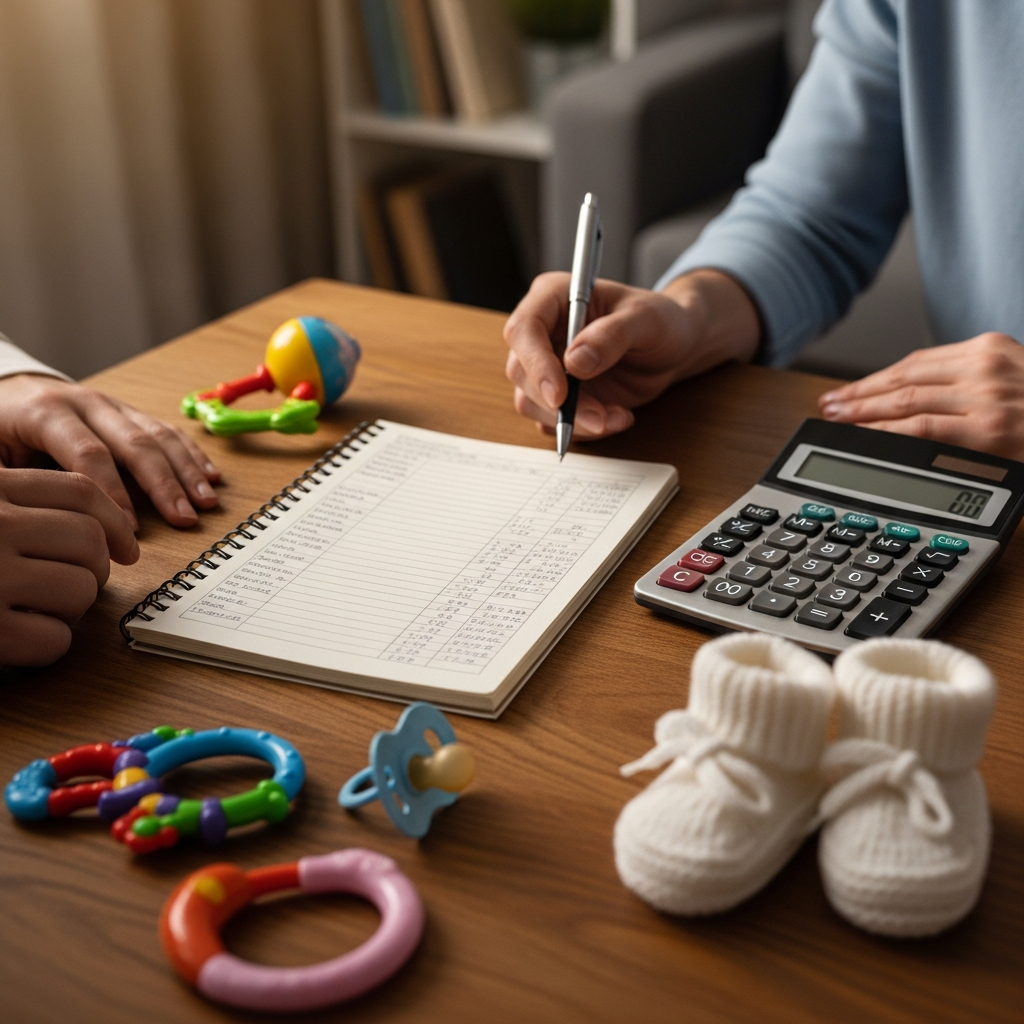
Saving Money on Baby Essentials Without Sacrificing Quality
Knowing the costs is one thing. Reducing them without sacrificing your baby's comfort and safety is where the real savings happen. Here is how to approach saving money with a newborn across the biggest expense categories.
Diaper and Wipes Strategies That Cut Costs by 30-50%
Your monthly diaper and wipes budget does not need to reach $100. These strategies can bring it down to $50-70:
- Cloth diapering: Costs $400-600 total over 12 months compared to $900-1,200 for disposables
- Bulk buying timing: Warehouse clubs and Amazon Subscribe and Save offer 15-25% savings
- Generic store brands: Consumer testing consistently shows store-brand diapers perform comparably to premium names
- Stockpiling during sales: Buy one size ahead when deep discounts appear
Feeding on a Budget: From Breastfeeding to First Foods
Breastfeeding, when possible, saves $1,800-6,000 in formula costs over the first year. However, not everyone can breastfeed, and that is perfectly okay. If you use formula, reduce costs with store-brand versions (nutritionally equivalent by FDA mandate), manufacturer coupons, and WIC benefits if eligible. When solids begin at months 4-6, homemade baby food costs a fraction of store-bought pouches, and baby-led weaning eliminates puree costs entirely.
The Registry Strategy That Offsets Thousands in Initial Costs
Build your baby registry strategically by prioritizing high-cost items that family and friends are most likely to purchase as gifts. Take advantage of completion discount programs -- most registries offer 10-15% off remaining items. Babylist's "open to secondhand" feature signals to gift-givers that pre-loved items are welcome. What baby items should you not waste money on? Skip wipe warmers, baby shoes for pre-walkers, and excessive newborn-sized outfits -- babies outgrow that size in weeks.
How to Budget for Baby Clothes Without Overspending
Baby clothing is one of the most emotionally tempting spending categories. Those tiny outfits are irresistible. But here is a counterintuitive truth: spending less on baby clothes often means your baby is dressed better, because a curated capsule wardrobe of versatile pieces looks more put-together than a chaotic drawer of impulse purchases.
Building a Capsule Wardrobe for Your Newborn on a Budget
A baby capsule wardrobe consists of 15-20 versatile, mix-and-match essentials rather than 50+ single-outfit pieces. Here is what you need:
- 6-8 bodysuits or onesies
- 4-5 sleepers or pajamas
- 3-4 pants or leggings
- 2-3 lightweight jackets or sweaters
- Socks and hats as needed
Your monthly baby clothing budget target should be $30-50 for budget-conscious families. Consider the price-per-wear calculation: a $12 onesie worn 30 times costs $0.40 per wear, while a $25 boutique outfit worn three times costs $8.33 per wear. Multi-packs and bundles offer the best value for everyday basics. Retailers like PatPat specialize in affordable baby clothing bundles and multi-packs that make building a capsule wardrobe easy without overspending.
Why Investing in Bamboo Baby Clothes Saves Money Long-Term
Here is a budget insight that surprises most parents: spending slightly more on bamboo baby clothes upfront often saves money over time. Bamboo fibers maintain softness and shape through 50+ washes, while standard cotton pills and fades faster, needing replacement sooner. The bamboo vs cotton baby clothes cost comparison favors bamboo when you factor in durability.
Beyond durability, bamboo is naturally hypoallergenic and antibacterial, which can reduce skin rashes -- meaning fewer diaper cream purchases and pediatric copays. Bamboo also regulates temperature, keeping babies cooler in summer and warmer in winter. This potentially reduces the need for season-specific wardrobe purchases. And if you choose gender-neutral bamboo basics, they can be reused for future siblings, doubling or tripling their value. You do not need to pay luxury boutique prices for bamboo quality. PatPat's bamboo baby clothes collection offers hypoallergenic, ultra-soft bamboo bodysuits and sleepers at accessible price points that fit a new parent budget.

Preparing Your Budget for Maternity and Paternity Leave
Most budgeting guides focus exclusively on expenses. But for many families, the income side of the equation creates just as much financial stress after having a baby. Understanding how to financially survive maternity leave -- especially without full pay -- is critical to your budget's success.
How to Financially Prepare Before Your Leave Begins
If you are expecting, start a leave savings fund 6-12 months before your due date. Target three months of essential expenses. Understand your employer's leave policy in detail: paid versus unpaid weeks, short-term disability coverage (typically 60-80% of salary for 6-8 weeks), and whether your state offers paid family leave. Front-load bills where possible and reduce variable expenses 2-3 months before baby arrives.
One powerful strategy: the "trial run." Live on your projected reduced income for 2-3 months before leave starts and save the difference. This simultaneously builds your savings buffer and proves you can handle the adjustment.
Single-Income Transition Guide for Growing Families
When figuring out how to budget when going from two incomes to one with a baby, start with the break-even calculation. If childcare costs approach or exceed one parent's take-home pay, staying home may be the financial decision, not just the lifestyle one. The U.S. Department of Labor's National Database of Childcare Prices documents the full scope of childcare costs by county and provider type, illustrating just how severe the childcare cost burden has become for American families.
If your family transitions to a single income, explore government assistance programs you may now qualify for: WIC (covers formula, food, and nutritional support), SNAP, Medicaid expansion for children, and CHIP. Also maintain a small discretionary budget for the non-earning partner -- this prevents resentment and preserves financial identity.
Tax Benefits and Savings Programs Every New Parent Should Know
Government programs and tax benefits can put thousands of dollars back into your family budget. Many new parents leave money on the table simply because they do not know these programs exist.
The Trump Account: A New Tax-Free Savings Option for Your Baby
Trump Accounts are new tax-advantaged long-term savings and investment accounts designed for children, established through the One Big Beautiful Bill Act in 2025. Here are the key details:
- Government deposit: $1,000 for children born between January 1, 2025 and December 31, 2028
- Annual contribution limit: $5,000 (employer may contribute an additional $2,500)
- Investment options: Funds must be invested in mutual funds or ETFs tracking American equity indices
- Launch date: Accounts officially become active on July 5, 2026
Compared to 529 plans that restrict funds to education expenses, Trump Accounts offer more flexible withdrawal rules once the child turns 18, when the account converts to a traditional IRA. For maximum impact, consider opening both: a Trump Account for flexible long-term savings and a 529 plan specifically for education.
Child Tax Credit, Dependent Care FSA, and Other Benefits
Here is a quick reference table of benefits available to new parents:
| Benefit | Annual Value | How to Claim |
|---|---|---|
| Child Tax Credit | Up to $2,200 per child | Annual tax return (Form 1040) |
| Dependent Care FSA | $1,000-1,500 in tax savings | Employer benefits enrollment |
| Trump Account government deposit | $1,000 one-time | Apply after July 2026 launch |
| 529 Plan state tax deduction | Varies by state ($0-500+) | State-level tax benefit |
For 2026, the maximum Child Tax Credit remains at $2,200 per qualifying child, with a refundable portion of up to $1,700. The Dependent Care FSA allows you to set aside $5,000 per year in pre-tax dollars for childcare expenses, effectively reducing your taxable income. Remember that adding a baby is a Qualifying Life Event, which means you can make mid-year changes to your health insurance and FSA elections outside of open enrollment.
Building an Emergency Fund and Long-Term Financial Security
A monthly budget handles predictable expenses. But babies bring unpredictable ones too -- illness, equipment failures, sudden job changes. Financial planning for new parents must include a safety net.
How Much Emergency Savings Do New Parents Actually Need?
The standard recommendation of 3-6 months of expenses adjusts upward for new parents. Aim for 4-6 months because baby-related emergencies are more common than most people expect. Calculate your target: monthly essential expenses multiplied by your chosen number of months. Even $50-100 per month into a high-yield savings account (earning 4-5% APY currently) builds real security over time. Keep your emergency fund in a savings account, not invested in the stock market -- you need it accessible without market risk.
Life Insurance, Wills, and Estate Planning Basics
These are the financial tasks new parents know they should handle but often delay:
- Term life insurance: 20-30 year terms cost $20-50/month for $500,000+ coverage. Both parents need coverage, including stay-at-home parents -- replacing childcare labor costs $15,000-30,000 per year
- Basic will: Name a legal guardian for your child and establish who manages finances if something happens to you
- Beneficiary updates: Update all retirement accounts, insurance policies, and bank accounts after your baby is born
Schedule a one-hour "family protection session" to address all three items. It is one of the highest-impact financial actions you can take as a new parent.
Frequently Asked Questions About Budgeting for a Baby
How much does it cost to have a baby in 2026?
The total first-year cost ranges from $20,000 to $50,000 depending on location, childcare needs, and insurance coverage. Without childcare, most families spend $6,000-$12,000 on essentials like diapers, clothing, gear, and healthcare. With full-time childcare, costs jump to $18,000-$37,000. Hospital delivery costs alone average $2,500-$6,000 after insurance.
How do you budget for a baby on a tight budget?
Focus on four high-impact strategies: breastfeed if possible to save $1,800-$6,000 in formula costs, buy diapers in bulk during sales to cut costs by 30-40%, build a capsule wardrobe of 15-20 versatile clothing pieces instead of 50+ items, and apply for every benefit you qualify for including WIC, Medicaid, CHIP, and the Child Tax Credit.
What is a realistic monthly baby budget for the first year?
A realistic monthly baby budget ranges from $400-$670 without childcare and $1,400-$2,470 with center-based childcare. The largest recurring expenses are childcare ($1,000-$2,500/month), diapers and wipes ($60-$100/month), formula if applicable ($150-$300/month), and baby clothing ($30-$80/month).
How much should you have saved before having a baby?
Financial advisors recommend saving $10,000-$20,000 before having a baby: $3,000-$5,000 for out-of-pocket delivery costs, $3,000-$5,000 for one-time baby gear, and $4,000-$10,000 as an emergency fund buffer for income loss during leave. If those targets feel out of reach, even $5,000 provides a meaningful cushion.
What are the biggest expenses in the first year with a baby?
The five biggest first-year expenses ranked by cost: (1) childcare at $12,000-$25,000/year, (2) hospital delivery at $2,500-$6,000 after insurance, (3) formula at $1,800-$6,000/year if not breastfeeding, (4) diapers and wipes at $900-$1,200/year, and (5) baby gear and furniture at $1,500-$4,000 one-time.
What is the 50/30/20 budget rule for new parents?
The 50/30/20 rule divides after-tax income into 50% needs, 30% wants, and 20% savings and debt repayment. After having a baby, most families temporarily adjust to 60-65% needs, 15-20% wants, and 15-20% savings. The ratio typically returns closer to the standard split within 12-18 months.
What is a Trump Account and should I open one for my baby?
A Trump Account is a new tax-advantaged savings account for children launching July 5, 2026. Children born after January 1, 2025 receive a $1,000 government deposit, and parents can contribute up to $5,000 annually with tax-deferred growth. Unlike 529 plans, Trump Accounts offer more flexible withdrawal options after the child turns 18. Most financial advisors recommend opening one alongside other savings vehicles.
How can new parents save money on baby clothes?
Build a capsule wardrobe of 15-20 versatile pieces rather than buying dozens of outfits. Shop off-season clearance sales for the next size up. Choose gender-neutral basics that work for future siblings. Buy multi-packs for everyday items like bodysuits. Invest in durable fabrics like bamboo that maintain quality through 50+ washes. Accept hand-me-downs and shop consignment sales to reduce your clothing budget by 50-70%.
Your Baby Budget Starts Today
Learning how to create a family budget after having a baby can feel overwhelming at first, but remember: you do not need a perfect plan on day one. You need a starting point. The financial stress that felt unmanageable now has a clear, step-by-step framework behind it. Here are your three most impactful next steps:
- Know your real numbers by tracking first-year costs using the expense breakdowns in this guide
- Build a written budget using the 50/30/20 framework adapted for your family's income and needs
- Claim every benefit available -- the Child Tax Credit, Dependent Care FSA, and Trump Account alone can put thousands back into your pocket
Start with just one step today, even if it is simply writing down your monthly income and fixed expenses. Budgeting for a baby gets easier with each month of practice. And if you are looking to stretch your baby clothing budget further, explore PatPat's baby clothes collection for affordable, quality essentials that keep both your baby and your budget comfortable. Your family's financial confidence starts with the decision to plan -- and you have already taken that step by reading this guide.





