The short answer
Christmas around the world differs most in three things: who brings the gifts, which night they arrive, and what the family eats or does together. In the United States the big moment is Christmas morning. In Germany, Poland and much of Scandinavia it is Christmas Eve. In the Netherlands the main gift night is December 5, in Spain and Italy many children wait until January 5 or 6, and in Ethiopia Christmas falls on January 7. The table below lays those out side by side, and the second half of this guide shows how to borrow one tradition at home in a single evening, sorted by your kids' ages.
Every custom here was checked against a tourism board, city government, museum or reputable publication, linked in the text. Where a custom is a folk belief rather than a common practice today, we say so.
Who Brings the Gifts, and When: A Country-by-Country Table
| Country | Gift-bringer | Main celebration | What children do |
|---|---|---|---|
| United States | Santa Claus | Night of Dec 24, opened Dec 25 | Hang stockings, leave cookies |
| Netherlands | Sinterklaas | Dec 5 (pakjesavond) | Leave a shoe out on evenings before |
| Iceland | 13 Yule Lads, then family | Dec 12 to 24, books on Dec 24 | Shoe on the windowsill each night |
| Germany | Christkind or Weihnachtsmann | Evening of Dec 24 | Wait for the gifts under the tree |
| Poland | Varies by region | Wigilia supper, evening of Dec 24 | Watch for the first star |
| Spain (Catalonia) | Tió log, then the Three Kings | Dec 24, and Jan 6 | Feed the log, then leave shoes out Jan 5 |
| Italy | La Befana | Night of Jan 5 | Hang stockings by the fireplace |
| Ethiopia | Varies by family | Jan 7 (Genna) | Fast beforehand, then church and a family meal |
| Japan | Santa | Dec 24 to 25 (not a public holiday) | Christmas cake and fried chicken |
Two patterns are worth pointing out to kids. First, many countries spread the season across several dates, so "Christmas Day" is not the only day that matters. Second, a lot of these customs include a shoe or a stocking left out overnight, which is one tradition children everywhere seem to share.
Europe: Shoes, Markets and a Night of Books
Iceland: 13 Yule Lads and the Christmas book flood
Iceland has 13 Yule Lads instead of one Santa. According to the Icelandic Tourist Board, the first one, Stekkjastaur, comes down from the mountains on December 12, and one more arrives each night until the last on Christmas Eve. Children put their best shoe on the windowsill and wake up to a small gift, or a raw potato if they have misbehaved.
On Christmas Eve itself comes Jólabókaflóð, the "Christmas book flood." Visit Iceland describes it as exchanging books on Christmas Eve and spending the rest of the evening, often the next day too, reading them. Since 1944 a catalog of new books, Bókatíðindi, has gone out to every household in mid-November, which is how families choose.
Germany: the oldest Christmas market and Christmas Eve gifts
The German National Tourist Board names the Striezelmarkt in Dresden, dating to 1434, as the oldest German Christmas market. It also explains that Germans open presents on the evening of December 24, when gifts brought by the Christ Child or Father Christmas are placed under the tree.
The Netherlands: Sinterklaas arrives by steamboat
Dutch children celebrate Sinterklaas weeks before Christmas. The St. Nicholas Center describes his official arrival in mid-November "by steamer from Spain," followed by evenings when children leave a shoe out for small treats. The main gift evening is December 5, called pakjesavond, which Holland.com also lists as the feast of St. Nicholas.
Sweden: St. Lucia on December 13
Lucia processions are led by a girl in a white gown with a red sash and a crown of candles, and saffron buns called lussekatter are part of the morning, according to Visit Stockholm.
Poland: Wigilia, the first star and an empty chair
Poland's Christmas Eve supper waits for the sky. As National Geographic describes it, the meal begins when the first star is visible, with 12 meatless courses, an empty place for an unknown guest and hay under the tablecloth. Before eating, each person shares a thin wafer called opłatek with everyone at the table and exchanges wishes.
Ukraine: a new date and the Holy Supper
In July 2023, Ukraine passed a law moving its official Christmas from January 7 to December 25, and 2023 was the first year the country marked it on the new date, Al Jazeera reported; the Ukrainian Orthodox Church with historic ties to Moscow still keeps January 7. The Christmas Eve Holy Supper, Sviata Vecheria, has 12 dishes, which the Kyiv Independent says symbolize the apostles or the months of the year.
Italy and Spain: the season runs into January
In Italy, La Befana is an old woman who, on the night between January 5 and 6, fills the stockings children have hung by the fireplace with sweets or coal, according to Italia.it. In Spain, children wait for the Three Kings: Spain's tourism office describes street parades on January 5 and gifts on the morning of the 6th.
Catalonia adds one of Europe's funniest customs. Families feed the Tió, a log with a painted face, from early December, and on Christmas Eve children beat it with a stick while singing so it "poops" presents, as the Barcelona city government explains.
United Kingdom: crackers and Boxing Day
The Christmas cracker comes from London confectioner Tom Smith, who, according to the Victoria and Albert Museum, patented his first cracker in 1847 and perfected the snap in the 1860s. December 26 is Boxing Day, a public holiday; when it falls on a weekend, as it does in 2026, the UK government moves the day off to the following Monday.
Asia, Africa and the Southern Hemisphere
The Philippines: a season that starts in September
Filipinos are known for one of the longest Christmas seasons anywhere. CNBC reports that "Christmas fever starts on Sept. 1" and runs into the first week of January, with Simbang Gabi, nine dawn Masses from December 16 to 24, and star-shaped parol lanterns in windows and streets.
Japan: a 1974 ad campaign became a family dinner
Christmas is not a national holiday in Japan, but many families eat chicken and a Christmas cake, notes japan-guide.com. The chicken part traces to a 1974 Kentucky Fried Chicken campaign, "Kentucky for Christmas," which KFC describes in its own history. It is a good example for older kids of how a tradition can start as advertising and still become a family habit.
Ethiopia: Genna on January 7
Ethiopian Orthodox Christians celebrate Genna, also spelled Ganna, on January 7, the 29th of Tahsas in the Ethiopian calendar. Rough Guides notes that it follows Tsome Nebiyat, the "Fast of the Prophets," which begins in late November.
Australia: Christmas in summer, carols by candlelight
Christmas falls in summer in Australia, which is why outdoor events dominate. Carols by Candlelight began in Melbourne in 1938, when about 10,000 people gathered in Alexandra Gardens, according to Vision Australia, the charity that still runs it.
Mexico: Las Posadas
In Mexico and in many Mexican American communities, Las Posadas runs for nine nights before Christmas Eve, reenacting Mary and Joseph's search for a place to stay. Groups go door to door singing, and the evening often ends with a piñata and warm ponche, a fruit punch. Christmas Eve, Nochebuena, is the main family dinner.
How to Borrow One Tradition at Home, by Age
Trying to do six countries in one December usually ends with tired kids and a sink full of dishes. One borrowed tradition, done well and explained, teaches more. These are our suggestions for doing each in a single evening.
| Tradition | Best ages | At-home version | Prep |
|---|---|---|---|
| Iceland's book flood | All ages | One new book each on Christmas Eve, then reading in pajamas | Buy books early December |
| Dutch shoe night | 2 to 8 | Shoes by the door on Dec 5 with a small treat inside | 10 minutes |
| Polish first star | 4+ | Dinner starts when a child spots the first star; share a wafer or cracker with wishes | Check sunset time |
| Catalan Tió | 3 to 9 | Draw a face on a log or a box, "feed" it, then tap it for small gifts | Hide gifts under a blanket |
| Swedish Lucia breakfast | 5+ | Saffron or cinnamon buns before school on Dec 13 | Bake the night before |
| Japanese Christmas cake | All ages | A strawberry sponge cake for dessert on Dec 24 | One store trip |
- Toddlers: pick something they can see or touch, like the shoe or the Tió. Skip candles entirely and keep wafers and buns for kids old enough to eat them safely.
- School-age kids: find the country on a map first, and let them explain the custom to a grandparent on a call.
- Tweens: give them one tradition to research and lead. The Japan story is a good one for talking about how advertising shapes habits.
The Book Night: Pairing Iceland's Tradition With Christmas Eve Pajamas
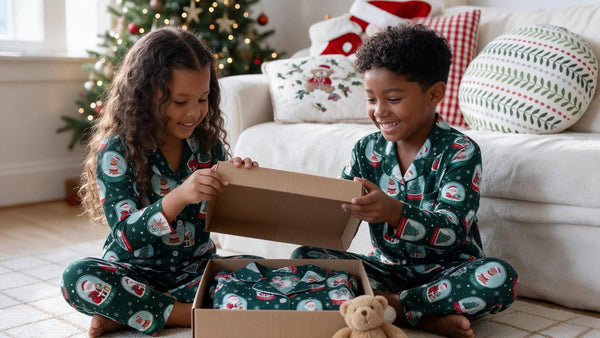
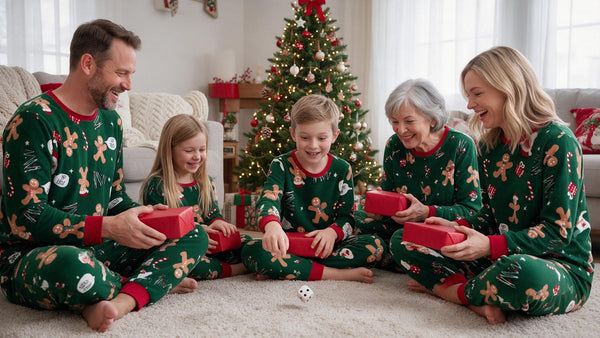
The Icelandic book flood fits a custom many American families already have, opening new pajamas on Christmas Eve. Put the two together and you have a complete evening: one new book and one new pair of pajamas each, changed into after dinner, then reading until bedtime. It is quiet, it costs less than another toy, and it gives the excitement somewhere to go. Our guide to why families wear matching Christmas pajamas covers where the pajama half of that comes from, and the Christmas Eve box guide explains how to pack the book and pajamas by age.
Two prints suit the theme. One looks like an old Christmas card village; the other uses the knit-style Fair Isle pattern associated with Nordic sweaters. Both come in matching Christmas pajamas sizes for adults, kids, babies and pets.
 Christmas village print family pajamas in whiteShop now
 Fair Isle print family pajamas in redShop now
The village print has a button-front collared top and pockets on the adult pants, and its listing says the fabric on kids' and baby sizes is flame-resistant. The red Fair Isle set is a pull-on two-piece with Christmas socks included, and its listing says the kids' and baby pieces are flame-resistant too. For the youngest readers, baby Christmas pajamas are sold separately.
Dressing for a Christmas Eve Dinner
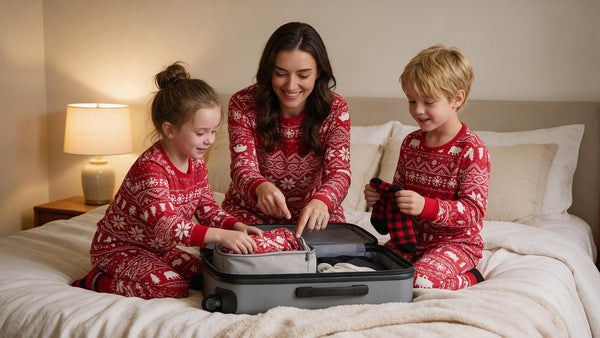
In the countries where Christmas Eve is the main event, such as Poland, Germany and Mexico, the evening often starts with a sit-down family dinner and sometimes a church service, so children are dressed up first and changed into pajamas later. If your family is hosting a Wigilia-style supper or a Nochebuena dinner, coordinated outfits make the group photo before the meal simpler. Matching family Christmas outfits cover that dressier half of the night.
 Velvet dresses and plaid shirts for the family in dark brownShop now
 Toddler girl red grid print ruffled dress with headbandShop now
The velvet-and-plaid set pairs plaid button-up shirts for dads and sons with velvet dresses for girls and a velvet top-and-skirt set for moms; each family member's piece is sold separately, and kids' sizes run from 3-6M to 11-12Y. The red grid-print dress is a pull-on toddler style with a gathered skirt and a matching headband, in stock from 2Y to 5-6Y when we checked. More choices are in kids Christmas outfits and toddler girl dresses.
Traveling to celebrate with relatives abroad? Our Christmas travel packing list for families covers what to carry on and how to pack outfits so they arrive ready to wear.
Frequently asked questions
Which countries open presents on Christmas Eve? Germany, Poland and much of Scandinavia exchange gifts on the evening of December 24, and Iceland gives books that night. In the Netherlands the main gift night is December 5.
Why do some countries celebrate Christmas on January 7? Churches that follow older calendars, including the Ethiopian Orthodox Church, mark Christmas on January 7. Ukraine moved its official date to December 25 in 2023, though one Orthodox church there still keeps January 7.
What is the Icelandic Christmas book flood? Jólabókaflóð is the custom of giving books on Christmas Eve and reading them that night. Families choose from a catalog of new books sent to homes in mid-November.
How can kids learn about Christmas traditions around the world at home? Pick one country, find it on a map and recreate one small custom, such as leaving shoes out for Sinterklaas or waiting for the first star before dinner. One tradition done properly sticks better than several rushed ones.
About this article
Written and fact-checked by the PatPat Editorial Team. How we research, source and review what we publish is set out on our editorial standards page.
Method. This replaces an older article on our site. We removed statistics and studies we could not trace, corrected dates (such as when the first Yule Lad arrives and Ukraine's 2023 change), and checked each custom against the sources below. The at-home versions are editorial suggestions. Product details and stock were read from PatPat listings on 27 November 2026; PatPat sells these products.
Sources. Iceland: Icelandic Tourist Board and Visit Iceland. Germany: German National Tourist Board. Netherlands: St. Nicholas Center and Holland.com. Sweden: Visit Stockholm. Poland: National Geographic. Ukraine: Al Jazeera and Kyiv Independent. Italy: Italia.it. Spain: Spain tourism office and Barcelona City Council. UK: Victoria and Albert Museum and GOV.UK. Philippines: CNBC. Japan: japan-guide.com and KFC. Ethiopia: Rough Guides. Australia: Vision Australia.
Last updated 27 November 2026 · Next review November 2027